



Flood of refugees puts bloc under strain









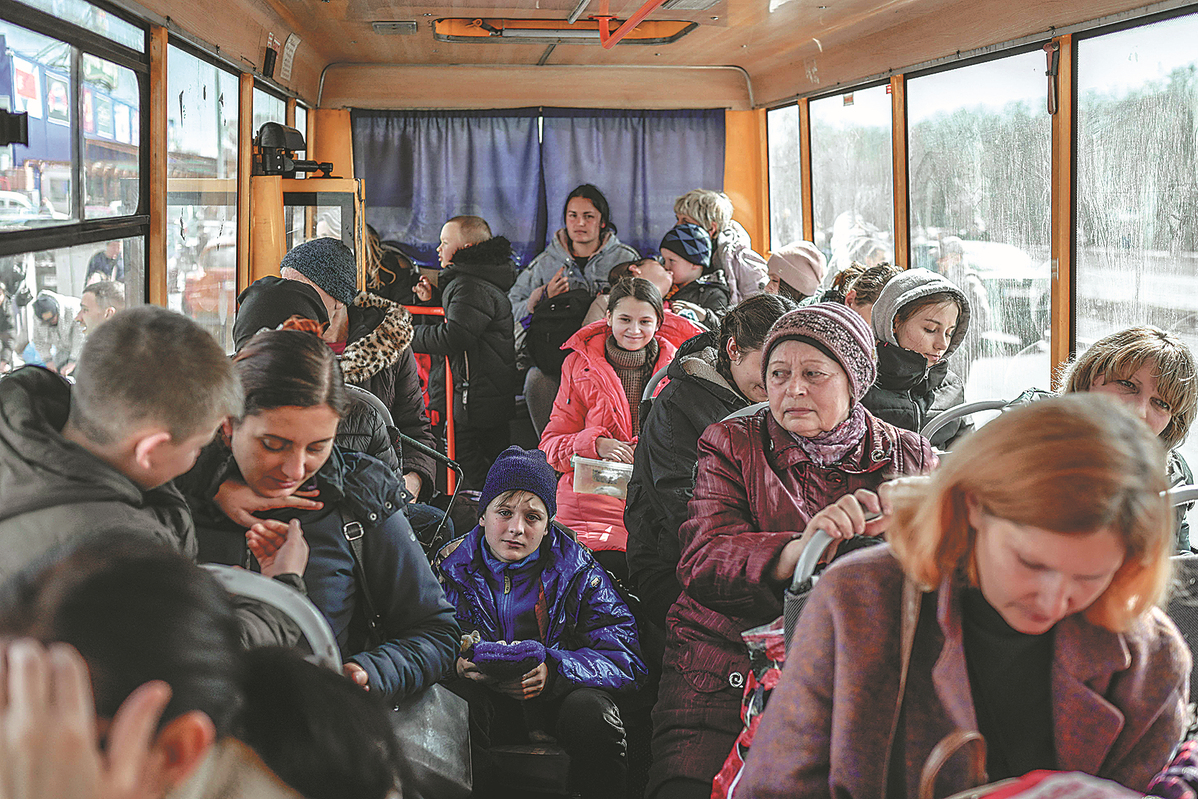
European countries have opened up to a flood of refugees fleeing conflict in Ukraine, and more than three months later they face growing challenges in confronting the largest refugee crisis since World War II.
Since the Russia-Ukraine conflict started on Feb 24, more than 6.5 million refugees are estimated to have fled to neighboring countries, the United Nations High Commissioner for Refugees says.
The European Union has welcomed Ukrainian refugees, and in early March it adopted an emergency plan allowing them to enter its 27 member countries without visas and granting them the right to live and work in the EU for up to three years. Many Europeans also opened their doors to host Ukrainian refugees.
Poland remains the main country of arrival for the refugees, of whom more than 3 million have arrived. The number of arrivals had slowed to about 20,000 a day last month, compared with more than 100,000 in early March, a UNHCR spokeswoman, Olga Sarrado, said.
While some refugees passed through and others returned home, most are still in Poland and receiving government support. Poland has registered more than 1.1 million people, 94 percent of whom are women and children. They are offered a state identification number that gives them access to services.
Other neighboring countries have also taken many refugees, with Russia and Romania each hosting nearly 1 million, and Hungary taking nearly 700,000.
The largest numbers of Ukrainian refugees in non-neighboring countries are in Germany, the Czech Republic and Italy, the UNHCR said.
Despite their hospitality, European countries are facing growing challenges as they try to provide long-term assistance to the refugees.
Over three months the 200,000-strong population of the Polish city of Rzeszow, has swelled by as much as 50 percent, a Reuters report said.
It quoted Konrad Fijolek, mayor of the city, about 100 kilometers from the Ukraine border, as saying the city will need new schools and housing to absorb refugees.
Finance ministers of 10 European countries, including Poland, Bulgaria and the Czech Republic, called on the EU to offer them more funding and more flexible spending rules to host Ukrainian refugees, according to the news outlet Politico.
'Heavy burden'
"The European Union is facing an unprecedented challenge due to the conflict in Ukraine," the finance ministers said, adding that the refugees constitute "a heavy burden on the social security system" of the 10 countries.
Poland has withdrawn some of the special benefits for Ukrainian refugees, including payments to households that host them, and free use of public transport. A law passed in March allowed people who have taken refugees into their homes to receive daily payments of about $9, and that benefit will no longer be available either.
The Czech Republic has also urged refugees from Ukraine to get jobs, and those who do not work risk losing welfare benefits.
Zhang Lihua, a professor in the Department of International Relations and director of the Center for China-Europe Relations at Tsinghua University in Beijing, said that in terms of geographical location, the European countries bordering Ukraine, such as Poland and Romania, are most affected by the refugee crisis.
"These countries are members of the European Union, but for various historical reasons their economic development lags behind the EU average. To a certain extent this has aggravated the difficulties in hosting refugees and helping them settle down."
Hosting Ukrainian refugees could cost EU countries 43 billion euros ($46 billion) this year, according to estimates of the Brussels think tank Bruegel.
That cost accounts for about a quarter of the EU's overall budget for this year, which was set at 171.8 billion euros, and is likely to increase with more refugees entering the bloc.
To strike a balance between accepting Ukrainian refugees and maintaining their own social security, countries in Europe, including Germany, have adopted corresponding restrictions.
Tian Dewen, deputy director of the Institute of Russian, Eastern Europe and Central Asian Studies at the Chinese Academy of Social Sciences, said countries in Central and Eastern Europe have expressed strong resistance to the EU's program of taking in refugees since the outbreak of the 2015 refugee crisis. Many European countries locked their doors to Syrian refugees as well as those fleeing Afghanistan last year.
As more EU countries face challenges in hosting the Ukraine refugees, society as a whole may also gradually adopt a more negative view of long-staying Ukrainians, and it is hard to guarantee that concerted efforts to accept Ukrainians will be sustained, Tian said.
Agencies contributed to this story.










