Washington's wishful thinking to divide and rule the world









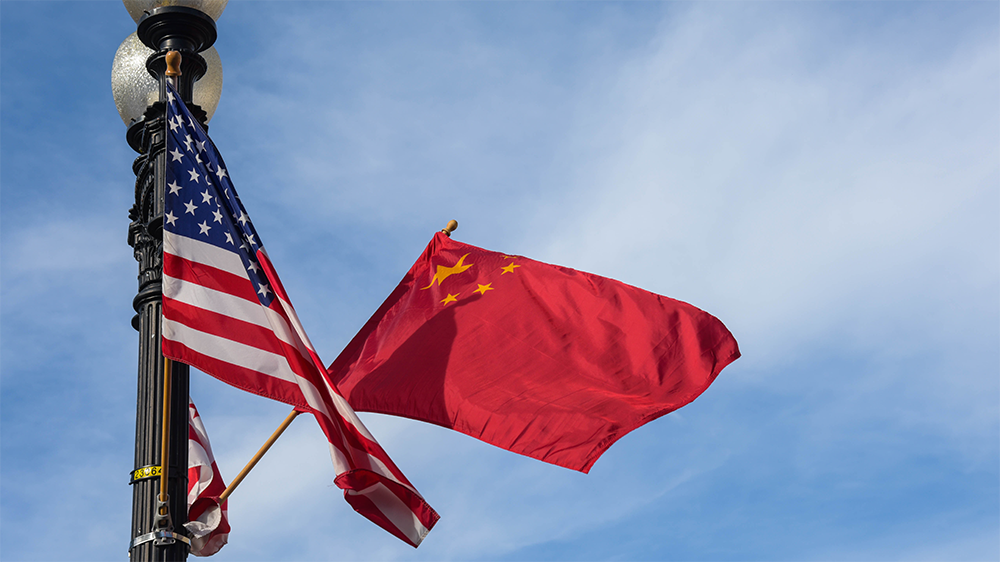
The United States has been trying hard to convince countries in many parts of the world that China poses a threat to the so-called "rules-based world order," and that bonding with Washington can lead to peace and prosperity.
At the three-day Shangri-La Dialogue held in Singapore that started on Friday, the United States once again peddled its Indo-Pacific strategy, professing a desire to "advance regional prosperity," but actually stoking geopolitical rivalry.
Since its inception, such a strategy has become a by-word for "bloc politics." It is no more than a political tool that has been tapped with increasing frequency in recent years by the world's sole superpower to salvage its declining global supremacy.
In history, the United States has a record of being an offshore balancer. When the country feels a potential "threat" to its global dominance, it will form all kinds of cliques, draw a line between "us" and "them," and coax its allies and others into keeping the "challengers" in check.
That is what the United States has been doing. To contain China, a "strategic competitor" as defined by Washington, the United States is sparing no effort to foment confrontations against Beijing.
In the name of "enhancing economic cooperation, promoting common values and safeguarding regional security," the United States has proposed an "Indo-Pacific Economic Framework" excluding China, strengthened the Five Eyes and the Quad mechanisms, as well as created an AUKUS pact at the expense of global nuclear non-proliferation.
Recently, it also made some irresponsible remarks on the China-India border issue, attempting to drive a wedge between the two neighbors.
It is clear that while Washington will do everything to keep its states united, it intends to shape a split world. That is how it can divide the global community and then seek to rule it supreme.
However, America's selfish actions run counter to the common aspiration for peace and development of a world in an age of irreversible interdependence.
Washington's confrontational moves are also detrimental to global post-pandemic recovery, where unity is a must to heal the disrupted supply and industrial chains.
Some US allies may argue that they can profit from those US proposed partnerships or frameworks. That is self-delusion. Being on the US chariot is not a free ride. For every little bit of benefit they get from Washington, there is a disproportionate cost at some point.
Take Europe as an example. When the US allies on the continent are bearing the brunt of the ongoing Russia-Ukraine crisis, the United States, which abetted its partners to ignite the conflict, has refused to get involved directly but fished in troubled waters.
What's more, if Washington faces a conflict of national interest with any of its allies, it will not hesitate to immediately cast aside that friendship.
Disappointed with some of New Delhi's reactions to the Ukraine crisis, the United States has warned India that the consequences of a "more explicit strategic alignment" with Russia would be "significant and long-term."
It has been increasingly clear that in the eyes of those Washington decision-makers, allies and partners are simply instruments to be used to promote the US self-interest.
This can partially explain why many hold a very bearish view of Washington's hollow commitments made at this week's Summit of the Americas hosted in Los Angeles, an event boycotted by several regional leaders because of the US exclusion of three countries from the meeting.
The United States "doesn't treat any country as an equal, not even its allies," Daniel Kovalik, an American lawyer who teaches international human rights at the University of Pittsburgh School of Law, said, adding the summit illustrates the hegemonic power's shrinking impact on the Western Hemisphere.
In the Asia Pacific, anxiety over an increasingly headstrong Washington seeking to stir up ideological confrontation has been on the rise.
Singapore's Prime Minister Lee Hsien Loong has recently warned "there will be no good outcome if Asian countries are split between the two camps, each siding with one or the other. A more stable, less tense configuration is for the two powers to have overlapping circles of friends."
In fact, the United States, facing skyrocketing oil prices and a soaring inflation rate, is nibbling on the bitter fruits it has produced itself. Yet its politicians still insist on wasting their time on partisan fighting at home, and stoking confrontation abroad.
It has also to be noted that a highhanded approach cannot hold up the inevitable demise of so-called US hegemony, nor will those maneuvers succeed in containing China, whose irreversible rejuvenation is mainly driven by its people's desire for a better life.