



China's aid strengthens global food security









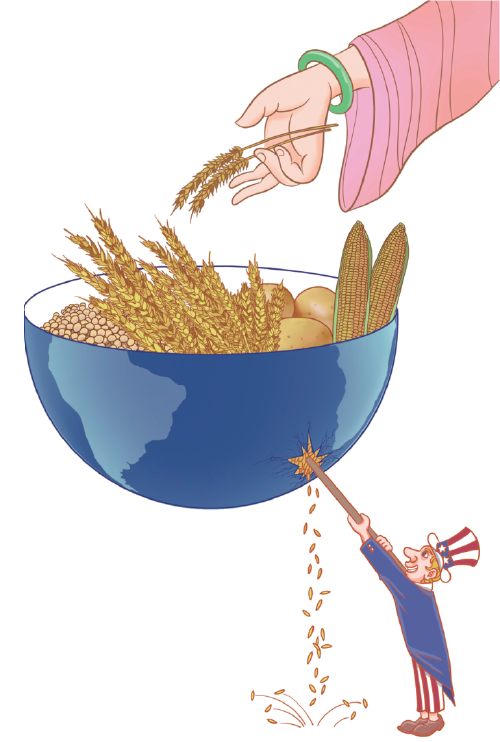
With a potential food crisis facing the world, some Western experts and media are trying to blame China for the situation. They are accusing China of hoarding grains and thus exacerbating the global food shortage, and claiming that China's contribution to the United Nations World Food Programme last year was less than one-thousandth of the United States. They also say that only China can solve the problem.
Since the Chinese people, like people in other parts of the world, see food as their primary necessity and since China has a population of 1.4 billion, it would be an unimaginable global disaster if a food crisis breaks out in the country.
Thanks to reform and opening-up, China has been feeding nearly one-fifth of the world's population with less than 9 percent of the world's cultivable land, and now accounts for about one-fourth of the global food production. These are China's biggest contribution to global food security.
In 2021, China's grain output was stable-at more than 650 billion kilograms for seven consecutive years-and its grain self-sufficiency rate exceeded 95 percent.
Given these facts, why would China overstock grains?
Besides, sending help in another country's hour of need is rooted in Chinese culture. With humankind's common interest in mind, President Xi Jinping has proposed building a community with a shared future for mankind and the Global Development Initiative. These two initiatives require the mobilization of forces, complementing each country's advantages and striving to achieve all the Sustainable Development Goals including food security.
In fact, with a total aid of 577,000 tons of food, China became the world's third-largest food aid provider-after the United States and the European Union-in 2005, the year it stopped receiving aid from the WFP.
Since then, China has been a key strategic partner of the UN Food and Agriculture Organization for South-South cooperation, has donated $130 million to the FAO South-South Cooperation Fund and sent a large number of experts and technicians to Asian, African, Latin American and the Caribbean, and Pacific island countries. In fact, as a developing country, China has provided the most aid for other countries, sent the maximum number of experts and implemented the highest number of projects under the FAO South-South cooperation framework.
Since 2016, China has been providing emergency food aid for more than 50 countries in Asia, Africa and Latin America, which has benefited tens of millions of people. Especially since the outbreak of the COVID-19 pandemic, China has responded to the initiatives of the UN and other international organizations, and provided emergency food assistance for multiple countries, including Afghanistan, Sri Lanka, Kenya, Uganda, the Republic of the Congo, Benin and Liberia, which has been highly appreciated by the international community and people of relevant countries.
Teaching one to fish is better than giving him fish. With the principle of "projects should be proposed, agreed and led by recipient countries", China has shared its technical experience in grain production and processing, and assisted recipient countries to boost agricultural production and food security, by dispatching experts, building demonstration centers, training farmers, and promoting crop varieties.
Since 1979, the plantation of Chinese hybrid rice has benefited dozens of countries in Asia, Africa and the Americas, with an annual planting area of 8 million hectares, and average yield of 2 tons per hectare, higher than that of local ones. Chinese researchers have visited more than 80 countries, including India, Pakistan, Vietnam, Myanmar and Bangladesh, to advise and train more than 14,000 technical personnel. A win-win situation has been realized, especially because China's agricultural assistance has also encouraged its enterprises and research institutions to "go global", and export machineries, fertilizers and seeds.
In terms of global food governance, China has always tried to promote the Trade Facilitation Agreement of the World Trade Organization, and called on countries to keep global grain trade open and fair, remove unilateral sanctions, and maintain the smooth and stable operation of global industry and supply chains. China has steadfastly safeguarded the legitimate rights and interests of developing countries, called for the creation of more policy room for developing countries and urged developed countries to reduce the excess subsidies on their agricultural products.
True, the Russia-Ukraine conflict has disrupted the global food industry and supply chains, as the two countries are respectively the world's largest and sixth-largest wheat exporters. But shouldn't the US that has pushed NATO's eastward expansion, supplied weapons and military equipment to Ukraine in order to keep the war machine running and continue making profits, and instigated the conflict in the first place be held responsible for the resulting food crisis?
Besides, the food shortage caused by the Russia-Ukraine conflict will likely be addressed by other food exporting countries. According to the US Department of Agriculture, Ukraine's wheat exports will dip to 10 million tons in 2022-23, compared with 19 million tons in 2021-22. Yet Russia's wheat exports in March increased by 60 percent year-on-year, and its exports in April may have tripled compared with the same period last year.
Also, Russian President Vladimir Putin has said that Russia's grain production may reach a record high of 130 million tons, including 87 million tons of wheat, in 2022. Accordingly, its grain exports are also expected to increase. In addition, Canada's wheat exports are expected to increase by 8.5 million tons and the European Union's by 5 million tons. All in all, global wheat exports are likely to reach 205 million tons, more than the 202 million tons in 2021-22.
In the first quarter of 2022, global grain prices rose by nearly 20 percent year-on-year, of which wheat prices rose by 60 percent. And the World Bank has warned that, for each 1 percentage point increase in food prices, 10 million people are thrown into extreme poverty. Yet the insanely high global food prices and the lack of buyers are the root causes of what appears to be a global food crisis, and factors such as the global economic downturn, rising logistics costs, manipulation and market panic have amplified the sense of crisis.
First, the giant multinational companies such as ADM, Bunge, Cargill and Louis Dreyfus monopolize the global grain market, accounting for more than 80 percent of the world's grain transactions. These multinational giants buy low and sell high in the grain futures market to reap high profits. And since they have the capability and power to set grain prices, they are using all means to ensure their stocks soar this year.
Second, Western countries headed by the US use grain to consolidate their hegemony and gain political benefits. The US has weaponized the "food crisis", by trying to antagonize developing countries against Russia and China and heighten geo-strategic and factional confrontations.
In addition, many developing countries that rely on the exports of agricultural products have become fearful of famine or drought-like situations. By mid-May, at least 35 countries and regions had implemented more than 50 export control measures on agricultural products, which further pushed up global grain futures prices, even triggering riots in some countries.
The fact is, as the world's largest grain exporter, the US is responsible for the current food crisis. Not only did it cause the food crisis, but it also hypocritically provided just one-thousandth of its grain monopoly profits as food aid to other countries, in order to consolidate the unfair US-led grain trade regime.
Worse, 40 percent of the 3,000 tons of wheat seeds donated by the US Agency for International Development to Syria were infected with nematode, which undermined Syria's food security. And the US troops deployed in Syria sent 40 trucks to steal local wheat stocks.
Moreover, US Secretary of State Antony Blinken said recently that differences between the US and China should not be allowed to get in the way of addressing issues that require bilateral cooperation, including the unfolding food crisis. But since China has always been open to food aid cooperation, and engaged in global development cooperation, it's time for the US to make the right move.
The author is a commentator on international relations. The views don't necessarily represent those of China Daily.
If you have a specific expertise, or would like to share your thought about our stories, then send us your writings at opinion@chinadaily.com.cn, and comment@chinadaily.com.cn.





