



Global South and new era of international development









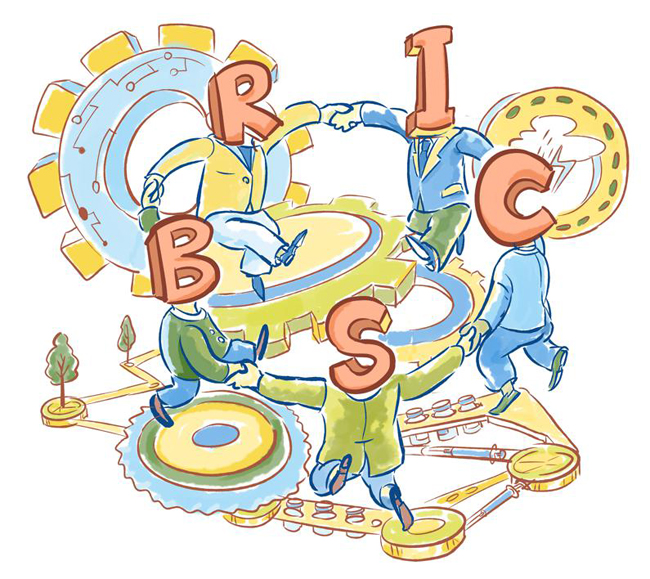
China has assumed the rotating presidency of BRICS(Brazil, Russia, India, China and South Africa) for 2022 and, accordingly, the bloc's slogan this year is: "Strengthen BRICS Solidarity and Cooperation, Respond to New Features and Challenges in International Situation".
That emerging market and developing economies play a leading role in today's complex international scenario akin to a "perfect long storm" is necessary, for their relationships are based on cooperation, solidarity and mutual understanding. And without building relationships based on cooperation, solidarity and mutual understanding for the "new era for global development", the future of the international political system will remain uncertain.
It was Tharman Shanmugaratnam, senior minister of Singapore, who said humankind has entered a period of "perfect long storm" in an article published in the International Monetary Fund's journal, Finance and Development, in June 2022. According to Shanmugaratnam, a confluence of "structural insecurities"-geopolitical, economic and existential-can be resolved only if bridges are built among states.
However, since structural problems are not rooted in short-term problems, the Russia-Ukraine conflict and the COVID-19 pandemic cannot be considered the main causes threatening to unsettle the future of humankind. These challenges have arisen in a world that was already unstable, insecure, and full of uncertainties.
But sincere efforts need to be made to stabilize the world and pave the path for future development. The global agenda of the BRICS member states is based on concrete solutions to concrete problems to build a better future for humankind. For about 10 years, BRICS has been proposing ways to address the structural problems pointed out by Shanmugaratnam. These proposals must be implemented to solve the structural problems, because the world can't be held hostage to a particular conjunctural agenda.
Armed conflicts, which some countries try to resolve through more armed conflicts, end up in pyrrhic victory. As such, armed conflicts should be resolved through dialogue and consensus among all the parties involved, and with the goal of promoting peace.
It is pertinent to mention here that those who want the Russia-Ukraine conflict to influence the BRICS Summit on Thursday do not understand the leading objectives and role of BRICS in the international political system.
The leading role BRICS members play in international relations contributes to the international community's security. Yet it is not BRICS members' responsibility to resolve armed conflicts. That responsibility lies with the United Nations Security Council. And since the five BRICS members have already presented their arguments on the Russia-Ukraine conflict to international and multilateral organizations, and the international community at large, their summit will focus on their main global agenda.
What the BRICS members can do in terms of strengthening global security, in general, has already been presented by President Xi Jinping at the opening session of the Meeting of BRICS' Ministers of Foreign Affairs last month.
According to President Xi, "BRICS countries need to strengthen political mutual trust and security cooperation, maintain close communication and coordination on major international and regional issues, accommodate each other's core interests and major concerns, respect each other's sovereignty, security and development interests, oppose hegemonism and power politics, reject Cold War mentality and bloc confrontation, and work together to build a global community of security for all."
So it is up to the wider international community and the UN to find concrete solutions to specific international security problems and conflicts.
It's time the international community realized that BRICS has been sincerely working to help provide concrete solutions for concrete problems, which Shanmugaratnam described as a "perfect long storm", and that things will not be any different during China's rotating presidency of BRICS. Solidarity and cooperation have been key to BRICS promoting sustainable development, multilateralism and global governance reform-and they will continue to be so.
Since the 2008 global financial crisis, the transformation of the world order from a unipolar to a multipolar configuration has accelerated, and regional powers have been fast gaining in strength. BRICS has been the leading representative of emerging and developing economies, and its members will continue to work hard to find solutions because they, along with their poorer neighbors, have suffered most from stagflation, climate change, economic inequality and geopolitical conflicts, which have origins beyond the Russia-Ukraine conflict and the pandemic.
The BRICS members, together with other developing nations, have the capability to build efficient regional networks to support sustainable development and contribute to regional peace. Also, they can play a bigger role in international relations and build bridges among states to solve the problems impeding the realization of the UN's 2030 Agenda for Sustainable Development.
The challenges facing the 2030 Agenda can be overcome when states and civil society realize that high-quality socioeconomic development, not blind, fast-paced GDP growth, is key to a better future. While living beings must be at the center of all things, diplomacy, solidarity and cooperation among states should be the guiding principle of the international political system.
Therefore, BRICS' new international agenda should not be confused with the interests and desires of some states which are still obsessed with zero-sum mentality and big stick diplomacy. As former Brazilian foreign minister Celso Amorin said, with the emergence of BRICS, the time when a few states used to meet in a room and unilaterally decide the agenda of the international community has come to an end.
Global uncertainties, insecurities and instability cannot be resolved through more armed conflicts and naming imaginary enemies. The BRICS member states not only have to seek deeper mutual understanding of the global agenda reform but also continue looking for concrete solutions to concrete problems for the global common good. And the international community has to understand that, without the awareness of a shared future, there will be no harmonious future after the "perfect storm".
The author is an associate researcher at Peru Research Center, the Center for International and Regional Studies, Hebei Normal University.
The views don't necessarily reflect those of China Daily.
If you have a specific expertise, or would like to share your thought about our stories, then send us your writings at opinion@chinadaily.com.cn, and comment@chinadaily.com.cn.





