



How slogans have shaped people's lives during the past century









Editor's note: Four decades of reform and opening-up have not only turned China into the world's second-largest economy but also changed the way of life in the country. A veteran journalist with China Daily looks at Chinese people's changing attitude toward slogans and mottos.
Slogans have been widely used by people to express their anger, frustration, pleasure and desire, and by political parties to publicize their principles and goals. A good slogan should be short, sharp and to the point. That's why slogan writers usually have to rack their brains to work out a good slogan.
There are exceptions, though. "I can't breathe", the last words of African American George Floyd, who died after a white police officer kneeled on his neck for nearly 10 minutes in Minneapolis, Minnesota, on May 25, 2020, immediately became the most frequently shouted slogan worldwide and triggered one of the largest protest movements in US history.
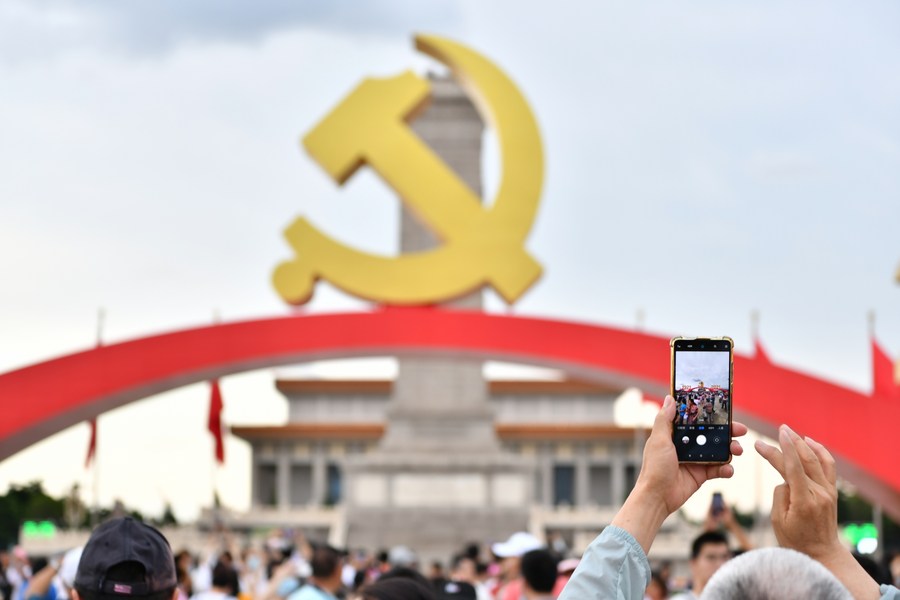
Back home, the Communist Party of China celebrated its 100th anniversary last year, and I think part of its success in the early days can be attributed to its slogans and mottos. The CPC, after all, has a long history of coming up with sharp, rousing and effective slogans.
One of the CPC's most effective slogans during its early days was: "Fight local tyrants, divide their farmlands". The short, six-character slogan made clear the Party's target and the means it prescribed to achieve the goal drew enthusiastic response from the landless peasants and motivated thousands of them to join the Red Army to safeguard their newly acquired land.
When the Red Army was forced to leave its bases in East China's Jiangxi province in the mid-1930s and set off on the Long March, its slogan was even shorter, "Advance north, resist Japan", which won the Party the support of the Chinese people under Japanese occupation.
In the late 1940s when the communists captured the areas north of the Yangtze River, there were debates both inside and outside the Party on whether the People's Liberation Army should stop their fight, leaving Kuomintang to rule the southern part of the country. No, said the Party and published a 10-character slogan: "Down with Chiang Kai-shek, liberate the whole of China". The slogan motivated both the PLA and the people to keep fighting until Chiang Kai-shek was forced to flee to the island of Taiwan.
In 1950, less than one year after the founding of the People's Republic, the Korean War broke out. When China decided to send its volunteer forces to fight in the War to Resist US Aggression and Aid Korea (1950-53), the Party publicized a powerful slogan: "Resist US aggression, aid Korea, defend our country." Short and precise, the slogan explained the reason, logic and purpose of China's involvement in the war, and inspired the Chinese people to defend the nation by fighting in the war, the first war the US failed to win.
The popular slogans before the launch of reform and opening-up in the late 1970s were mostly political. The slogans I shouted the most during school gatherings were "Down with American imperialism" and "Down with Soviet revisionism" even though I didn't know the meaning of imperialism and revisionism.
Over the past four decades, slogans and mottos have encouraged people to work harder or publicized the policies of the Party and/or the government.
The slogan, "Serve the people heart and soul", which explains the Party's requirements, has lasted the longest-it's been popular since the late 1930s. Today, I think one of the most popular slogans is a call by President Xi Jinping: "Let's roll up our sleeves and work harder."
The slogan that directly affected common Chinese people's life probably is "It's good to have only one child". Even though the one-child policy has been withdrawn and couples are being encouraged to have up to three children, such slogans can still be seen, written in big characters, on some walls in rural areas.
But most of the family planning slogans on village walls have given way to slogans that teach farmers how to increase their incomes, such as "To become rich, plant trees first", or "To become rich, build roads first". Such slogans are the brainchild of poor farmers themselves, drawn from their experience of how to emerge from poverty.
The author is former deputy editor-in-chief of China Daily. kangbing@chinadaily.com.cn





