



Envoy: Why China opposed Pelosi trip









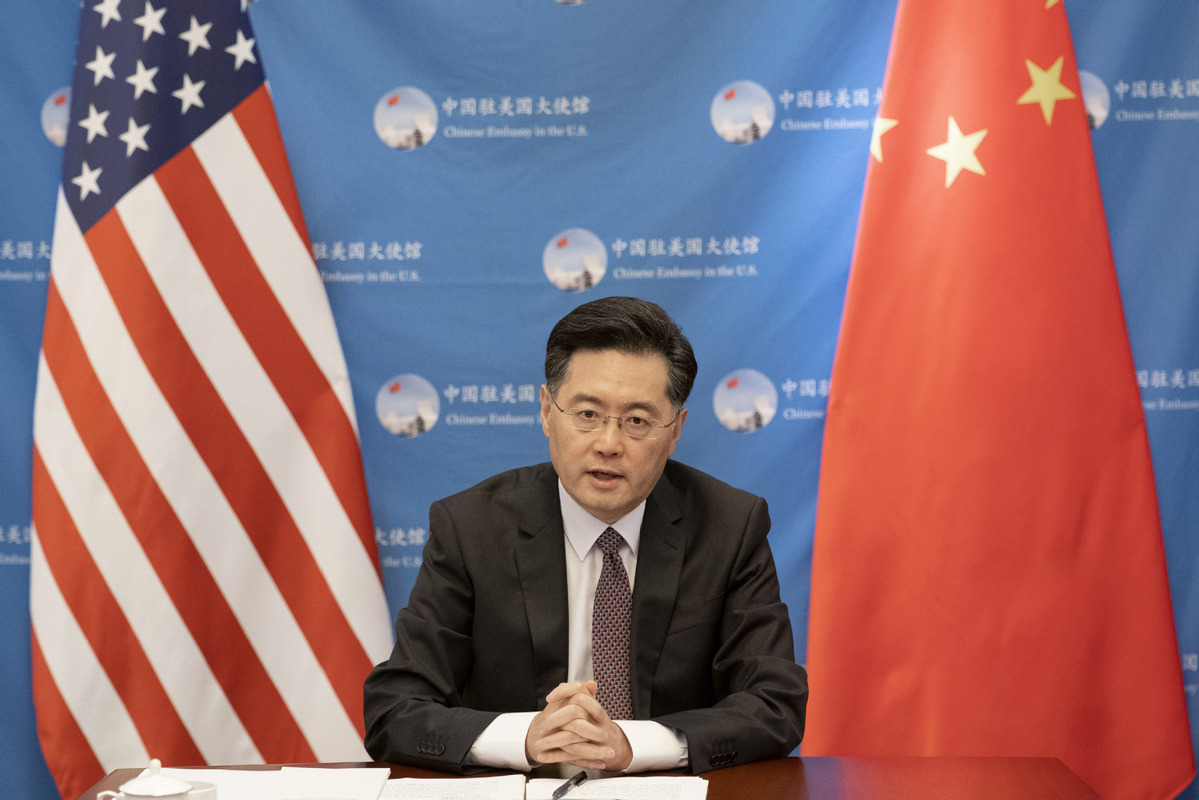
China opposed US House Speaker Nancy Pelosi's visit to Taiwan because the trip has openly broken America's commitment not to develop official relations with the island and served to send a strong signal to the "Taiwan independence" forces that the United States is on their side, Beijing's top envoy in Washington has said.
In an opinion piece published in The Washington Post on Thursday, Ambassador Qin Gang noted that when China and the US established diplomatic relations on Jan 1, 1979, the US recognized in the joint communique with China that the government of the People's Republic of China is the sole legal government of China, and since then, the US has long been committed to not developing official relations with Taiwan.
Traveling in a military aircraft, Pelosi, the third-highest-ranking official in the US government, paid a high-profile "official visit to Taiwan" on Tuesday — as her office put it upon her arrival — and was given full-protocol treatment by Taiwan's Democratic Progressive Party authorities, who make no secret of pursuing independence in their party platform.
"Such a visit has openly broken America's commitment not to develop official relations with Taiwan," Qin wrote. "These are extremely irresponsible, provocative and dangerous moves."
The ambassador's article, "Why China objects to Pelosi's visit to Taiwan", was a response to Pelosi's op-ed, "Why I'm leading a congressional delegation to Taiwan", which was published in the Post to coincide with her arrival on the island.
In her article, the top US lawmaker said that her visit "in no way contradicts the long-standing one-China policy", which she said is "guided by the Taiwan Relations Act of 1979, the US-China Joint Communiques and the Six Assurances", and that the United States continues to oppose unilateral efforts to change the status quo.
The Chinese ambassador pointed out that the one-China principle is part of the postwar international order and has become a general international consensus. The US, which deems itself a champion of the "rules-based international order", should naturally abide by the one-China principle, Qin said.
But Washington has violated and undermined the principle by adopting the Taiwan Relations Act and the "Six Assurances" to Taiwan.
"It is doing so again now in a broader attempt to unilaterally change the status quo on Taiwan and alter the postwar international order," Qin wrote.
In his article, Qin mentioned Henry Kissinger, who was personally involved in the negotiations for the normalization of China-US relations a half-century ago, and witnessed how the Taiwan question was properly handled on the basis of the one-China principle.
He quoted the former secretary of state as saying in late May, "The United States should not by subterfuge or by a gradual process develop something of a ‘two-China' solution."
The ambassador also noted that the US sees Taiwan as a means to contain China and has been "hollowing out" the one-China principle. In the past 18 months alone, it has made five rounds of arms sales to Taiwan.
US President Joe Biden has said many times that the United States will not change its one-China policy and does not support "Taiwan independence".
"But for the ‘Taiwan independence' forces, Pelosi's visit represents an exceptionally strong signal that 'the US is on Taiwan's side,'" Qin wrote, adding that that goes against the one-China principle, the three Sino-US joint communiques and America's own commitments.
In addition, the Pelosi visit will lead "Taiwan independence" forces further down a dangerous path, with peace and stability across the Taiwan Straits hanging in the balance, Qin wrote.
"If an American state were to secede from the United States and declare independence, and then some other nation provided weapons and political support for that state, would the US government — or the American people — allow this to happen?" he continued.
While it is high time for the two countries to ramp up cooperation and work with other countries to address crises like COVID-19 and the Ukraine conflict, some politicians choose to damage China's core interests, either to seek the limelight or to cement their political legacy, which will only end up with eroding China-US relations and imperiling the peoples and militaries, Qin said.
As Taiwan is one of the few issues that might take China and the United States into conflict, the ambassador called for "extra caution" and "a sense of responsibility" when it comes to Taiwan.










