Power from above benefiting rural villages










County a role model
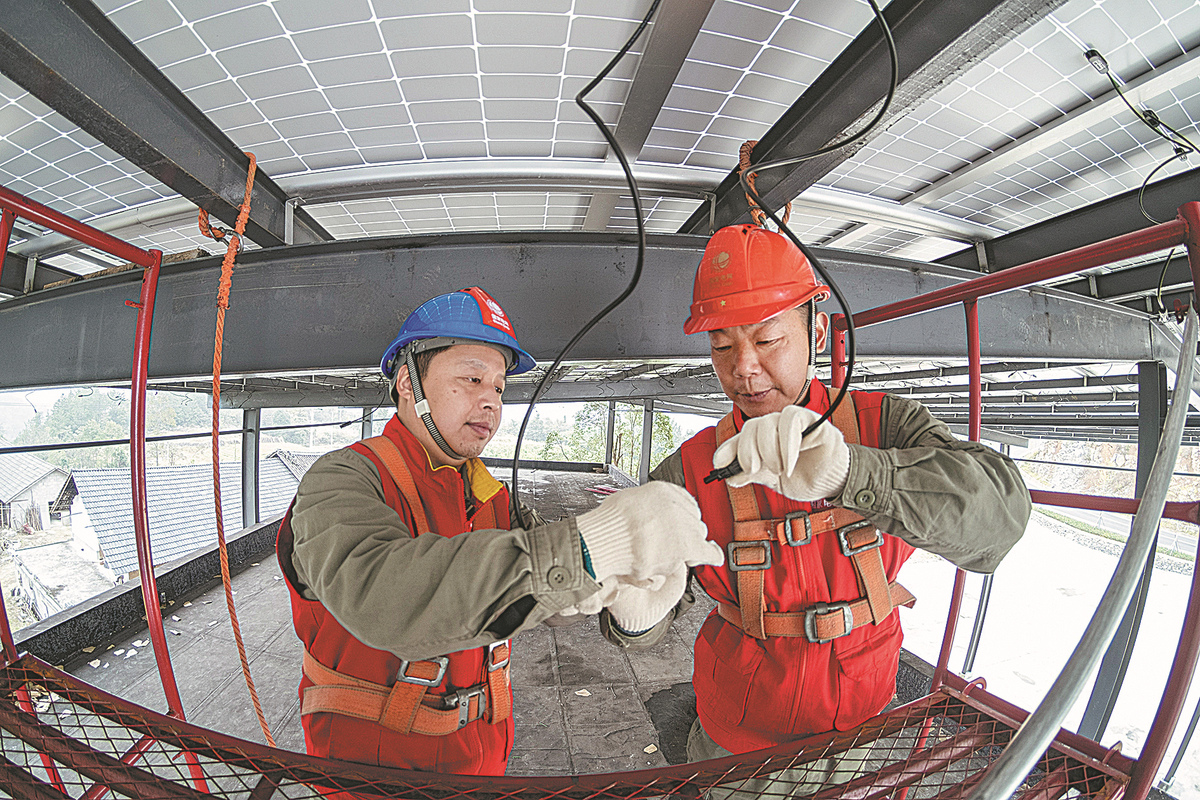
Forty-nine photovoltaic power stations have been built in the county, which has 167 villages. The power project has covered 27,000 villagers who at the time were living below the poverty line. The poverty-stricken villages garnered, on average, more than 200,000 yuan a year from the power projects.
The combination of the photovoltaic power projects with poverty alleviation in Zigui has made the county a role model for other areas.
One of Zigui's highlights is putting the land beneath the photovoltaic panels to good use. Take, for example, the village of Xikouping, where farmers grow tea plants.
The photovoltaic panels are installed in the village's collectively owned tea plantation. Receiving annual subsidies of 100,000 yuan from the central government, the photovoltaic power station in Xikouping churned out annual earnings of 100,000 yuan from power generation. The village has spent the money on creating job opportunities, particularly for villagers living in poverty.
Li Benhua, 48, is the breadwinner of a family of three. Before 2017, the family lived on a mountain.
The three lived a poor life, with annual income of only 20,000 yuan from raising several pigs and growing tea on a 1,333-square-meter tract of land.
Since the power station was built in 2017, Li has become an employee there, with an annual wage of 6,000 yuan. He is also making 8,000 yuan a year by sweeping the village's roads and serving as a forest ranger. Tea growing, pig farming and disposal of rubbish also contribute to his total annual income of 47,000 yuan.
Meanwhile, the installed capacity of China's solar power could surpass 388 gigawatts this year after adding 85 in 2021, according to Bloomberg.
China's solar industry could deliver 45 percent average profit growth this year, with tail winds from surging volume and falling raw material costs. Growth of 25 percent in 2022 is more likely, Bloomberg said, and similar growth is possible through 2025.
In February last year, President Xi announced a "complete victory" in eradicating absolute poverty, and with that, China created yet another "miracle" that would "go down in history", he said.
Xi's vision of a better life for the people goes far beyond the already unprecedented feat of feeding and sheltering all of China's 1.4 billion people.
He has also set the goals of peaking carbon use by 2030 and achieving carbon neutrality by 2060.
In May, the State Council, China's Cabinet, released a circular on a plan to implement "high-quality development of new energy". It aims to accelerate the construction and development of a low-carbon environment to realize the carbon-peak goal.
According to the State Council, "China will focus on building major wind power and photovoltaic power stations in desert areas, integrate new energy exploitation and utilization with rural vitalization, and promote new energy application in industry and construction sectors."
By combining its targeted poverty alleviation efforts with clean energy projects in rural areas, China is killing two birds with one stone.
Northwest China's Qinghai province is one example of launching solar power projects to pull poor villages out of poverty.
Yangjiashan, a village in the Qinghai city of Haidong, has installed more than 100,000 solar panels on top of mountains in the area to generate power. These panels were incorporated with the power grid in June 2020.
Covering 66.7 hectares, the project was one of 31 villager-led photovoltaic poverty alleviation projects in Qinghai, according to China Global Television Network.
Qinghai's solar power projects had an installed capacity of 730,000 kilowatts of photovoltaic power as of April last year, and they are expected to generate a total of 570 million yuan over 25 years. About 283,000 villagers in poverty, accounting for 52.5 percent of the total poor population of the province, have benefited from these projects, CGTN said.
'A good approach'
"China's solar photovoltaics poverty alleviation program is a good approach to dealing with the country's poverty issue," said Zou Jintai, a researcher with the Institute of Rural Economy of the Academy of Social Sciences of Hubei.
There are already many ways to fight poverty in rural China, including poverty alleviation policies focusing on industrial development, aquaculture and farming, Zou added.
"But these approaches are subject to market fluctuations," Zou said. "Take pig farming. You can give the targeted poor farmers piglets and fodder. If they can't sell their pigs, they can't make money. In other words, they don't have a reliable source of income. There is a possibility that they become poor again."
On the other hand, he said, the photovoltaic poverty alleviation program, "funded by the government, will be a stable source of income for poor people".