Raised standards
Karot Hydropower Station in Pakistan has set an example for high-quality Belt and Road projects









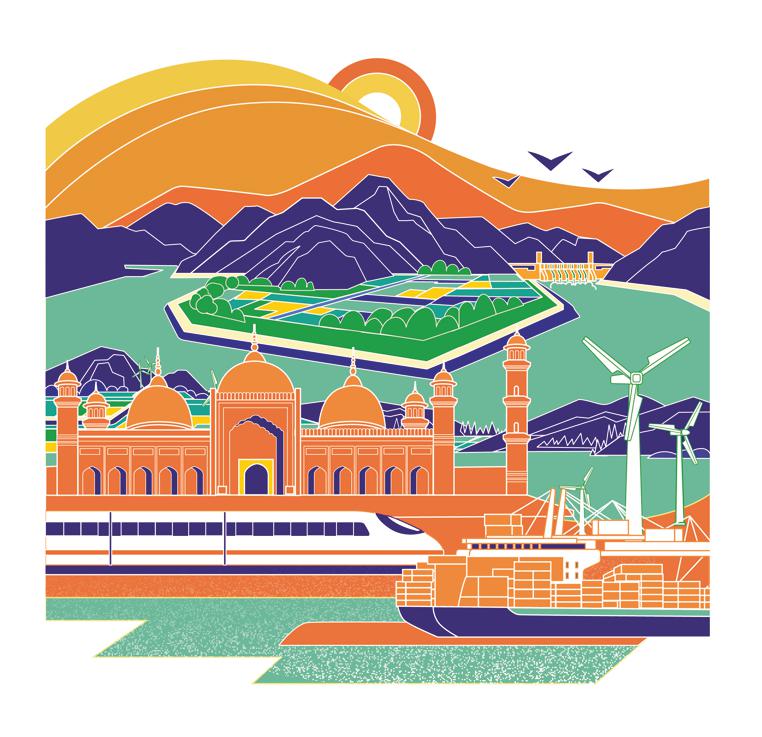
Karot Hydropower Station in Pakistan has set an example for high-quality Belt and Road projects
Less than a decade old, the Belt and Road Initiative has been the subject of considerable attention and conjecture. Although warmly welcomed and praised by many developing countries, there have also been high concerns from international stakeholders about the initiative's standards and norms related to environmental and social impacts and integrity issues. The initiative has been constantly accused of not complying with the so-called best practices, such as only involving Chinese enterprises in implementation and operation, undermining the ecological environment, disrespecting the legitimate rights and interests of workers, and failing to engage with and benefit local communities. Western countries have even continuously launched programs in the name of "higher quality" to counter the Belt and Road Initiative, including Japan's Partnership for Quality Infrastructure, the European Union's Global Gateway, and the G7's recently announced Partnership for Global Infrastructure Investment, among others.
Such accusations and stances are largely unfounded and have shrunk the space for cooperation and mutual learning for the common good. They have also overlooked the efforts made by different Chinese stakeholders to promote a high-quality Belt and Road Initiative, featuring openness, greenness and cleanness, at both the policy and practical levels.
On the policy level, the Guidelines for Outbound Investment and Cooperation in Green Development in 2021 requires compliance with host countries' laws and regulations, underlies the need to conduct environmental and social impact assessments, and guards against ecological and environmental risks. In the field of anti-corruption, China's Criminal Law stipulates that those who grant financial aid to foreign public officials or officials of international public organizations in order to secure improper commercial interests will be convicted of the crime of bribery and punished. The Chinese government has also taken anti-corruption cooperation in the Belt and Road Initiative as an important part of its international anti-corruption cooperation, issuing the Beijing Anti-Corruption Declaration and emphasizing the importance of building clean modern Silk Roads.
On the practical level, the Karot Hydropower Station in Pakistan provides a good example of how the objective of a high-quality Belt and Road Initiative is being translated into actions on the ground. The 720-megawatt hydropower station, located on the Jhelum River, has been developed by China's Three Gorges Corp through its subsidiary company CTG South Asia Investment Ltd under the China-Pakistan Economic Corridor. After six years of construction, it commenced commercial operations in June 2022.
The Chinese company has adhered to high standards in the construction of the project. For example, in terms of openness, the project is not only financed by Chinese financiers such as the Export-Import Bank of China, China Development Bank, Silk Road Fund, but also the International Finance Corporation. In the process of construction, it has not only followed its own compliance management system, but has strived to meet the requirements of the IFC and align itself with international rules and standards. In the beginning, CSAIL had insufficient knowledge and understanding of the IFC's rules and standards and problems in safety, hygiene and vocational health kept emerging. Nevertheless, CSAIL actively cooperated with the IFC and accepted regular monitoring by third party consultants on the social and environmental impact of the project, as well as labor, pollution prevention, community health and safety, land acquisition and biodiversity issues, among other things. With continuous efforts, the project has won confidence from all sides and almost no social and environmental issues were detected in the later stage.
With regards to ecological protection, CSAIL developed a comprehensive Biodiversity Management Plan for the construction and operation stages of the project. The plan addresses regional biodiversity concerns and focuses on achieving "no net loss" of aquatic fauna. The company also engaged the International Union of Conservation of Nature, a leading environmental organization working both at the policy and community levels, to implement the BMP.Moreover, the plan strives to protect two nearby national parks, which are included in the catchment area of the reservoir and extend 27 kilometers upstream.
CSAIL has also actively carried out community engagement and addressed the concerns of local people. All activities such as resettlement, land acquisition, vegetation protection and restoration went through consultations and hearings. In 2014, CSAIL organized a series of consultations in different project sites as part of the Environmental and Social Impact Assessment process. In January 2015, about 165 local representatives attended public hearings, focusing on land and relocation, job opportunities, compensation and improvements in social services. The project company also hired a third-party agency to communicate with all the households in the project location to evaluate the land and fixed assets, and established a community liaison and a complaint mechanism to record, deal with and publicize the complaints and solutions.
When it comes to integrity, CSAIL has strictly implemented Pakistan's anti-corruption laws and regulations and international anti-corruption conventions. During the six-year construction process, no corruption case was reported or filed.
The project is designed to generate 3.2 billion kilowatt-hours of electricity once put into operation to meet the power demand of about 5 million people in Pakistan and help reduce electricity prices. It will reduce 3.5 million metric tons of carbon emissions annually and save around 1.4 million tons of standard coal equivalent each year. During the construction of the project, CSAIL provided donations to more than 20 public welfare projects such as schools, hospitals and roads for local communities to promote development of surrounding communities. In addition, the project offered more than 4,500 direct and indirect local jobs.
For such projects, meeting high standards in environmental, social and governance requires the joint and continuous efforts of different stakeholders. China's efforts at both policy and practical level should be encouraged rather than being overlooked or defamed. Meanwhile, the Karot Hydropower Station offers some implications.
First, Chinese stakeholders are capable of attaining international ESG standards at a controllable cost. Nevertheless, complying with high standards requires dedicated efforts and is not a linear process.
Second, establishing a compliance system and fostering a compliance culture are the keys. Compliance should be improved at the levels of system, mechanism, organization and corporate culture, especially with regard to bidding and contract management, labor rights protection, environmental and social impact assessment, resettlement and integrity.
Third, the effects of the projects on local community should be greatly considered. Efforts should also be made to communicate with different stakeholders, especially the local communities, incorporate their concerns and opinions in decision-making, encourage localization in employment and procurement, and innovate corporate social responsibility practices, so as to enhance the acceptance of the project among the public in the host country.
The author is director of the division of general affairs at the China Center for International Knowledge on Development. The author contributed this article to China Watch, a think tank powered by China Daily.
The views do not necessarily reflect those of China Daily.
Contact the editor at editor@chinawatch.cn