A matter of course










US and China have shared responsibility to navigate a way to a peaceful future
The Russia-Ukraine conflict has shifted the world's focus to Eastern Europe. It seems that the tragedy unfolding in Ukraine has overshadowed other regions. The possibility of the emergence of Cold War 2.0 and establishing a new iron curtain dividing Russia and the West are hotly debated topics among experts, academicians, and broader society. But, the conflict in Ukraine does not alter the fundamentals of 21st century geopolitics — the world is undergoing a shift of economic power from the West to the East, and, simultaneously, power diffusion is taking place
These developments are occurring within a broader geopolitical framework — the transformation of the unipolar world order. It is too early to speak about the time frame of the process, as well as the final results, but one thing is clear now — the unipolar world is coming to its end, and there is no way back to 1991. The main feature of this transformation is the rise of other non-Western economic powerhouses.
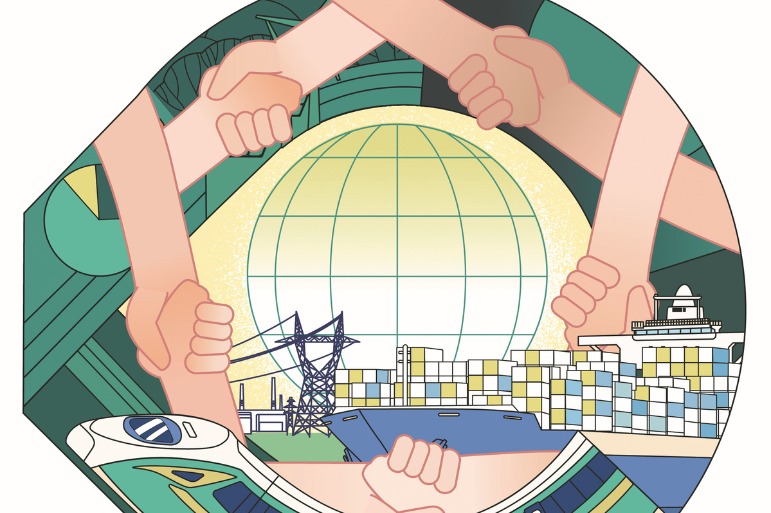
In this context, China's peaceful rise will have an enormous impact on the world. Over the past four decades, China has managed to lift some 800 million people out of absolute poverty and transform itself into an economic dynamo, passing the United States in terms of purchasing power parity in 2014. Given the rise of China, US-China relations will shape the geopolitics of the 21st century, and these two countries bear enormous responsibilities for the future of humanity. The rapid growth of transnational threats, such as climate change, pandemics and food insecurity, makes cooperation even more significant, as no country can overcome these challenges alone.
The relations between a declining hegemon and rising new powers have never been easily manageable throughout history. However, any talk about unavoidable clashes is exaggerated. Nothing is predetermined in the world. The current actors will shape the future with their actions and policies. In this context, the United States and China face a dilemma between healthy competition that is beneficial for the two and the entire world, or rivalry, which may spiral out of control and result in confrontation.
The first thing needed now is to bid farewell to the Cold War mentality and Cold War era concepts such as containment and deterrence. Any strategy seeking to encircle countries with a web of military alliances to put pressure on them, or efforts to contain economic development by imposing non-market restrictions on exports or imports of goods is a remnant of the Cold War strategy. Such moves will not facilitate healthy competition but will only deepen mistrust and trigger countermeasures. The decision to launch trilateral cooperation on nuclear-powered submarines among the United States, the United Kingdom and Australia, and efforts to establish an "Asian NATO", either using the Quadrilateral Security Dialogue or creating another organization, are taken from the Cold War playbook and will only increase tensions between the US and China. Moves such as these will divide the world into two confronting parts, making the needed cooperation to overcome transnational challenges almost impossible. They may trigger a new arms race, which will benefit the behemoths of the defense industry but will take resources from such spheres as education, health and civilian infrastructure.
The growing calls for "economic decoupling" between the US and China, restrictions over the export of advanced technologies, and other non-market actions will only fragment the global economy, deepen the gap between developed and developing world and harm the Global South. Digital technologies, such as artificial intelligence, data science, robotics and 5G, continue their penetration into everyday life — from smart homes to self-driving cars. The decoupling of the digital world may result in the creation of non-compatible technologies and solutions, which will have an enormous negative impact on the everyday life of ordinary people everywhere.
This grim scenario is not inevitable. There is an alternative path, one based on mutual respect and the recognition of diverse ways of development for different countries. It will require countries to drop the Cold War rhetoric and cease their efforts to bring back "the unipolar moment". Multipolarity does not necessarily mean chaos, the permanent fight of everyone against everyone, and the dominance of the "rule of the jungle". Multipolarity means complex negotiations to overcome the differences where possible and to define clear competition rules where interests do not coincide. Multipolarity also means the recognition of the rights of medium and small powers, and the acceptance of the fact, that these powers are not pawns on the geopolitical chessboard.
To secure such an outcome, the US and China need to talk to each other, and the meeting between US President Joe Biden and Chinese President Xi Jinping during the G20 Summit in Bali was a step in the right direction. The decision to launch bilateral working groups on specific areas and an agreement for US Secretary of State Antony Blinken's visit to China were encouraging. It is hoped that the US and China shoulder their shared responsibility for the future of humankind and are ready to explore ways to healthy competition.
The author is the chairman of the Center for Political and Economic Strategic Studies in Yerevan, Armenia. The author contributed this article to China Watch, a think tank powered by China Daily.
Contact the editor at editor@chinawatch.cn