



Power from above benefiting rural villages









A 'gold mine'
"The villagers are growing morels and other plants such as Distylium racemosum (an evergreen shrub or tree)," said Cai, the State Grid Corp employee. "The previous low riverbank has been turned into a 'gold mine'."
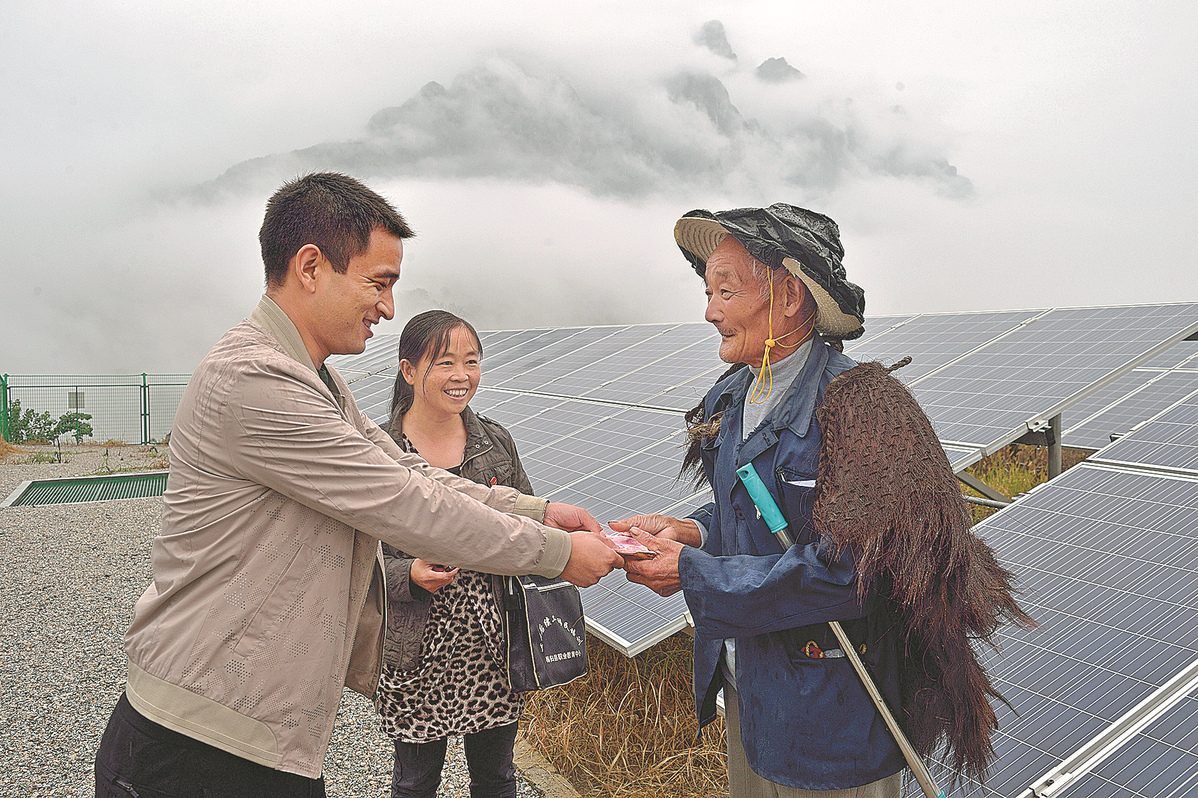
Jiandong receives 34,000 yuan each year from State Grid Corp for the land lease. In addition, the farmers who work part-time cleaning the solar panels are paid 26,000 yuan a year, said Fu Qingsong, the village's Party chief.
From 2013 to 2015, China allocated 24.78 billion yuan to extend power grids to areas without electricity, benefiting some 1.55 million people. It carried out an independent solar photovoltaic power supply project, providing electricity to 1.19 million people. By the end of 2015, China had achieved electricity coverage for its entire population.
Poverty alleviation through solar photovoltaic power generation is one of the top 10 targeted poverty alleviation projects in the country.
Starting in 2014, China's rural poverty alleviation and development have shifted to a model of comprehensive, targeted poverty alleviation that is implemented throughout the entire process of identifying the impoverished, arranging targeted programs, utilizing capital, taking assistance measures, contacting officials in charge of poverty elimination, and conducting reviews of poverty alleviation.
The country has strengthened power grid building and operation services, and it has promoted various photovoltaic poverty alleviation projects, which are funded by the government and implemented by enterprises.
The photovoltaic power program has contributed greatly to the country's poverty reduction efforts, according to a white paper released by the State Council Information Office in April last year.
In rural areas with the appropriate resources and suitable conditions, the Chinese government has funded the construction of power stations, which are owned collectively by local villages. The income created by the power stations is used entirely for poverty alleviation purposes.
As of the end of 2020, 100,000 villages had built photovoltaic power stations, with a total annual electricity generating capacity of 18.65 million kW, bringing an average annual income of 200,000 yuan for each village, the white paper said.
The earnings have been used to create public welfare jobs, fund small public welfare programs and offer small bonuses and subsidies, according to the white paper.
The clean energy projects established in rural areas of the country have not only brought income for villagers, but also improved the environment, fueling rural vitalization.
In September 2021, Zigui made it to the list of the National Development and Reform Commission-led national project aimed at installing photovoltaic panels in every town of certain counties. Zigui got an investment of 280 million yuan from the central government for this.
Cheng Jian, director of Zigui's development and reform bureau, said some 40 percent of schools, hospitals and village committee facilities should have photovoltaic panels, as well as around 20 percent of local residential buildings.
Zigui, which encompasses the easternmost portion of the Three Gorges of the Yangtze River, had been a poor county for a long time. The installation of photovoltaic panels has helped lift people in the county out of poverty. In April 2019, Zigui was removed from the list of poor counties.
County a role model
Forty-nine photovoltaic power stations have been built in the county, which has 167 villages. The power project has covered 27,000 villagers who at the time were living below the poverty line. The poverty-stricken villages garner, on average, more than 200,000 yuan a year from the power projects.
The combination of the photovoltaic power projects with poverty alleviation in Zigui has made the county a role model for other areas.
One of Zigui's highlights is putting the land beneath the photovoltaic panels to good use. Take, for example, the village of Xikouping, where farmers grow tea plants.
The photovoltaic panels are installed in the village's collectively owned tea plantation. Receiving annual subsidies of 100,000 yuan from the central government, the photovoltaic power station in Xikouping churns out annual earnings of 100,000 yuan from power generation. The village has spent the money on creating job opportunities, particularly for villagers living in poverty.
Li Benhua, 48, is the breadwinner of a family of three. Before 2017, the family lived on a mountain.
The three lived a poor life, with an annual income of only 20,000 yuan from raising several pigs and growing tea on a 1,333-square-meter tract of land.
Since the power station was built in 2017, Li has become an employee there, with an annual wage of 6,000 yuan. He is also making 8,000 yuan a year by sweeping the village's roads and serving as a forest ranger. Tea growing, pig farming and disposal of rubbish also contribute to his total annual income of 47,000 yuan.
Meanwhile, the installed capacity of China's solar power could surpass 388 gigawatts this year after adding 85 gigawatts in 2021, according to Bloomberg.
In May, the State Council, China's Cabinet, released a circular on a plan to implement high-quality development of new energy. It aims to accelerate the construction and development of a low-carbon environment to realize the carbon-peak goal.




















