



Autonomous vehicles eye bigger business opportunities









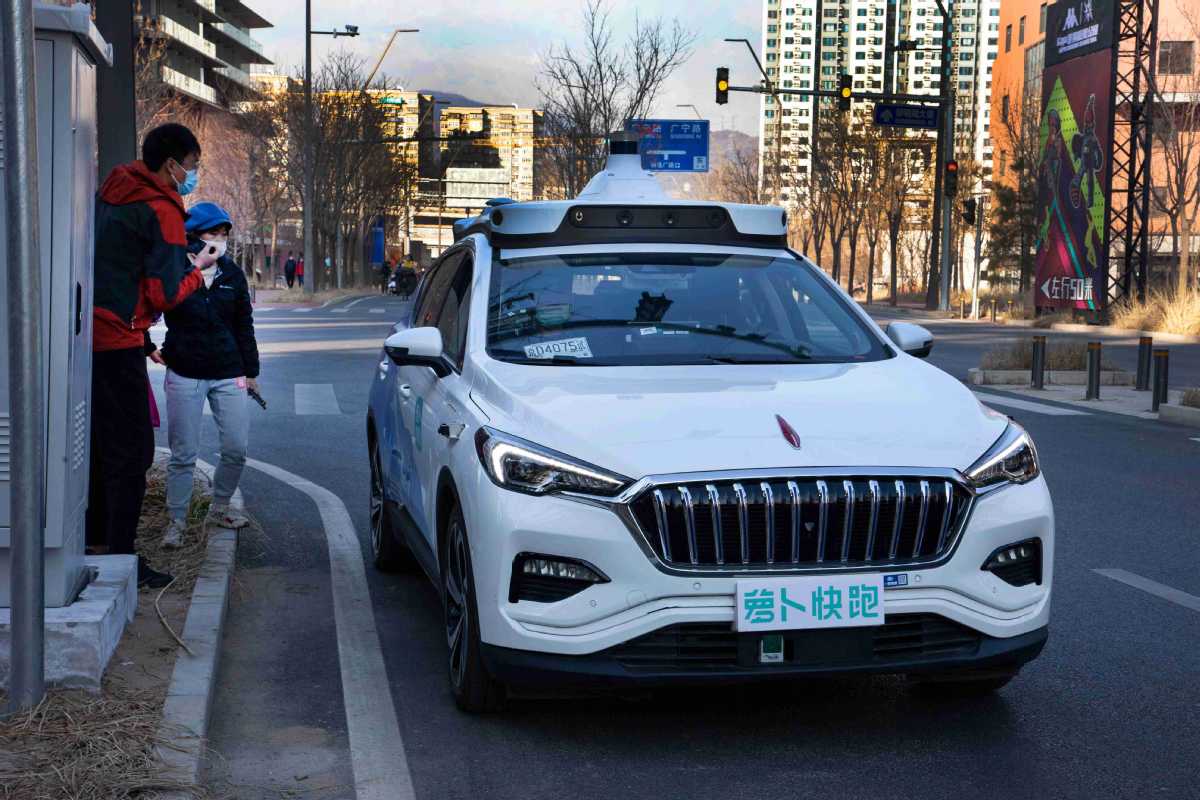
Authorities roll out series of supportive policies to promote robotaxi technology
Autonomous driving vehicles may be more ubiquitous much sooner than we originally expected. The commercialization of self-driving technology is expected to gain momentum in China in the next few years, thanks to continuous technological innovation and considerable policy support, industry experts said.
China has taken the lead in the research and development as well as application of autonomous driving technology around the world and it is the first country to allow fully driverless paid robotaxi operations, as the market potential of this technology continues to grow in the nation, they added.
The self-driving industry is set to witness robust growth in the coming years. The market size of China's self-driving taxi services is expected to surpass 1.3 trillion yuan ($188.6 billion) by 2030, accounting for 60 percent of the country's ride-hailing market by then, said a report by global consultancy IHS Markit.
It is noteworthy that the domestic robotaxi market will eventually be dominated by two to three major service providers, with the top providers occupying more than 40 percent of the total market share.
Chinese tech companies have been striving to advance the technology and accelerate the commercial use of autonomous driving vehicles. Baidu Inc recently announced it plans to put an additional 200 fully autonomous driving robotaxis into operation across the country in 2023 and build the world's largest fully driverless ride-hailing service area.
"The massive cost reduction will enable us to deploy tens of thousands of autonomous vehicles across China. We are moving toward a future where taking a robotaxi will be half the cost of taking a taxi today," said Robin Li, co-founder and CEO of Baidu.
Li said the company plans to expand its autonomous ride-hailing platform Apollo Go services to 65 cities in 2025, and 100 in 2030. Currently, Apollo Go covers more than 10 cities in China, including Beijing, Shanghai and Guangdong province's Guangzhou and Shenzhen.
So far, Baidu has accumulated more than 40 million kilometers of L4 autonomous driving test mileage. By the end of the third quarter of 2022, the cumulative order volume for Apollo Go rides exceeded 1.4 million, making Baidu the world's largest robotaxi service provider.
Autonomous driving is categorized from L1 to L5 — the higher the level, the more intelligent the technology. L4 autonomy means the car can drive by itself in most conditions without a human backup driver. It is one level below L5, which is generally described as full automation, able to drive by itself in all conditions.
Chinese authorities have rolled out a slew of supportive policies to promote the commercialization of self-driving technology. In November, the Ministry of Industry and Information Technology and the Ministry of Public Security unveiled a draft guideline to expand road tests for autonomous driving vehicles nationwide.
On Dec 30, Beijing granted its latest autonomous driving permits to two robotaxi operators — Baidu and Pony.ai — to test their fully driverless vehicles on public roads, with no driver or safety operator in the car, a major step in its autonomous ride-hailing business in the capital.
With permits issued by the head office of the Beijing High-Level Automated Driving Demonstration Area, the two companies can provide up to 10 autonomous vehicles each in a designated area in Yizhuang, a southern suburb of Beijing, covering a series of complex road scenarios. A remote safety operator will take control of the vehicle in case of emergency via an online assistance platform.
In August, China released its first national draft guideline on the use of self-driving vehicles for public transport. Local governments in Wuhan, Hubei province, and Chongqing's Yongchuan district granted Baidu the country's first permits to charge fares for fully driverless ride-hailing services — completely without human drivers in the car — in designated areas the same month.
In addition, the South China metropolis of Shenzhen has allowed fully autonomous vehicles without human drivers to run on certain roads since Aug 1, when a local regulation on smart and internet-connected vehicles came into effect.
"Continuous testing on public roads, easing regulations as well as cost reductions in autonomous vehicle manufacturing will help accelerate the deployment and commercialization of self-driving cars," said Lyu Jinghong, an intelligent mobility analyst at research firm BloombergNEF.
Saying that China has caught up with the United States in the development of autonomous driving, Lyu added that clear regulations at the national level will encourage local governments and autonomous driving companies to speed up the application of self-driving technology, which is crucial to achieving commercialization targets.
According to BloombergNEF's 2022 Electric Vehicle Outlook, China will operate the world's largest robotaxi fleet with about 12 million units by 2040, followed by the US, with around 7 million autonomous vehicles.
China is planning to realize the scale production of vehicles capable of conditional autonomous driving and commercialization of highly autonomous vehicles in certain circumstances by 2025, according to a blueprint issued by the National Development and Reform Commission and 10 other ministries.
Self-driving startup Pony.ai is ratcheting up efforts to push forward the commercial application of self-driving technologies. It has received permits to operate 100 autonomous vehicles in Guangzhou's Nansha district, charging fares based on local standard taxi pricing for its robotaxi services.
Pony.ai plans to expand its commercialized robotaxi footprint to Shanghai and Shenzhen this year and to more cities in 2024. It has also inked partnerships with OnTime, Chinese carmaker GAC's ride-hailing app, and Caocao, another ride-hailing platform, in an effort to deploy more robotaxis on the streets and gradually improve the public's trust in autonomous driving.




















