Scientist tracks wild camels through space technology









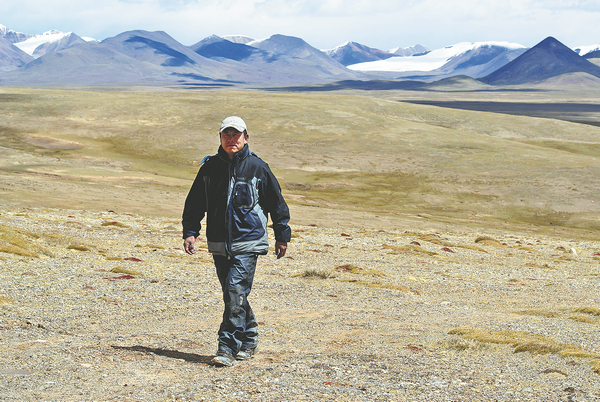
In the office of remote sensing scientist Liu Shaochuang, there is a huge photograph of a camel he snapped a decade ago in the Xinjiang Uygur autonomous region. Wearing camouflage, he crouched for hours by a pool of water in the Gobi Desert to capture the image.
This is the subject of his research.
Since 2012, he has led a team in tracking and studying wild camels using satellite remote sensing technology. Unlike zoologists who focus on species, Liu has studied the interrelationship between endangered animals and their environment, which he believes will help develop better protection strategies in the face of climate change.
In the run-up to World Wildlife Day on March 3, Liu's research came under the spotlight, as it was held up as a successful example of how advanced space technology can benefit animal protection efforts on Earth.
Liu works at the Aerospace Information Research Institute of the Chinese Academy of Sciences. His studies have covered many fields, including polar region scientific expeditions and mapping the headwaters of great rivers across the globe, while he has also developed the navigation and localization systems for China's lunar rovers and Mars rover.
His interest in wild camels began when his team tested a prototype design of the lunar rover Yutu in the desert. Living in the harsh deserts in northwestern China and southwestern Mongolia, the even-toed camel is listed as critically endangered by the International Union for Conservation of Nature. Experts estimate that the population of this species is currently less than 1,000, of which around 650 are in China.
"Ten years ago, the research relied solely on human observation, (which was) very primitive," Liu says. Because wild Bactrian camels are fully migratory and can travel over long distances, scientists used to learn their habits by studying hoof prints and droppings. It was hard to find one camel in the desert, let alone track it.
But, Liu thought his expertise in satellite navigation and remote sensing might come in useful in the study of wild camels.
It was not easy at first. Liu learned zoology from scratch. His team had to spend several weeks each year braving dust and sandstorms in the vastness of the Gobi Desert seeking out camels. A scar on his right eyebrow is the result of a rollover accident on a rugged mountain road in Xinjiang.
"The most thrilling moment was attaching trackers to the wild camels," Liu recalls. On May 6, 2012, Liu's team, for the first time, succeeded in putting a satellite positioning collar on a wild camel — a female — in Xinjiang's Lop Nur Desert.
The tracking collar, equipped with special receivers, weighs only a few hundred grams. It can detach automatically and will not have a negative impact on the daily lives of the animals. According to Liu, at least seven wild camels are currently fitted with tracking collars, and their locations are transmitted via satellite every day. Based on tracking data, scientists can get to know their migratory paths, living environments and possible threats they may encounter.
The short message function provided by China's BeiDou Navigation Satellite System enables the collar to transmit and receive signals in real time. Even when the communication network signal is poor, collars with BeiDou chips can send back the positions of the wild camels through Chinese satellites. Sitting in his office in Beijing, Liu can also obtain information about the surrounding environment on his computer, including temperature, vegetation, and water sources.
His latest discovery is that the suitable habitat range has shrunk greatly due to climate change, and that wild camels have moved to the colder Altun Mountain Range in China, and higher-altitude regions in Mongolia as a result.
This implies that the animals may face more dangers, Liu says. For example, the narrowing habitats may lead to an increased chance of attacks by wolves, a reduction in drinking water and a higher risk of disease.
Liu is calling for an expansion of current protection zones and the establishment of a larger-scale national park for the wild camels. Meanwhile, he suggests the building of a space-air-ground integrated monitoring system, which will use remote sensing satellites in space, aircraft in the sky, and wireless smart sensors on the ground, to strengthen observation capabilities.
For Liu, it is worth the significant sci-tech effort to study such a rare species. Scientists have found that the DNA of the wild camel is 2 to 3 percent different from that of domesticated camels, while the DNA difference between humans and chimpanzees is only 1 percent. Wild camels are more resilient in harsh environments, and some researchers believe that their genes may provide useful insight for the treatment of cancer and diabetes.
Liu admitted that it would take a long time for humans to fully understand this rare species. Much is unknown about its population, distribution and habits. The 60-year-old Chinese researcher plans to enhance cooperation with his Mongolian counterparts to boost wild camel protection this year, and to apply the tracking techniques to the study of other species.
"I like to explore the unknown," Liu says.
More than 40 BeiDou navigation satellites are currently operating in orbit. China will launch three to five more this year to enhance its constellation. Liu says wildlife protection and research will become more precise and efficient with the help of technology.