



Tug of growth
China's economic rebound will help pull the ASEAN members through the storm of uncertainties









Editor's note: The world has undergone many changes and shocks in recent years. Enhanced dialogue between scholars from China and overseas is needed to build mutual understanding on many problems the world faces. For this purpose, the China Watch Institute of China Daily and the National Institute for Global Strategy, Chinese Academy of Social Sciences, jointly present this special column: The Global Strategy Dialogue, in which experts from China and abroad will offer insightful views, analysis and fresh perspectives on long-term strategic issues of global importance.
China's economic rebound will help pull the ASEAN members through the storm of uncertainties
With rising protectionist sentiment in the United States escalating the tension between the US and China, weaker growth in the US and the European Union due to tighter monetary policies, as well as the Russia-Ukraine conflict, the Association of Southeast Asian Nations members are entering a period of rising uncertainties and turbulence. Like people on small- and medium-sized boats sailing into increasingly turbulent seas, they are experiencing rising fear and concern about their economic prospects.
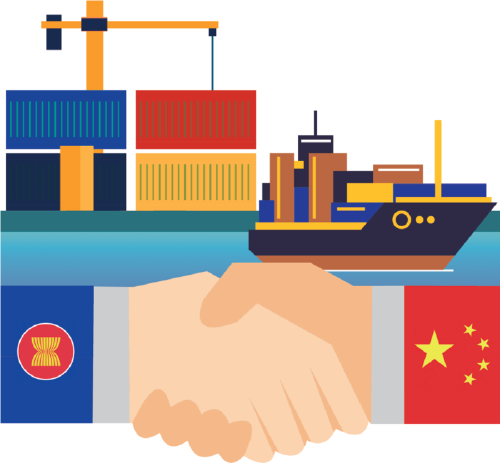
Fortunately, as ASEAN's largest trading partner and most critical locomotive, the Chinese economy is showing increasing signs of rising economic expansion and recovery in the post-COVID era.
World Bank estimates show that a 1 percentage point expansion in China's GDP would result in a GDP increase of 1.3 percentage points for Singapore, 0.8 for Malaysia, 0.6 for Indonesia, 0.5 for the Philippines and 0.4 for Thailand.
Meanwhile, in its latest January 2023 report, the International Monetary Fund has projected China's economy, now reopened, will be rebounding to 5.2 percent in 2023.Estimates compiled by Bloomberg on private sector economists' forecasts indicate an even more optimistic estimate of 5.5 percent for China. This compares to the US at 1.4 percent and the EU at 0.7 percent. The five main ASEAN members are projected by the IMF to benefit from China's rebound and grow by a respectable 4.3 percent.
China has witnessed a year-on-year trade increase of 15 percent with ASEAN in 2022, the first year the Regional Comprehensive Economic Partnership came into effect.
China's imports and exports to ASEAN amounted to 6.52 trillion yuan ($970 billion) in 2022, a significant increase of 15 percent. Of this, exports accounted for 3.79 trillion yuan, an increase of 21.7 percent, and imports made up 2.73 trillion yuan, up 6.8 percent. This can partly be attributed to the growth effect brought about by the RCEP, which has greatly facilitated the expansion of the intra-regional value chain.
Since early this year, China's economy has shown signs of a stronger rebound. The manufacturing sector posted its biggest improvement in more than a decade, services activity has expanded and the hitherto weak housing market has finally stabilized.
In February, China's manufacturing purchasing managers' index rose to 52.6, the highest reading since April 2012. A non-manufacturing gauge measuring activity in both the services and construction sectors improved to 56.3. Both indexes significantly beat economists' expectations. This is a clear indication that the economic upward momentum in 2023 will be very strong.
In this context, the PMI provides the first comprehensive data of the economy's recovery after the pandemic control measures were optimized late last year. Infection waves have begun to ease, and businesses have rapidly recovered after the Lunar New Year holidays. The figures add to other signs of a rebound in the economy and put policymakers in a good position.
Most crucially for ASEAN, China's rebound is also giving a boost to manufacturing in other parts of Asia. The PMI in Thailand, Vietnam and other Southeast Asian producers climbed last month. In North Asia, the recovery is much weaker, with Japan's factory activity falling.
Further confirming the rapid recovery of the Chinese economy, congestion in major cities in recent weeks was the worst since at least the start of 2022, based on data compiled by Bloomberg and Baidu. The number of people riding the subway in Beijing, Shanghai, Chongqing and other major cities was back to or even above pre-pandemic levels.
In addition, UBS Group's latest China consumer survey, released on Feb 28, showed an increase in dining out, shopping in stores and offline entertainment.
Chinese housing sales also rose for the first time in 20 months, according to data from the 100 biggest real estate developers. China's inbound foreign direct investment also grew for a third consecutive year in 2022, indicating the country remains a magnet for foreign investment despite the trade and tech war as well as the depressing effect of the pandemic.
The FDI inflow into China in 2022 hit $189.13 billion, rising 8 percent in US dollar terms and maintaining stable growth, according to data from the Ministry of Commerce. This compared to FDI which totaled $173.48 billion in 2021 and $144.37 billion in 2020.
As of 2021, the private sector in China generated 58 percent of exports, much larger than that of the foreign-invested sector (34 percent) and the State-owned enterprise sector (8 percent). This dynamism of the private sector is crucial. This is why despite rising US-China tensions and tepid economic growth, total trade between China and the US rose by 5.1 percent, from $657.4 billion in 2021 to $690.6 billion in 2022.
Among other economies that trade with ASEAN, China's economic dominance has been growing significantly. As a share of ASEAN's total trade, ASEAN-China merchandise trade increased from 13 percent in 2012 to 20 percent in 2021, far outpacing the US (11 percent), the EU (8 percent), and Japan (7 percent). The RCEP will likely further boost ASEAN-China trade in the future.
For the small- and medium-sized countries in ASEAN, China is likely to play an increasingly important role as the key locomotive of growth and help ASEAN to weather the increasingly turbulent and uncertain global trading environment.
The author is a professor of economics at the Nanyang Technological University in Singapore. The author contributed this article to China Watch, a think tank powered by China Daily. The views do not necessarily reflect those of China Daily.
Contact the editor at editor@chinawatch.cn.





