


Digital technology revives treasured murals in Beijing









In 1937, Angela Latham, a British journalist, published an article in the Illustrated London News about her visit to Fahai Temple in the western suburbs of Beijing.
Fahai Temple was first built in 1439, the fourth year of the reign of Zhengtong in China's Ming Dynasty (1368-1644). It is noted for its frescoes, known as the "three major frescoes in China" together with the murals found in Dunhuang and Yongle Palace.
"To me, as a fresco painter, the technique of these Ming paintings seems to be superb, in every way comparable to that of the greatest masters," she said.
"Since people who undertake that kind of work are seldom themselves fresco painters and do not understand the medium, or lack of one, with which they are dealing, it is preferable that the paintings should be left as they are, in the custody of monks, who do not appreciate their value," said Latham, who expressed in her article both her joy at the discovery of the frescoes at Fahai Temple and her concern about the neglect and degradation of the ancient treasures.
Fahai Temple was repeatedly damaged or destroyed in the history. After the founding of the People's Republic of China in 1949, the Chinese government appropriated funds for overhaul four times. The historical appearance of the temple was restored, and its murals have been preserved to this day.
Although the frescoes of Fahai Temple, which look resplendent and have the effect of three-dimensional reliefs, are still shining after nearly 600 years, those who want a clearer picture of their original magnificence might not feel enough.
According to Tao Jun, deputy director of the repository of cultural relics at Fahai Temple, workers must ensure the ten existing pieces are kept away from light for a long time to protect the frescoes. The Grand Hall, where the frescoes are located, is open to the public on a limited basis every day, and visitors are required to use cold-light flashlights only when watching the murals.
Chinese cultural relics conservators have gradually found a balance between protecting and utilizing frescoes at Fahai Temple by strengthening management and preservation measures and applying digital technology to cultural relics. Relying on the new means of protection and presentation generated by the technological updating, the "aging" process of Fahai Temple's frescoes could be delayed, and the temple has a new vitality.
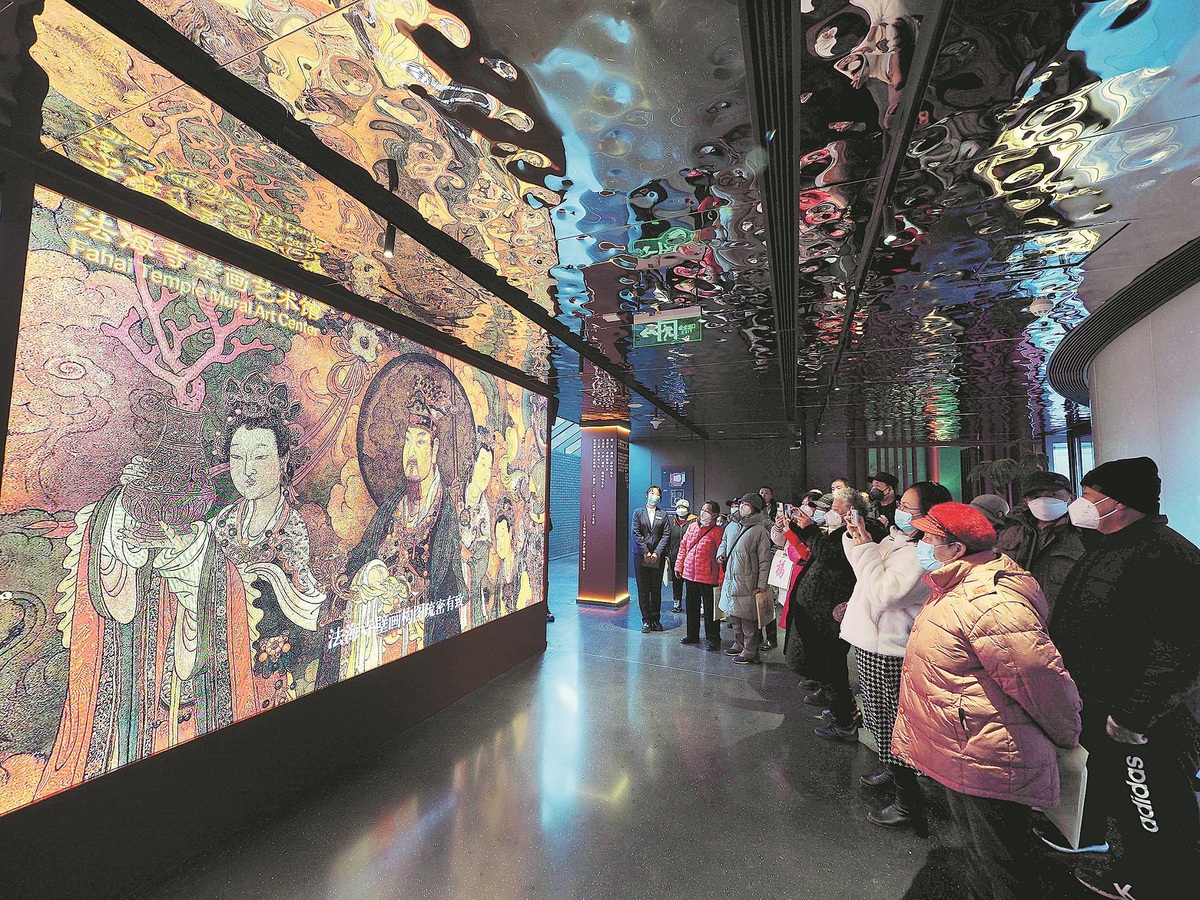
An immersive digital art gallery themed on Fahai Temple murals, which revitalized the treasured murals, made its debut to the public in January.
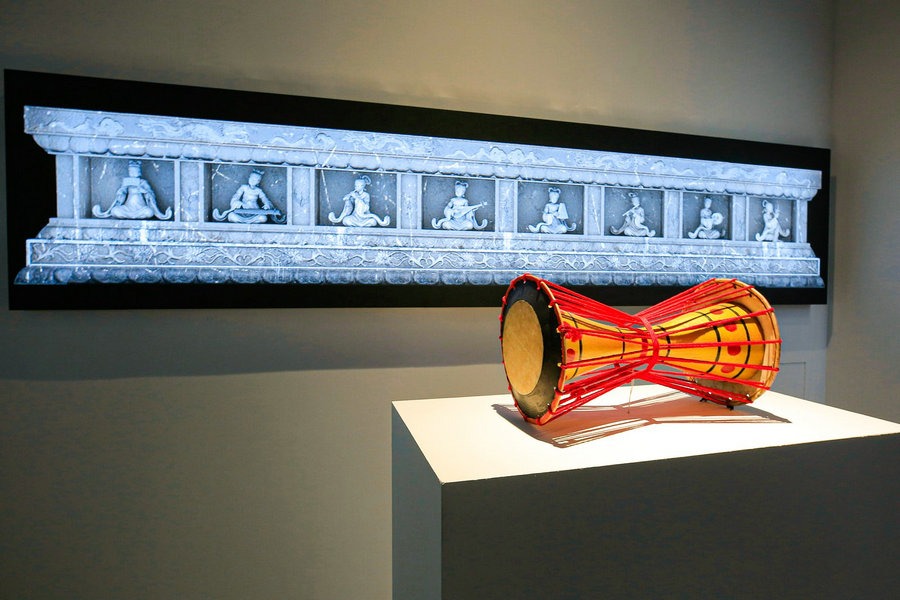
At the exhibition of Fahai Temple Mural Art Center, the original scale of mural paintings is presented with a 4K HD display. Each one of the 77 figures is portrayed with immaculate attention to detail by 3D modeling of pixel-level.
The facial details of Water-moon Avalokitesvara, one of the most representative figures on the frescoes of Fahai Temple, are hard to make out in dim conditions. However, after 3D modeling, the over 3-meter-high figure's face can be seen clearly on the 4K HD screen at the Mural Hall in the basement of the art center.
"The frescoes are particularly striking after digital restoration. The figures, animals, flowers, and birds on the frescoes seem to come from history to reality. I feel the wisdom, ingenuity, and exquisite skills of ancient painters," a visitor surnamed Liu said about the mural exhibits.
"The advantage of the digital display is that it can break the limitations of time and space so that the audience has enough time to understand the rich historical and cultural connotations they carry," said Liu Xiaobo, curator of the art center.
Liu said it took about two years to complete the construction of the art center. They also spent years preparing for the exhibition, visiting numerous museums and cave mural sites.
Amid its efforts to promote high-quality development, China has pledged promoting the digital development of public cultural venues such as libraries and museums. Digitization has become a vital means to inherit, protect and utilize the country's cultural relics.
"Advanced digital technology helps us protect, discover, and explore the splendid cultural treasures left by ancient people, and the frescoes of Fahai Temple still have many hidden ideas and artistic codes waiting to be discovered," Liu said.