



Relief program put back to work









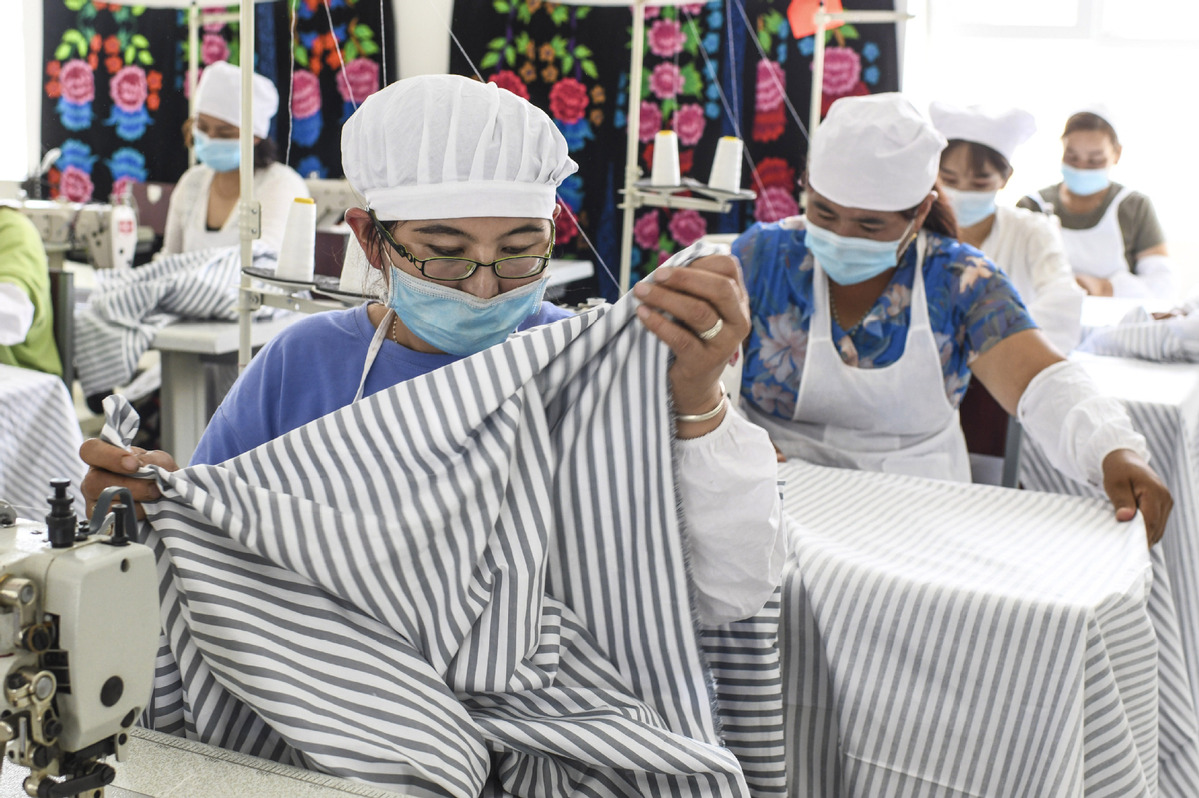
Scheme helping older, rural workers find training, job opportunities closer to home
Central authorities are increasingly turning to the visible hand of the government to ensure that older, less-skilled rural workers are able to find work at a time when manual laborers are increasingly being replaced by artificial intelligence and automation.
One of the most recent moves was the push to promote a work-as-relief program through publicly funded infrastructure projects.
The program, which dates back to the early 1980s, was designed to bolster rural workers' financial standings via job opportunities, instead of through cash relief. It has worked efficiently in China's decadeslong campaign to revive the once-impoverished inland provinces, and contributed to the drive to wipe out rural poverty.
The programs are by nature a form of social assistance, but in addition to creating a salaried post, they also help train participants, said Wu Sa, a researcher at the Academy of Macroeconomic Research, a national think tank with a focus on development issues.
"Low-income people are like everyone else, eager to make a happy life for themselves with their own hands," he said in an interview with Beijing News.
"However, the lack of skills and sometimes, an insufficient understanding of the importance of skills, can hold them back."
As the Communist Party of China engages more deeply in rural vitalization as part of its socialist modernization drive — which was announced at the Party's 20th National Congress last October — the work-as-relief program will be given a new lease on life.
Central authorities have directed that the mechanism be coupled with major construction projects, especially the expansion of infrastructure in rural regions. Local governments have also been encouraged to raise salaries for workers.
The measures were outlined in this year's No 1 Central Document — the first policy statement released annually by the CPC Central Committee and the State Council, China's Cabinet. The document has long served as an indicator of government priorities for the year ahead.
The directives appeared in a section titled "promoting farmer employment and income", which also laid out other job-promoting measures aimed at rural workers.
For example, local authorities have been tasked with rolling out favorable policies targeting medium and small businesses employing rural migrant workers, helping rural workers develop new skills and ensuring that they get paid on time. Currently, many migrant workers are not paid each month, making them vulnerable to a loss of income when projects end.
The section noted that authorities must protect the labor rights of older workers, who frequently work well past the legal retirement age to supplement meager rural pensions.
The relevant departments have been instructed to fast-track the creation of a system to protect the rights of temporary workers, and to construct industrial parks and startup incubators for those wishing to start businesses in the countryside.
Revisions to a guideline governing the rollout of work-as-relief programs also came into force this month.
The updated rules, issued by the National Development and Reform Commission, the national economic planner, laid greater emphasis on allowing participants to gain new skills through these programs and strengthened oversight for funding.
One of the revisions, which required that the programs "use manual labor for as long as it is possible to go without machinery, and employ local workers for as long as it is possible to go without professional construction teams", has roused public debate in recent weeks. Some netizens claim the moves are a waste of resources and a regression from industrialization.
However, a commentary published by the Farmers' Daily newspaper argued that the arrangement is necessary as it helps create more job opportunities for farmers on their doorsteps, which is important because the rural workforce is generally less skilled and less competitive in the job market.
"China has a large population and an obvious gap in development levels between regions," it said. "To ensure full employment for groups with special challenges, we need to give better play to the role of both the government and the market."
According to the NDRC, the central government earmarked almost 30 billion yuan ($4.3 billion) in funding for work-as-relief programs between 2016 and 2020, and the money, coupled with some 3.5 billion yuan in investments made by local governments, has fueled the construction of a range of rural projects.
Last year, the programs enabled 5 million rural workers to find work closer to home, avoiding the necessity of having to travel to larger cities for opportunities. Those workers earned 8,000 yuan on average, the NDRC said.


- People across the Taiwan Strait celebrate Spring Festival together
- 8 dead, 2 injured after fireworks retail store blast, fire in East China
- China predicts over 285 million inter-regional trips on first day of Spring Festival holiday
- Galloping into Chinese New Year
- Xi's article on key tasks of China's current economic work to be published
- Spring Festival greetings from envoys








