Get real
New opportunities have appeared for internationalization of the renminbi









New opportunities have appeared for internationalization of the renminbi
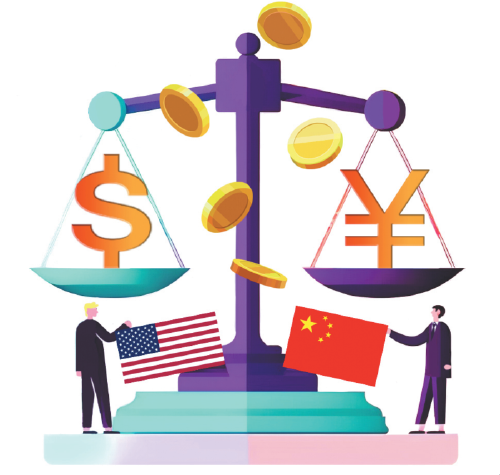
Recently, Chinese oil and gas player CNOOC and French energy giant Total Energies have completed China's first renminbi-settled liquefied natural gas trade; Brazil has announced a decision to accept trade settlements and investments in yuan, with an agreement reached between central banks in February, and the appointment of a yuan clearing bank; and the Association of Southeast Asian Nations countries have had discussions on ways to reduce their US dollar dependence and promote the use of local currencies in trade settlements. These events have once again sparked discussions in the market about such topics as global "de-dollarization" and the internationalization of the renminbi.
China is now the world's second-largest economy; however, the global use of its currency lags far behind its weight in the world economy. In the wake of the US subprime mortgage crisis, economic globalization has slowed and countries around the world have strengthened financial supervision. The COVID-19 pandemic and the Russia-Ukraine conflict have further facilitated the anti-globalization and de-financialization trends. Against such a backdrop, the United States' long-standing advantages in the financial sector are diminishing, which will have a far-reaching influence on the international monetary system at large.
Over the past 40 years, the dollar system has been based on economic globalization and financialization. Amid the anti-globalization trend, however, countries are attaching more importance to economic security and geopolitical goals, a shift from the pursuit of efficiency featuring low-cost.
Anti-globalization has brought more supply constraints across the world and governments are playing a bigger role in resource allocation. The first evidence is that tech rivalry has replaced trade frictions to become the main arena for Sino-US competition — the US has been intensifying its crackdown on Chinese tech companies. The second evidence is global supply chain adjustments. Reeling from the COVID-19 pandemic and geopolitical events including the Russia-Ukraine conflict, countries around the world are paying more attention to the stability and security of industry chains and supply chains, resulting in new constraints on global supplies. The most recent adjustments have been in the allocation of resources as a consequence of the conflict in Ukraine. In the wake of the Russia-Ukraine conflict, governments across the world have been playing a bigger role in resource allocation.
The de-financialization trend is reflected in changes in the debts of economic entities and the form of assets.
With regard to debts, de-financialization is evidenced by a shift of debt from the private sector to the government — a decline in private debt and an increase in public debt.
In terms of assets, de-financialization is manifested in economic entities attaching greater significance to real assets, compared with the previous focus on financial assets.
Since 2022, the US Money Supply M2 once grew by nearly 30 percent, nearly half of which came from government spending. China, on the other hand, used credit expansion as a major means of monetary easing in response to the pandemic. However, since 2022, China has been strengthening the coordination between its fiscal policy and monetary policy. In April 2022, China's central bank handed over profits to fund fiscal spending — a way of injecting cash into the markets via higher fiscal spending. In a nutshell, de-financialization means tougher financial supervision combined with increased fiscal spending, that is, tight credit policy and loose fiscal policy.
When the US started to impose financial sanctions against Russia in February 2022, views began to emerge that rethink the dollar hegemony and believe the move would intensify other countries' mistrust toward the US dollar, therefore resulting in a larger number of countries seeking safe haven assets other than the dollar assets.
The future international monetary system will probably be a dollar-based multipolar system wherein a number of currencies coexist and coordinate, including the renminbi.
Pushing for the internationalization of the renminbi doesn't always have to start from capital account opening, but rather, should place more focus on the competitiveness of China's real economy.
To start with, the payment system based on the renminbi has great potential for development. Such potential derives from the economic complementarity between China and a number of countries as well as China's advantages in the economies of scale and economies of scope as the world's largest goods-trading nation. As a matter of fact, China has already made a slew of non-dollar payment arrangements with a number of countries in Africa, Latin America and other regions.
Second, Chinese government bonds could become an important supplement to the global safe-asset supplies. And the currency swap deals between China's central bank and other countries' central banks and China's strategic reserve cooperation with the world's major commodity exporters are likely to play the role of safe assets.
For instance, China and Eurasian economies have the potential to roll out regional currency coordination mechanisms. Take China and Russia for example. The value of the imports and exports between the two nations is roughly equivalent, with strong economic complementarity between the two. Of that, in 2020, the top five China exports to Russia were finished goods — mechanical and electrical products ($20.9 billion), others ($5.6 billion), textile and garment ($5.4 billion), metal products ($3.7 billion) and chemicals ($2.7 billion). On the flip side, the top five Chinese imports from Russia were raw materials — fuel ($33.4 billion), metal products ($6.6 billion), woodwork ($4.9 billion), mineral products ($3.5 billion) and animals ($2.2 billion). Given the strong economic complementarity, China and Russia are totally capable of establishing a regional currency coordination mechanism that use local currencies in bilateral trade settlement. The same could apply to China and other countries including Latin American countries and African countries.
As far as Sino-US bilateral ties are concerned, de-financialization means the US' advantage in international finance will be undercut, and therefore, the internationalization of the renminbi should not always start from capital account opening, but rather, should focus on the competitiveness of China's real economy.
In a multipolar international monetary system, Sino-US competition will be increasingly focused on the real economy, especially technological innovation and commodities, rather than the financial sector. It's not that finance doesn't matter, but that at the global level, there's also a need for the financial sector to serve the real economy and facilitate technological innovation.
The author is dean of the Global Institute of China International Capital Corp, chief economist and head of Research Department of CICC. The author contributed this article to China Watch, a think tank powered by China Daily.
Contact the editor at editor@chinawatch.cn.