



Discharge of tritium from Fukushima to harm human body, scientist says in S. Korea









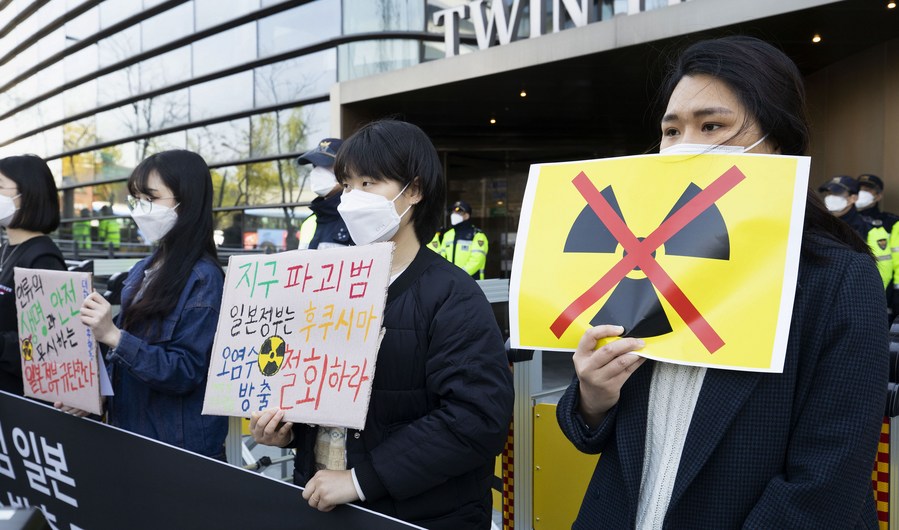
SEOUL - Tritium, which the Japanese government planned to dump from its crippled Fukushima Daiichi nuclear power plant into the Pacific Ocean, will harm human beings' inside bodies as internal exposure can be more dangerous than external exposure, a renowned scientist said Thursday.
"When tritium gets inside the body, it's at least as dangerous as any of the other radionuclides. And in some cases, it's more than double as dangerous in terms of the effects of the radiation on the genetic material, on the proteins," Timothy Mousseau, professor of biological sciences at the University of South Carolina, told a press conference in Seoul.
The Japanese government and institutions, including the Tokyo Electric Power Company (TEPCO), have claimed that tritium is not dangerous because it emits a very "weak" beta particle, but the professor called it "fiction."
"Ingestion is really the most dangerous. People have said that tritium is not dangerous based on the concerns for external exposure, but using the same argument, you would say that uranium 235 is not dangerous," he noted.
Tritium is known as an emitter of low-energy beta particles incapable of penetrating a human body as they are stopped by a layer of clothing, in contrast to gamma rays that can pass through a human body and only be stopped by several feet of concrete.
If the tritiated water or the organically bound tritium discharged from the collapsed Fukushima power plant is consistently ingested, the ionizing radiation would directly damage DNA or indirectly affect other metabolic activities through oxidative stress or an imbalance inside the body that can lead to cell and tissue damage.
"The way it works is that the tritium molecule comes inside the cell and ejects an electron...It's a little bullet. It's like a bullet coming from a gun. It comes out from the nucleus of the tritium atom. That bullet hits something like the DNA," Mousseau said.
"What makes tritium more dangerous than high-energy emission is that the bullet is moving kind of slow, so it hits something and bounces. And it hits something else and then it hits something else. It doesn't go anywhere, so you end up with a clustered damage from that beta particle," the professor noted.
"High-energy beta particles are higher energy. They will hit something, yes, but then they continue and go through the cell, maybe out of the body, and do much less damage as a result. So, this is why we need to pay attention to tritium in particular," he added.
Mousseau, who published over 130 scientific papers related to radiation effects, presented a new paper on the biological consequences of exposure to tritium earlier this month based on 250 studies after scanning over 700,000 references to tritium.
According to the paper, the scientific literature indicated that tritium could be genotoxic and carcinogenic and can affect reproductive systems such as sperm and eggs.
Japan planned to release over 1.2 million tons of the tritium-laced water into the ocean for 30 years from 2023, but the discharge would last much longer than planned, Shaun Burnie, a senior nuclear specialist at Greenpeace East Asia, told the press conference.
"Those discharges could begin as early as July, possibly later, and continue for many decades, not just the 30 years but maybe 50, 60, 70, 80 years. Next century is really possible," said Burnie.
"This is water that's radioactive in tanks, so it's the deliberate decision to pollute and contaminate the environment, which doesn't need to take place because actually there is sufficient storage space in the two districts next to the Fukushima nuclear power plant," he noted.
Burnie was also skeptical of Japan's claim that the contaminated water could be diluted through an advanced liquid processing system (ALPS).
"This is water that has come in direct contact with a reactor, a nuclear fuel that suffered a severe melt, which means fission products within the nuclear fuel became in direct contact with water," the specialist said.
"It's unclear how successfully the ALPS system processes the water. Around 70 percent of the water in the tanks still needs to undergo further processing. So, we still don't know how effective it's going to be. It can't be discharged as it is at the moment," he added.










