US national security abuse undermines trade relations with China









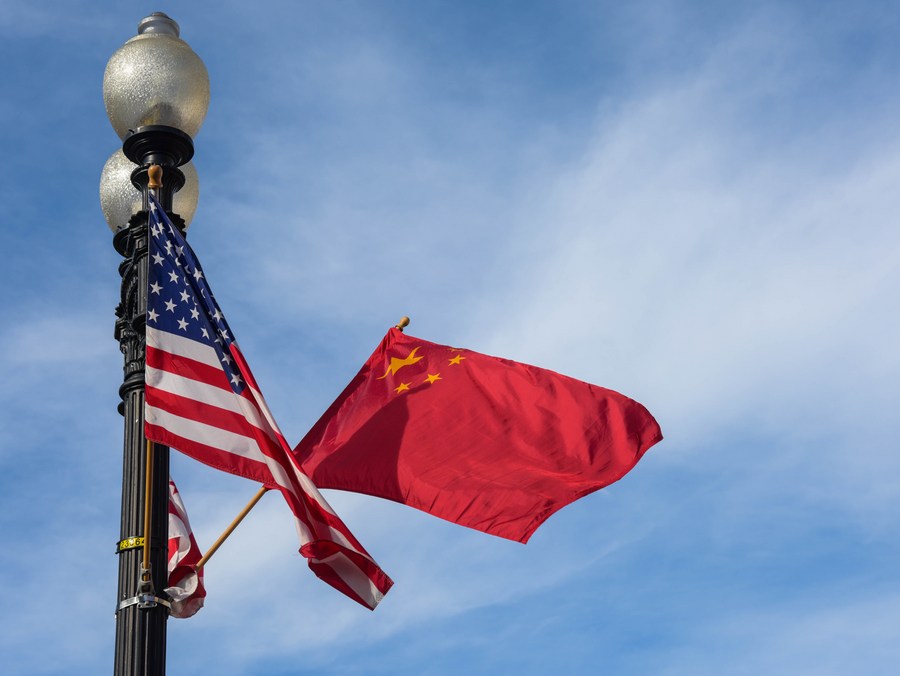
BEIJING -- For the United States, national security seems a panacea for fast-tracking a host of ill-founded policies, from tightening semiconductor export controls on China to proposing a ban on short-video platform TikTok.
The United States has frequently invoked national security as a justification for policies that violate international law. Such acts -- which many consider unreasonable and even unacceptable -- will not only hurt businesses and households of both countries, but also disrupt global supply chains.
A full US-China decoupling -- though unlikely -- would be catastrophic to both sides and the global economy, according to economists and observers, who have urged more rationality and pragmatism in crafting trade policies.
Abusing national security
In a recent speech, US Treasury Secretary Janet Yellen -- despite calling for "constructive" engagement between the world's two largest economies -- said national security is "of paramount importance" in the US relationship with China.
Calling the statement "unreasonable," Lewis Ndichu, a researcher at Nairobi-based think tank Africa Policy Institute, told Xinhua that "by ranking security ahead of trust or even economics, the US is effectively putting the cart ahead of the horse."
Although Yellen claimed US actions are "targeted," economists have voiced concerns over the overuse of national security.
Gary Hufbauer, nonresident senior fellow at the Washington-based Peterson Institute for International Economics, told Xinhua via e-mail that US measures "go way beyond the reasonable scope of national security."
Hufbauer, a former US Treasury official, said the Trump administration's tariffs, extended by the Biden administration, "have nothing to do with national security," and the steel and aluminum tariffs on numerous trading partners "have no justification."
"Advanced semiconductors and some AI and telecom have security implications, but not commodity chips (the bulk of the market) or services like TikTok," he added.
In the latest proof of its national security obsession, the Biden administration is reportedly considering an executive order that will limit US businesses' investment in Chinese tech firms.
"The US habitually politicizes technology and trade issues and uses them as a tool and weapon in the name of national security," Chinese foreign ministry spokesperson Wang Wenbin said at a recent press briefing.
Wang added that the true intention of the United States is to take away the right to development from China and maintain US supremacy for its selfish interests.
Some argued that the United States' overuse of national security doesn't come as a surprise given its history.
Yellen's recent layout of the US "geo-economics" strategy has historical roots, which advocated that it should achieve its geopolitical dominance through military as well as economic means, a former chief economist at the Ministry of Planning in Pakistan, Arshad Zaman, told Xinhua.
Such hostile policies might have stemmed from US politicians' efforts to garner support and win election, according to Cavince Adhere, a Kenya-based international relations scholar.
"Candidates running for office often use the rhetoric of being tough on China to win votes. Eventually such campaign-driven attitudes end up informing US foreign policy towards China," said Adhere.
Damaging to all
According to an October 2022 White House document, the Biden administration's National Security Strategy plans to achieve a better future of "a free, open, secure and prosperous world." But its national security-related trade measures would do otherwise.
"As a result of these measures, the share of US imports from China has declined by a couple of percentage points, and both Chinese and US trade has been reoriented toward third countries, like Brazil and Vietnam," said Hufbauer.
Zaman said the US-levied tariffs not only raised import costs for American businesses and lowered sales for Chinese exporters, "but had also disrupted global supply chains, which led to higher costs for businesses and consumers around the world."
Echoing his remarks, Ndichu said this has pushed the global supply chains to become "less elastic, less efficient, and more costly," and their ability to counteract inflationary pressures has declined.
Both American and Chinese consumers will feel an impact from "politicization of the economy" in the United States, but the global economy will suffer from it, said Zeno Leoni, a lecturer in the Defence Studies Department of King's College London, also an affiliate of the Lau China Institute.
Such measures would be especially damaging to a significantly slowing US economy -- with its GDP expanding an annualized 1.1 percent in the first quarter -- and a sluggish global economy, the growth rate of which is projected to remain low in at least five years.
The measures will bite into the US economy as the country is suffering from high inflation and fear of economic slowdown, said Joseph Matthews, a senior professor at the BELTEI International University in Phnom Penh, Cambodia.
Worse, US restrictive measures against China will further weigh on the global economy, which is already struggling due to the Ukraine crisis, high fuel and food prices, supply chain disruption, and climate change, hampering global efforts to revive the economy, he said.
Despite continued US rhetoric and actions to decouple from China, Dawie Roodt, chief economist at South African wealth management company Efficient Group, among others, told Xinhua that it is "extremely improbable" that the US and Chinese economies will separate due to the co-dependence of their economies.
Many -- including the US treasury secretary -- have warned of the catastrophic impact of a full US-China decoupling.
"A full separation of our economies would be disastrous for both countries. It would be destabilizing for the rest of the world," said Yellen. "Rather, we know that the health of the Chinese and US economies is closely linked."
In the long term, decoupling could lead to the fragmentation of supply chains and standards in the global economy, potentially reducing the benefits of globalization and cooperation, said Zaman, who was also a senior economist with the World Bank.
"It is important, therefore, for the US to find ways to cooperate and manage its differences with China, to avoid a further escalation of tensions and potential economic disruption," said the economist.