



Astronauts meet in Tiangong space station core module









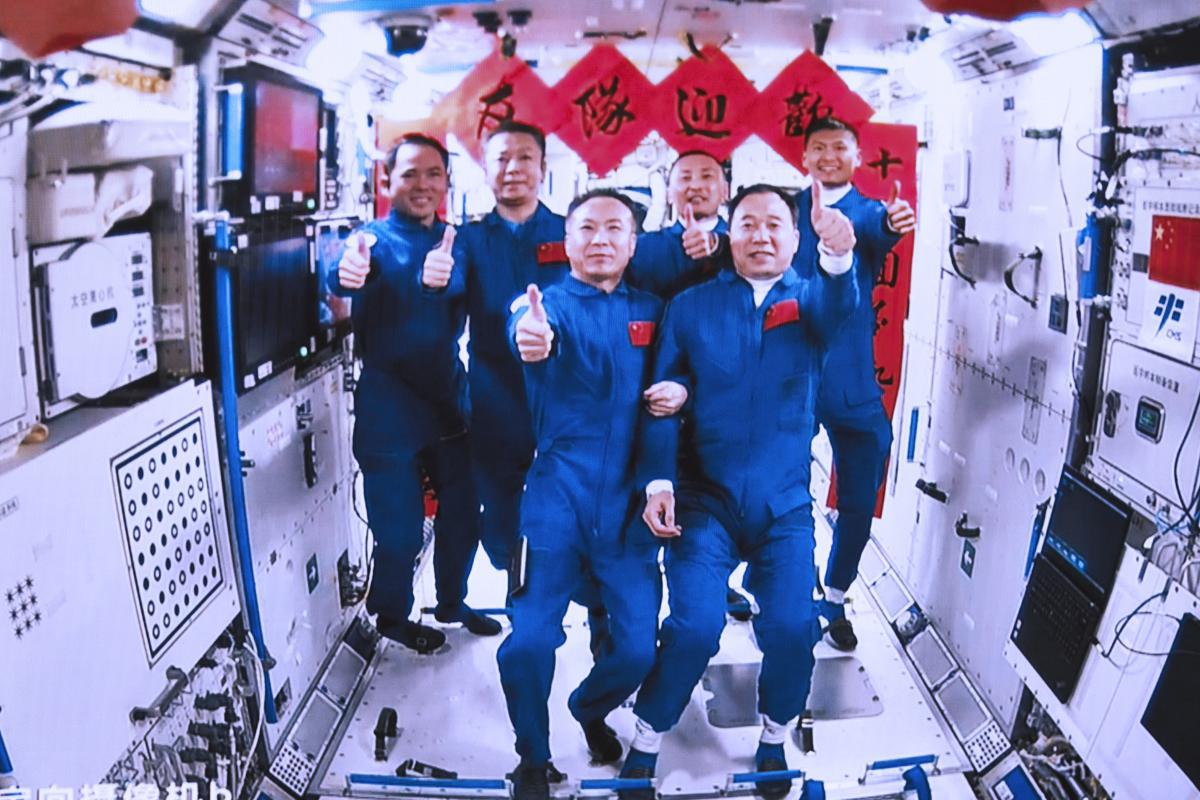
The Shenzhou XVI mission crew, which includes the first Chinese civilian astronaut, reached orbit on Tuesday and started work in the Tiangong space station.
Aboard the Shen-zhou XVI spacecraft, mission commander Major General Jing Haipeng, spaceflight engineer Colonel Zhu Yangzhu and Professor Gui Haichao, the mission's science payload specialist and the first Chinese civilian in space, were launched by a 20-story-tall Long March 2F carrier rocket, which blasted off at 9:31 am from the Jiuquan Satellite Launch Center in northwestern China's Gobi Desert.
After a short flight, the 8-metric-ton spaceship was placed into a low-Earth orbit about 400 kilometers above the planet and then activated the rapid rendezvous-docking mode to approach the Tiangong station.
On Tuesday afternoon, the spacecraft connected with the radial port on Tiangong's Tianhe core module.
After about two hours of preparatory work following the docking, Jing opened a hatch on the Shenzhou XVI spaceship and floated into Tianhe's connection cabin at 6:19 pm.
He was welcomed by Major General Fei Junlong, leader of the Shenzhou XV crew, who had been waiting inside the cabin.
"Let's hug! I am so happy!" Fei said as he embraced Jing.
Following Jing, Zhu and Gui moved into the connection cabin one by one, and they were also greeted and hugged by Fei.
The Shenzhou XVI trio then moved into the Tianhe module and hugged the other Shenzhou XV crew members — Senior Colonel Deng Qingming and Senior Colonel Zhang Lu — who were waiting there and recording the emotional moment on a smartphone.
The two crews chatted for a while before taking a group selfie to applause from the ground control staff.
The entire procedure was broadcast live on China Central Television.
The two teams are scheduled to stay together for about five days, and the Shenzhou XVI crew will then take over the massive orbital outpost from Fei's team, who have been in orbit for six months and will return to Earth as scheduled.
Jing and his crew members will stay in Tiangong for around five months and are scheduled to return to Earth in November. They will carry out several spacewalks during the mission to mount equipment outside the station and also conduct maintenance work, Lin Xiqiang, deputy director of the China Manned Space Agency, said at a news conference on Monday.
Other major tasks will include assisting with the docking and departure of visiting spacecraft such as cargo ships and a space-based telescope, conducting scientific experiments and demonstrations of technology, and hosting science lectures, Lin said.
The official said he expects that new scientific data in a wide range of research fields such as general relativity and the origins of life will be obtained during the Shenzhou XVI mission.
The journey is the debut flight of China's third generation of astronauts, and the first time a Chinese civilian has traveled into space.
Jing and Zhu are members of the People's Liberation Army's Astronaut Division, while Gui is a doctoral supervisor at the Department of Spacecraft and Launch Vehicle Technology of Beihang University's School of Astronautics in Beijing.
Lin said that after stringent training, all of the third-generation astronauts have passed qualification tests and have been cleared for space missions.
Moreover, the Shenzhou XVI mission is Jing's fourth spaceflight, making him China's most experienced astronaut.
According to Lin, China now has all prerequisites for sending foreign astronauts into space — a well-constructed space station, a reliable astronaut transportation system, and mature methods for astronauts' training and support.
"We are actively working on this matter. I very much welcome and look forward to foreign astronauts flying on board our space station," he said.
One of the world's largest and most advanced spacecraft, Tiangong currently consists of three major components, the Tianhe core module and the Wentian and Mengtian science lab modules, and it is connected to three visiting vessels, the Shenzhou XV and Shenzhou XVI crew craft and the Tianzhou 6 cargo ship.


- Rare yellow orchid mantis photographed in Yunnan
- China's quantum computer operating system Origin Pilot opens for public download
- Goldfish displayed at park in Fuzhou
- Crabapple flowers and cherry blossoms create springtime splendor in Yunnan
- New 'air taxis' debut in Central China as nation accelerates low-altitude drive
- TüV Rheinland invests $21.74 million in Guangzhou operation center








