"Who are you?" asked two men to a third person who had just interrupted their conversation onstage.
"I'm a national treasure," he replied with pride and an enigmatic smile.
"A 'national treasure'? You are … Meng Lan, or Huahua?" they responded in a disbelieving undertone.
That drew an instant eruption of laughter from the audience, for Meng Lan and Huahua are two celebrity giant pandas — one living in the Beijing Zoo and the other in Chengdu, Sichuan province. Their photos and videos have become an internet sensation.
The dialogue was even funnier because it was inserted into a play about ancient history titled Joyful Songs in Flourishing Age, recently presented at the National Museum of China. The play's creators said they added in bits of contemporary culture to liven it up and make it more relatable to today's audiences.
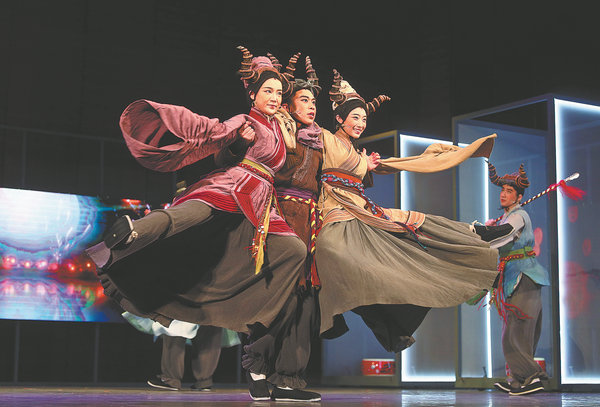
The primary inspiration for the performance also was a figure of mirth — an ancient pottery statue of a comedian or jester beating a drum. The statue, dating to the Eastern Han Dynasty (25-220), is one of the most popular artifacts in the museum's Ancient China exhibition.
The museum's purpose in hosting the play was to collaborate with other cultural and educational institutions to bring cultural relics to life. Teachers and students at the Communication University of China performed in the presentation.
The 56-centimeter-tall statue is characterized by its wide smile and an animated pose — he holds a flat drum with one arm and a drumstick in the opposite hand, and he raises a leg in an exaggerated movement.
The figure, excavated from a tomb in Sichuan, is evidence of what historians say was a common practice among royalty, aristocrats and other members of high society thousands of years ago. They would employ resident comedians to entertain themselves and guests. The custom can be dated as far back as the Spring and Autumn Period (770-476 BC).
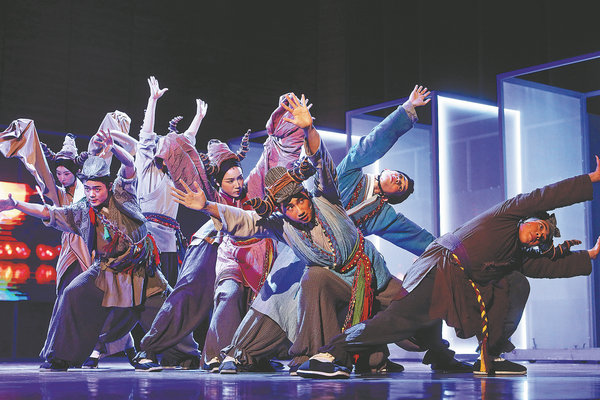
The hour-long play, performed from May 26-28, focused on the lives of those performers, who struggled at the bottom of the social strata, trying to make a place for themselves in the homes of the upper class. They worked hard to cheer up their masters by cracking jokes, singing and telling folk tales, often while beating a drum. But the jesters also had to compete for attention with menke, the retainers in ancient times who also owed services to the same masters.
The play also includes scenes in which the comedians revel in talking and singing about the lives of ordinary people and in suggesting that their masters — the rulers and policymakers — make improvements. There is evidence of this in historical records, experts said.
Yang Yang, the play's producer and director, says the show was meant to help more people learn not only about the clay figure itself, but also about ancient Chinese art and culture, which reached a pinnacle in the Han Dynasty (206 BC-AD 220).

"The music, the acrobatics and many other kinds of baixi performing arts that thrived in the Han Dynasty have been incorporated into the plot." Baixi is a historical term for a wide variety of such arts.
Yang, a professor at the Communication University of China, says producing the play inspired great creativity among her collaborators. While they sought help from researchers at the National Museum of China for historical details, they also added elements of imagination and, especially, pop culture, such as rap and the giant panda craze, to enrich the dialogue and singing and to help people relate to the show.
Liu Min, who directed the play's visual arts, says they adopted the minimalist style of the stage of classic Chinese opera: "We designed six 'light boxes' on the stage, resembling the museum showcases, in which performers can act and which were to connect different scenes and chapters of the play. And a long LED screen in the background showed patterns from the pictorial bricks of the Han Dynasty to give audience a vivid sense of history."
The bricks were carved and painted with pictures and were part of tombs and ancestral temples.
Yang says the production was an exploratory effort of the museum to diversify the presentation of their collections, for teachers and students to renew ways they apply knowledge, and an approach to appeal to people of different ages.