Fragile, slender leaves spawn a rural attraction









Time-honored tradition
When he was 19, Yu became an apprentice learning to fry tea leaves in iron pots heated to more than 200 C.
Now, the 54-year-old is well aware that his hometown's time-honored tea growing tradition is an asset that deserves to be cared for for years to come.
According to local chronicles, some 1,270 years ago, Great Master Faqin created Jingshan Temple and planted there a few tea bushes as offerings to Buddha.
Over the years, the tea spread throughout the valleys and developed a unique, fresh flavor, becoming what is known today as Jingshan tea.
The monks of Jingshan Temple collected the tea leaves during the Grain Rain, the solar term marking the end of Spring, and stored them in small pots to serve others and for their own use as they dwelled on Buddhist doctrines.
"The tea leaves have properties such as refreshing spirits and the ability to improve one's eyesight," Yu said,
Soon after, the tea culture flourished.
Japanese monks who furthered their studies in Hangzhou, then called Lin'an and the capital of the Southern Song Dynasty (1127-1279), brought tea-making techniques and teaware back to the island country, which inspired the Japanese tea ceremony.
"It's no exaggeration to say that Jingshan mountain spawned the Japanese tea ceremony," Yu said, and he added that even today, Japanese monks and tea lovers make pilgrimages to the village to trace their cultural roots.
Revival
With the gradual decline of the temple starting in the 14th century, the ceremonious drinking rituals surrounding Jingshan tea were almost lost.
It was only about 50 years ago that Zhejiang tea industry insiders started attempting to revive the planting of the tea and its drinking rituals, the latter of which were designated as part of the national intangible cultural heritage in 2011.
Jingshan tea now is the center of a sprawling industry, which Yu said is worth more than 3 billion yuan ($421 million).
To boost added value, Yu said, the village has acquired organic certification for its 200 hectares of tea plantations.
It expanded the spectrum of its products from just green tea to also include black tea, and other derivatives such as pomelo-flavored tea leaves and tea powder.
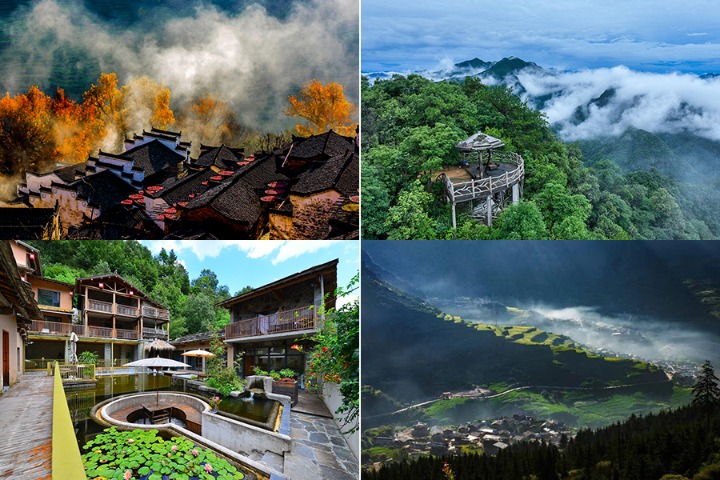
Jingshan village has also built on its cultural heritage and has transformed itself into a resort complete with homestays and workshops.
To achieve that, village authorities called on locals to tear down high walls and replace them with idyllic fences as part of a broader effort to improve the aesthetic experience.
The village has renovated some deserted farmhouses and repurposed them into workshops and cultural classrooms.
In these, a range of courses are offered. They include introductions to tea-drinking rituals; handwork courses about making chaxian, a brush-like tool used to foam the tea; and diancha, a tea-making technique that resembles the technique of latte art.
"We want tourists to come, sit down and hear the story of Jingshan tea's past and present," he said.
In the run-up to Dragon Boat Festival, which falls this year on June 22, the tea master said the village is bracing for an influx of tourists, in part because the traditional Chinese festival — like many others — is usually celebrated with tea drinking.
"We're planning activities that can give visitors an immersive experience, including allowing them to wrap tea-flavored zongzi here in the village," Yu said, referring to the treat for Dragon Boat Festival, which usually comes in a tetrahedron, an elongated cylinder or cone shapes.
It is usually made of glutinous rice with various fillings, wrapped in bamboo or reed leaves and either steamed or boiled for a few hours.
On a recent workday, Jia Lei, who works in the real estate sector in Shenzhen, Guangdong province, was among the scores of visitors loitering about in the village after a tour to the temple.
"I first heard about the place through a friend of mine," he said, adding that he was on a pilgrimage to learn about rural development ideals. "Jingshan village is a poster child for China's rural construction."
A tea lover himself, Jia only learned about the village's merging of tea and Buddhist culture when he arrived.
The 50-year-old treated himself to a sip of the tea and found it exceeded his expectations.
"It's quality tea."