



Transatlantic alliance a troublemaker in trouble









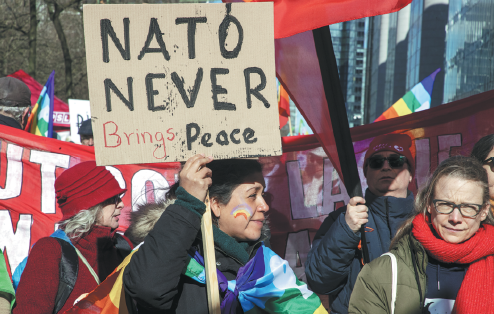
The North Atlantic Treaty Organization was established at the dawn of the Cold War in 1949. The transatlantic military alliance was formed "to keep the Russians out, the Americans in, and the Germans down", as NATO's first secretary-general Hastings Lionel Ismay said. NATO was established to perpetuate the US' military hegemony over Western Europe, provide a US security umbrella for the Europeans and make them dependent on the US for security-related issues.
Initially, NATO comprised 12 countries, but soon Greece and Turkiye (in 1952), and West Germany (in 1955) joined the alliance.
France, incidentally, was always cautious about too much US influence in Europe. In March 1966, France even announced its intention to withdraw from NATO's integrated military command structure and requested the removal of all Allied headquarters from French territory. A new Supreme Headquarters Allied Powers Europe was established in Casteau, Belgium, in 1967, and the NATO headquarters was moved to Brussels in October of the same year.
After the end of the Cold War, the disintegration of the Soviet Union and the dissolution of the Warsaw Pact, NATO lost its primary goal, with many saying that the transatlantic alliance, too, should be dismantled. But under then US president Bill Clinton, Washington pushed forward the idea of NATO's expansion by including former socialist states into the organization and extending not only NATO's reach but also US influence over Eastern and Central Europe, even though verbal guarantees were given to the Soviet Union in the late 1980s that after the reunification of Germany, NATO will not expand eastward.
The NATO's expansion, particularly the April 2008 Bucharest summit decision on the future accession of Ukraine and Georgia into NATO, triggered a new confrontation between Moscow and the West (especially Washington) and is one of the primary reasons for the Russia-Ukraine conflict, which broke out in February 2022.
Since NATO's establishment, many leaders of member states have questioned the necessity of the organization. In November 2019, French President Emmanuel Macron made his famous remark about Europe seeing the "brain death of NATO", saying Europe should start thinking of itself strategically as a geopolitical power in control of its own destiny.
However, the Russia-Ukraine conflict and the complete rupture of Russia-West relations seem to have injected a new lease of life into NATO. Declaring Russia a strategic threat to the alliance, NATO seeks to give a new meaning to itself, with the US pushing NATO to take a more anti-China approach, inserting into the alliance's strategic documents anti-China rhetoric and seeking to extend NATO to the Asia-Pacific.
NATO plans to open a liaison office in Japan in 2024 to coordinate strategic moves with close partners across the "Indo-Pacific region", including Australia, the Republic of Korea and New Zealand, while the alliance and Japan plan to strengthen cooperation to tackle cyber threats, disinformation, and emerging and disruptive technologies.
The US seeks to use the Russia-Ukraine conflict to consolidate its hegemonic hold over Europe, sending a clear message to its European members that Europe faces a serious threat from Russia, and China, without a US security umbrella. But despite the US' efforts to present its policies as fair and necessary, below-the-surface issues continue to define the organization.
One such contentious area is the candidate for the next NATO secretary-general's position. After months of struggle, the NATO states decided to continue with Jens Stoltenberg as secretary-general for another year, which temporarily halts the jockeying between candidates and countries that compete for the White House's support.
The struggle shows the lack of unanimity in the alliance and, at the same time, proves the role of the US as the ultimate decision-maker of NATO.

The views don't necessarily reflect those of China Daily.
If you have a specific expertise, or would like to share your thought about our stories, then send us your writings at opinion@chinadaily.com.cn, and comment@chinadaily.com.cn.





