Cultural administration trying to tackle ticketing issues









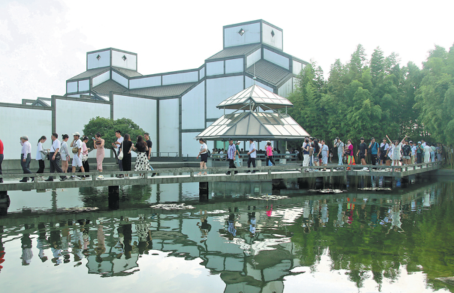
On July 13, the Beijing Public Security Bureau announced that it has punished nine ticket scalpers who snapped up a number of free tickets to the National Museum of China and sold them to tourists, making a tidy profit for themselves, while limiting access to tickets for would-be visitors.
This is just one of the measures authorities are taking to solve a problem being faced by many people, who are finding it increasingly difficult to get tickets to museums and galleries, especially during holiday periods, says Liu Yang, director of the museum and antique department of the National Cultural Heritage Administration.
He mentioned the incident during a news conference held in Beijing on July 28, at which officials of the administration elaborated on what has been done in recent years, especially since last year's 20th National Congress of the Communist Party of China.
In 2022, China registered 382 new museums, bringing the total number to 6,565 nationwide. Throughout the year there were 34,000 exhibitions and nearly 230,000 educational activities held, receiving 578 million visits, according to Liu.
He also mentions a recent survey of 45 large and medium-sized museums in China, which include some top level national and provincial level institutions. This shows that the phenomenon of ticket scarcity often occurs at famous and popular museums, reflecting "the contradiction between the ever-growing spiritual and cultural needs of the people and unbalanced and inadequate high-quality cultural supply", says Liu.
He mentions many museums, like the National Museum of Classic Books and the Military Museum of the Chinese People's Revolution, have extended their opening hours and increased the cap on the number of visitors they receive. Some others, like the Palace Museum and Sichuan Museum, have opened special ticket booking and entry channels for underage, old and disabled people to shorten their queuing time.
In the future, a blacklisting system to punish ticket scalpers will be established, and tourist guides' work will be standardized to optimize visits.
Li Qun, director of the National Cultural Heritage Administration, introduced to assembled media the latest discoveries of a comprehensive national research program to trace the origins of Chinese civilization, which was launched in 2001.
According to Li, in 2020, the fifth session of the program kicked off, with the participation of more than 500 researchers from 29 institutes nationwide studying eight subjects. In the following years they have made important discoveries.
For example, discoveries have been made in some central settlement sites, like the crisscrossing road network unearthed at the Erlitou site in Luoyang, Henan province. The site is widely believed to have been the capital of the Xia Dynasty (c. 21st century-16th century BC) during its latter stages. Six new sacrificial pits have been found at the Sanxingdui site in Guanghan, Sichuan province, with 12,000 artifacts unearthed.
Moreover, they have made important breakthroughs in the methods used to measure the time period of ancient sites, to restore the ancient natural environment in a more accurate way to reveal its role in the origin and formation of the Chinese civilization, and in understanding ancient economies and their relationship with social development, says Li.
The archaeological progress is not only important academically, but also serves urbanization and social development, according to Deng Chao, director of the artifact and historical site department of the National Cultural Heritage Administration. He says archaeological sites are becoming important cultural landmarks and tourist destinations. For example, UNESCO World Heritage Sites in China receive more than 300 million annual visits, while national archaeological ruins parks receive 34.6 million visits a year.
wangru1@chinadaily.com.cn