



Japan draws up whitewash plan to salvage image









Misplaced prioritization suggests lack of confidence over toxic water release
Japan plans to strengthen the monitoring and analysis of information about the discharge of nuclear-contaminated water from the Fukushima Daiichi Nuclear Power Plant into the ocean and is seeking extra funding to step up public relations efforts at home and abroad.
The Japanese foreign ministry intends to include approximately 70 billion yen ($474.21 million) in its budget request for the next fiscal year to combat the spread of information it believes to be incorrect regarding the ocean discharge, Japanese public broadcaster NHK reported. It also plans to enhance strategic external communication.
Specifically, this includes expanding monitoring to detect so-called fake news and strengthening the capacity to disseminate information that the Japanese government believes to be accurate. The ministry also plans to utilize artificial intelligence for information collection and analysis, the report said.
Before taking the above measures, the Japanese government devoted a lot of effort in whitewashing its decision to release nuclear-contaminated water into the ocean.
Tokyo has set up a 30-billion-yen fund with the aim of minimizing the reputational impact associated with the ocean discharge. The fund has been used nationwide to support the expansion of seafood sales channels, temporary purchase and storage of seafood, and public relations activities related to the Fukushima plant's contaminated water.
Publicly available information indicates that the fund has so far supported 16 public relations projects. The maximum support for these projects totaled 2.7 billion yen.
Winning bidders of the projects include the Yomiuri Shimbun Group, the Distribution Economics Institute of Japan, and JR East Marketing & Communications.
"The government should spend more money finding better ways to deal with the nuclear-contaminated water, rather than trying to promote the idea that the radioactive water released into the ocean is safe," said Michiko Ueno, 64, a resident of Chiba Prefecture.
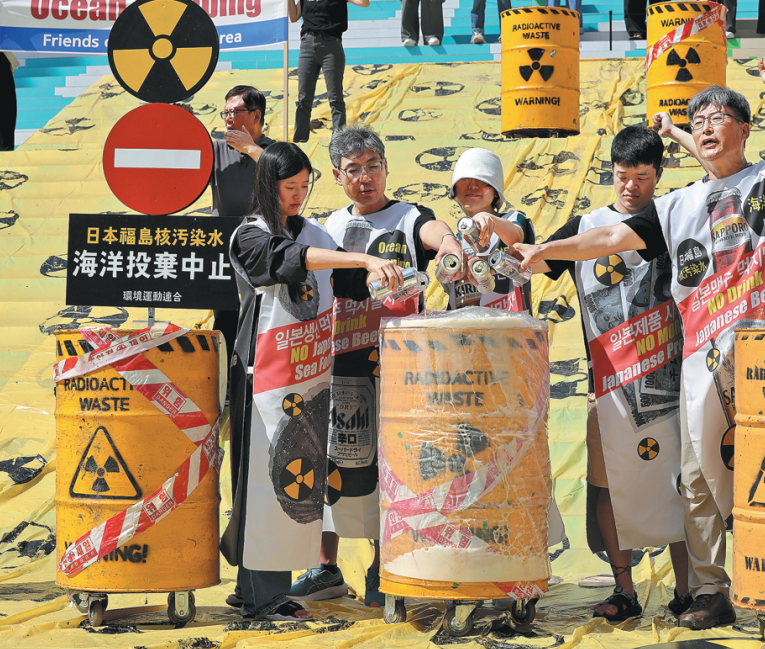
Given that various types of radioactive substances remain in the contaminated water, Ueno is concerned about the safety and health issues that may arise from the discharge. She joined a protest in Tokyo on Sept 6 and urged the government to spend money to develop methods to properly remove radioactive substances from the contaminated water so that it does not have to be discharged into the sea.
"Discussions in the Japanese media about alternative solutions for Fukushima's contaminated water are not enough. The government should thoroughly explore various solutions together with all stakeholders, including local fishermen," she said.
Since Japan announced plans to release the toxic water over two years ago, the legitimacy, legality, and safety of the plan have been continuously questioned by the international community.
Managing public perception
Japan needs to manage public perception to address major concerns about the long-term reliability of the filtration system that is expected to remove multiple radionuclides from the water, the accuracy of data related to the contaminated water, and the effectiveness of ocean-discharge monitoring arrangements, said Chen Xiang, an associate research fellow with the Institute of Japanese Studies at the Chinese Academy of Social Sciences.
"Japan is aware that with the release of nuclear-contaminated water into the sea, there is a likelihood of unpredictable ecological damage and harm to human health, necessitating proactive public relations efforts to address these issues in advance. Therefore, the public relations expenditure is aimed at salvaging Japan's national image to prevent a collapse of reputation," Chen said.
Zhang Yulai, vice-president of the Japan Institute of Nankai University, said: "The Japanese government is allocating a significant amount of funding toward public relations instead of addressing the issue. This misplaced prioritization suggests a lack of confidence in its ocean discharge plan, as the Japanese government could have been more transparent by sharing information more extensively and inviting relevant organizations for full-process monitoring."
Li Ruoyu, a visiting research fellow at the Institute of Japanese and Korean Studies at Sichuan Normal University, said Japan can hardly achieve the goal of enhancing the tolerance of ocean discharge globally with the 70.1-billion-yen budget because the international community, which has access to various information, will raise questions about why the Japanese government insisted on ocean discharge rather than adopting alternative solutions.
jiangxueqing@chinadaily.com.cn










