Scientists help combat desertification woes, promote UN goals









The great achievements made by Chinese scientists in curbing desertification have been extended to Africa, through the adoption of practices and technologies accumulated over the past decades for the prevention and control of desertification in the continent.
"Some research teams in China have already had successful experiences in the prevention and control of desertification, and restoration of desert and salt marsh areas, which are badly needed by some African countries," Zhang Linxiu, director of the United Nations Environment Programme-International Ecosystem Management Partnership, or UNEP-IEMP, said.
"Such international cooperation not only helps solve desertification faced by African countries, but also promotes the realization of the United Nations' goal for global sustainable development."
Chinese scientists are cooperating with their counterparts in some African countries seriously impacted by desertification, such as Mauritania and Nigeria, in the research and control of desertification, and have made some progress, Zhang said.
In Mauritania, Chinese scientists have introduced tree and grass species that are suitable to grow in the desert, and efforts have been made to promote the use of unique techniques to fix shifting sand near the country's capital. Under the Ecosystem-based Adaptation (EbA) projects of UNEPIEMP, 450 hectares of desert in the country have been ecologically restored over the past 10 years.
Wang Yongdong, a researcher in desertification control and prevention at the Xinjiang Institute of Ecology and Geography of the Chinese Academy of Sciences, said the institute has been participating in the research and the prevention and control of desertification in Mauritania, Nigeria and Ethiopia for more than 10 years.
Control and prevention
"We planned to promote the techniques we used in China to these countries for desertification control and prevention, but each country has its own climate and conditions, so we have made some effort to innovate and develop unique methods for the prevention and control of desertification for each country," he said.
In Ethiopia, some areas saw serious soil erosion due to land degradation, so Wang said researchers from the institute adopted water conservation techniques they used in China so water can be stored during the rainy season and used in the dry season.
The researchers also taught herdsmen how to remove invasive bushes that are hostile to farm animals and how to nurture grass on degraded land, so that they can still rely on the land for a living while curbing desertification.
After years of working with the authorities in Ethiopia, 3,800 hectares of degraded land in the country has been restored, and grass have been restored on 50,000 hectares of land that previously had hostile bushes growing on it. This has benefited more than 40,000 locals, Wang said.
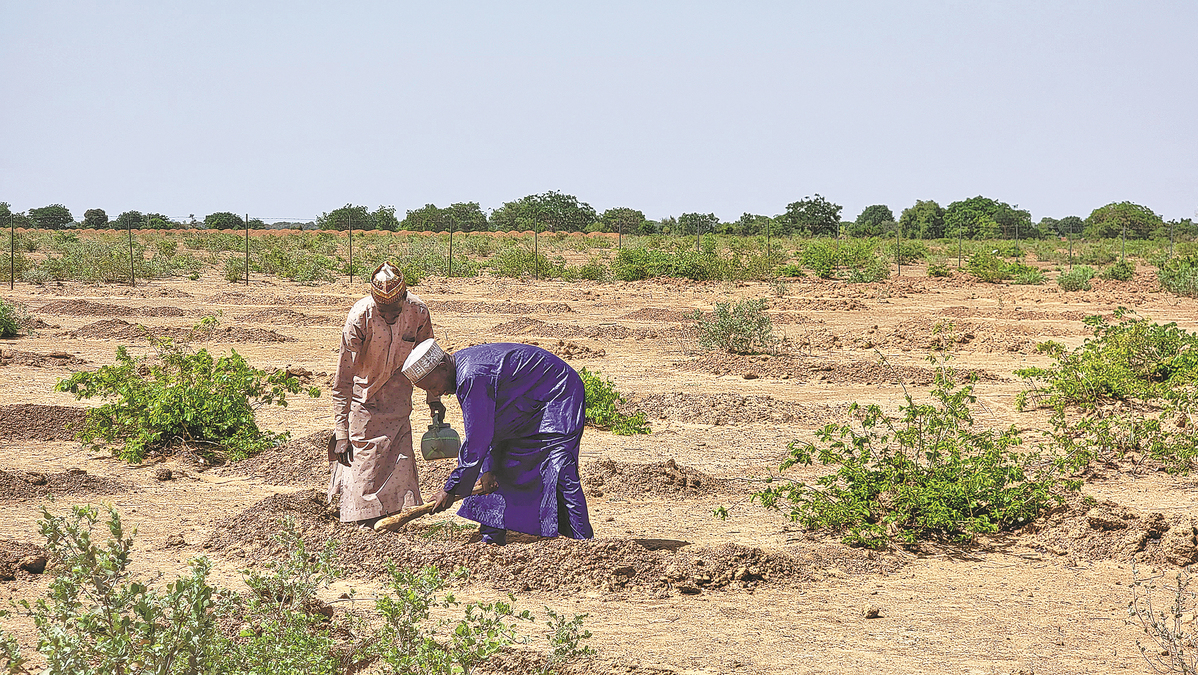
In Kano, a city in northern Nigeria on the southern edge of the Sahara Desert, the Chinese Academy of Sciences has been working on a project with villagers to try to stop desert sand from encroaching onto their homeland.
Launched last year, the project sits on about 4 hectares of land near Gwarmai village and is part of the African Union-led Great Green Wall Initiative in Nigeria. The plot of land, fenced with barbed wire and planted with various kinds of small trees, is intended for research and demonstration of desertification control in Kano. Eventually, the project is expected to expand so a green wall will be built between Kano and the Sahara, the world's biggest desert.
Bala Muhammad, a villager who works as a gardener for the project, said he fetches water twice a day, in the morning and afternoon, from a borehole about 1 kilometer away to water the small trees planted on the land.
Although the village is at least 20 km away from Sahara Desert, Muhammad fears it will eventually become part of the desert if nothing is done.
"In recent years, there is less rain due to climate change, and the land has become drier and yield has lessened," he said.
"I hope in a few years the trees will grow big and they will help to reduce the temperature in the area and reduce land erosion and landslide."
Musa Haruna, another villager who lives near the project site, said there needs to be more support from the local government to prevent and control desertification, and much bigger areas should be planted with trees to prevent the desert from encroaching onto six nearby villages.