Born in Beijing in 1920, Zao gained admission to the Hangzhou National College of Art (now known as the China Academy of Art) in 1935, and following his graduation in 1941, took up a role as an instructor at the institution.
He received a traditional Chinese education and training in calligraphy from childhood. While studying at the Hangzhou National College of Art, he embraced the artistic principles of Lin Fengmian and Wu Dayu, which blended Eastern and Western influences, and was deeply influenced by impressionism, as well as paintings by Cezanne, Matisse and Picasso.
"I sought to express movement, its slow, haunting motion, or its dazzling flashes. I wanted to make the surface of the canvas vibrate thanks to contrast, or the quivering of a single color," Zao once said.
In 1948, he left for France to pursue further studies. When he arrived in Paris, his paintings were still expressions of life memories. However, in 1951, while living in Switzerland, he saw the paintings of Paul Klee, which led to an epiphany about the creative potential of traditional Chinese culture. Inspired by oracle bone scripts and bronze inscriptions, he used imaginary characters as compositional elements to create form and space in his paintings.
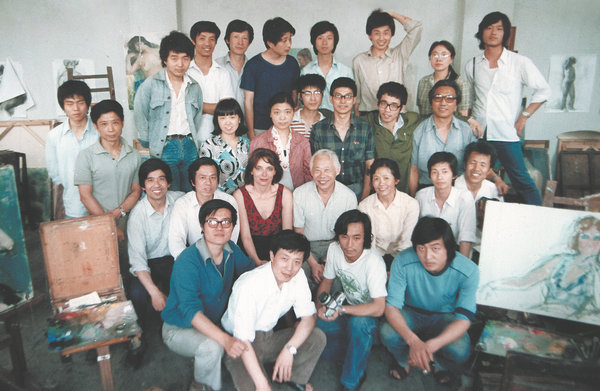
In 1985, the Ministry of Culture invited Zao to return to his alma mater to host the Zao Wou-Ki Painting Workshop, which enabled him to pass on his painting experience and insight, contributing to contemporary Chinese art and art education.
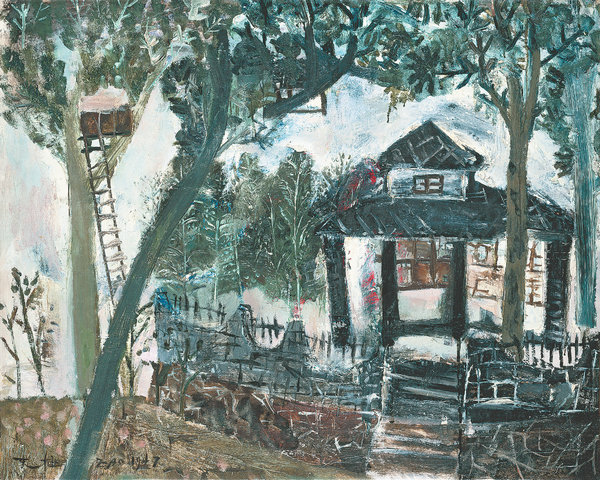
Xu Jiang, general adviser of the exhibition, recalls that, in the summer of 1985, he studied with Zao at his workshop for a month.
Reminiscing about his time spent at the workshop, Xu says he will cherish the candid conversations students shared with Zao, while seated around him during the breaks between sketching sessions.
"He was a man of few words, but the main point he tried to make was that we needed to learn from the outstanding traditions of our nation, from the first-rate masters across the world, and that we should combine both aspects and inject our own individual traits. Only in this way would we be able to naturally integrate every aspect in order to form our own style, which should not be local, but rather global," Xu says.
He remembers that Zao once said, "When you start to paint, you might as well forget everything, just like when meditating. Allow your emotions and personality to rise to the surface and connect to the painting through your hands. A painting needs to breathe just as much as a person."
Since 1958, Zao's works were mostly titled by the date they were completed. Xu thinks they can be seen as journals of his circumstances. "There was homesickness, bereavement, anxiety and despair in these works," Xu says.
In the spring of 1989, Xu and several classmates from the academy workshop paid Zao a visit at his Parisian home.
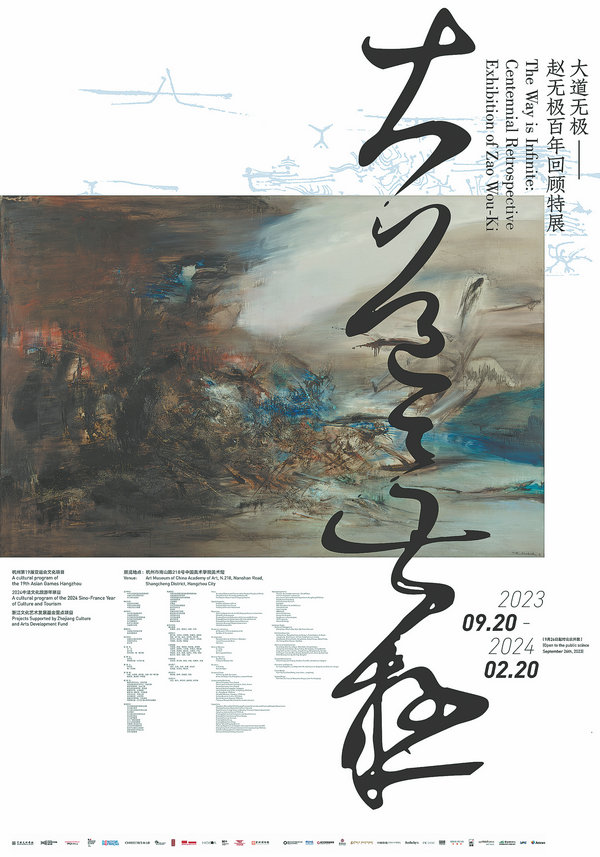
"Zao pointed at his well-insulated studio and told us that he was always caught up in a struggle there," Xu says.
"Sometimes, a large painting fell on him, which trapped and 'buried' him for as long as 10 minutes," Xu recalls, adding that Zao's sincere pursuit of great art was "a kind of indulgence during the journey of his soul".
In recognition of his exceptional contribution, Zao was honored with lifelong membership of the Academie des Beaux-Arts in Paris in 2002. He passed away in Switzerland in 2013.
For Gao, Zao's later work became more unadulterated, similar to the purity that modernist poets advocated. "In his later years, Zao's free, optimistic and careless state of mind manifested itself in a more tranquil, spiritual, glorious and noble expression in his paintings," he says.
Gao recalls that Zao once said that everybody is bonded by one tradition, while he, by two. "His art embodies Chinese and Western cultural traditions," Gao explains, adding that Zao deftly navigated the waters of ancient, modern, Eastern and Western art, serving as a cultural bridge between Chinese classics and Western modernity.
"Painting was as natural and indispensable to him as breathing," Gao says.