


Strokes of genius
Few others can boast the centuries of cultural influence of Wang Xizhi, whose work, thanks to the medium of rubbing, has obsessed emperors and laymen alike for nearly two millenniums, Zhao Xu reports.










Few others can boast the centuries of cultural influence of Wang Xizhi, whose work, thanks to the medium of rubbing, has obsessed emperors and laymen alike for nearly two millenniums, Zhao Xu reports.
On a spring day in 353, Wang Xizhi, who would go on to become the greatest Chinese calligrapher of all time, invited 41 of his closest and most eminent friends to his foothill garden abode in what today is Shaoxing city, East China's Zhejiang province.
There, in a place known as the Orchid Pavilion, they were seated alongside a winding brook, the halting flow of which carried cups of rice wine downstream. Whenever a cup came to a hesitant stop, the nearest person was required to imbibe its contents before coming up with a poem.
Challenging as the game was, the group reveled in it, producing a total of 37 pieces collectively known as "the Poems Composed at the Orchid Pavilion".
Wang, dutifully playing the role of the host, wrote a preface for the collection, which almost three centuries later endeared itself with Li Shimin (599-649), the second emperor of the Tang Dynasty (618-907), so much so that the emperor sought it out before taking it with him into his own burial ground.
"However, today we are still able to appreciate the profound beauty of both Wang Xizhi's words and brushstrokes, thanks to the efforts of those who either copied his work on paper, or inscribed it into stone to make rubbings," says Wang Yi, an ancient rubbing expert from the Palace Museum in Beijing.
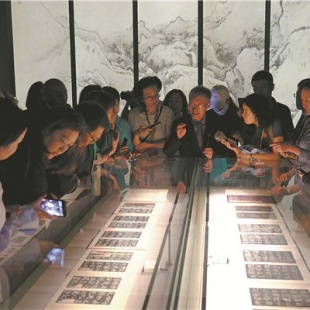
Fourteen of those rubbings, all from the Song Dynasty (960-1279), are currently on display at the museum, shedding a tantalizing beam of light onto an enduring cultural phenomenon.
"A lot had happened between Wang Xizhi composing his preface and the varied rubbings being taken from various stones, all bearing the same name. The more I study them, the less adequate I feel to talk about them in any conclusive way," the curator says.
First of all, no one knows for sure whether the original Preface had ever been etched onto the stone before its suggested disappearance underground, although many scholars believe that it never was. If this is indeed the case, then all the rubbings of the Preface that have ever existed in history must have been made from stone inscriptions based either on one of the handmade paper copies or a previous rubbing that could ultimately be traced back to one of those handwritten copies.
It is believed that Li Shimin, after getting hold of the Preface, ordered some of his best contemporary calligraphers to make — presumably more than a few — copies of it, to share with his important court officials.
"During the Tang Dynasty, there were typically two ways to make a copy of a calligraphic piece by hand. One could put a piece of semitransparent paper over the original writing and trace it. Or, one could try to imitate the brushstrokes based on his own understanding," says Wang Yi.
"While the first way typically led to a replication in the true sense of the word, with the second way, a calligrapher could choose adhering more closely to the original piece, or incorporating a little bit of their own personal style."
Rock of ages
Those who had tried their hand at doing so included Chu Suiliang, Yu Shinan, Feng Chengsu and Ouyang Xun. Of the previous three, the Palace Museum today holds copies tentatively attributed to them, although scholars debate their authenticity, as they do over the exact means these men had employed for the task. (Some have suggested a combination of both the aforementioned techniques.)
Ouyang composed what is considered today to be the earliest extant rubbings catalog. Keeping that in mind, it's only fitting that his transcription was reportedly inscribed into stone upon the edict of Li Shimin.
Although all the other hand copies were believed to have been given the same treatment at one point or another, it was Ouyang's copy that has made the biggest impact in the world of making and collecting rubbings.
"The popularity this version enjoyed during the Song Dynasty had a lot to do with the discovery at the time of its original Tang Dynasty stone inscriptions," says Wang Yi.
By that time, the inscribed stone tablet had already been subjected to enough tumult: After having stood for centuries inside Tang palaces, being admired by generations of scholar-officials, the stones were removed from the Tang capital Chang'an (modern-day Xi'an city, Shaanxi province) to Bianzhou (modern-day Kaifeng city, Henan province), the newly ordained center of power for the Later Liang (907-923), the first of the five short-lived dynasties that occupied central China upon the fall of the Tang in 907.
In 947, the stones were taken on a northward journey by a Khitan emperor whose horseback warriors had defeated and terrorized the central dynasties. When the emperor died mid-journey, the stones were left behind by those who apparently had failed to recognize their cultural significance.
Another century had passed before the stone's rediscovery in Dingwu (modern-day Dingzhou, Hebei province), about 80 kilometers from where the Khitan leader had died. Although this was hardly the end of the stone's trials, it has since been known as the Dingwu stone, and all rubbing copies traceable to it, the "Dingwu version".
It didn't take long before the Dingwu stone became a treasure of the Song Emperor Huizong (Zhao Ji, 1082-1135), who has gone down in history as a hugely talented artist-calligrapher who knew very little about the art of governance. Consequently, the Northern Song Dynasty (960-1127) under Zhao Ji was characterized by an unfortunate combination of cultural prowess coupled with political and military insouciance.
In 1127, with the capture of Zhao Ji and his son Zhao Huan by the empire's nomadic enemy from the north, the Song court, having lost large tracts of land, was forced to relocate to the south of the Yangtze River, where it would stay for another one and half centuries, until it was swept off the table of history by the Mongols in 1279.
"Since there was no longer the original Dingwu stone, those living to the south of the river felt free to make their own — one for each (cultured) family," wrote the influential painter-calligrapher Zhao Mengfu (1254-1322). Born a quarter of a century before the fall of Southern Song (1127-1279), Zhao spent the prime of his life acting as a trusted court official and adviser to the Mongol rulers of the Yuan Dynasty (1271-1368). A devotee to the Preface, here Zhao was referring to the Dingwu stone going missing during the humiliating retreat of the Song court which, perhaps not so surprisingly, turned its new base "south of the river" into a fertile ground for the cultural revival already set in motion. (The Song Dynasty entered its Southern period, also called the Southern Song Dynasty, in 1127, with its previous incarnation conveniently known as the Northern Song Dynasty.)
"During the Southern Song, the commissioning of calligraphy rubbings had become a largely private undertaking, with a strong ego factor attached to it," says Feng Xiaoxia from the Palace Museum, who also contributed her knowledge of ancient rubbings to the current exhibition.
"People who constituted the society's educated elite, or aspired to that status, prided themselves on the ownership of rubbings associated with master calligraphers. A copy of the Preface is a proof of taste."
Thus recut stones were made, based on previous rubbings that may or may not be plausibly traceable to the original Dingwu stone, the whereabouts of which was all but a mystery. There were, of course, many other stones made, based on either rubbings or hand copies that had identified themselves, sometimes not so convincingly, with other, equally able Tang Dynasty transcribers of Wang Xizhi's original writing — Chu Suiliang, for example.
"For those that have survived the ages, the circumstances surrounding their production and inheritance may never be fully known to us. Yet what is truly impressive is the cultural phenomenon to which they attest," says Feng. "Never has there been another age when a single piece of art played such a prominent role in social life."