



US advised to reduce trade curbs on China
National security 'de-risking' not a real change from 'decoupling', economist says









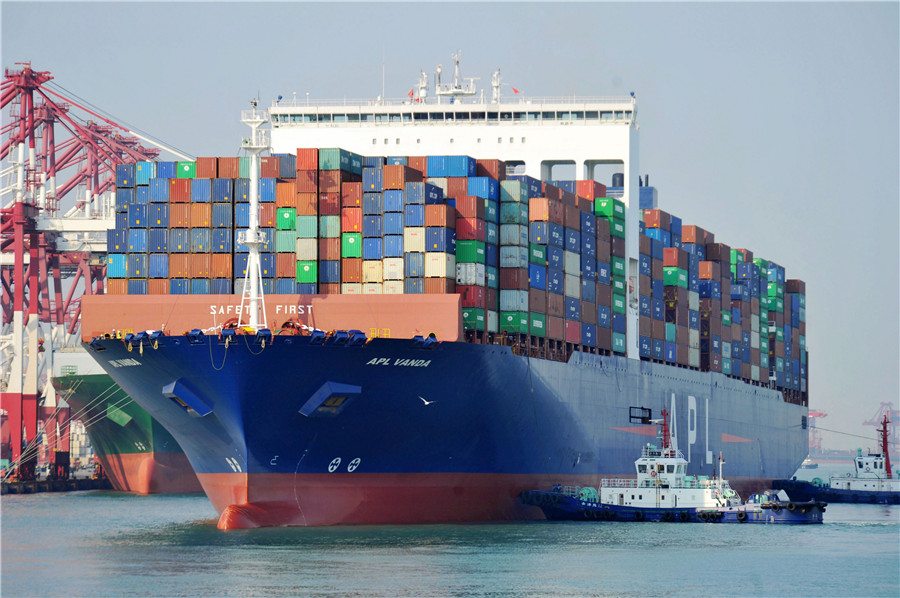
An economist in the United States has expressed concern that the country will restrict trade with China in goods unrelated to national security, such as electric vehicles and batteries.
"The US government should dramatically reduce the scope of Section 301 tariffs and carefully explain the rationale for any new national security trade or investment restrictions," said Gary Hufbauer, a senior fellow at Peterson Institute for International Economics in Washington, DC.
"Moreover, the US government should welcome Chinese students who want to study in US universities, and Chinese professors who are offered US faculty positions of teaching or research," he said.
While such steps should be taken, Hufbauer said that, because of politics, "it probably will not happen".
"Maybe a few products will be taken off the 301 list and exempted, but not a lot of products the way I recommend," he added.
Section 301 of the US Trade Act of 1974 authorizes the president to take action, including tariff — and nontariff-related, "to obtain the removal of any act, policy or practice of a foreign government that violates an international trade agreement … and that burdens or restricts US commerce".
On Jan 18, agents of the US Department of Homeland Security searched Harco Manufacturing Group in Moraine, Ohio, which was acquired in 2015 by the Chinese company Qingdao Sunsong. The department said the search was "part of an ongoing federal investigation".
In September, members of a US House of Representatives committee sent a letter to Homeland Security Secretary Alejandro Mayorkas, accusing Qingdao Sunsong of moving some of its production to Thailand to avoid US tariffs.
The lawmakers described the action as "a serious violation of US law and undermining American economic and national security".
"What they assert is that because this Chinese company has a subsidiary over in Thailand, and the Thai company is selling to the United States, it must be some kind of evasion," Hufbauer said. "I don't agree with that at all."
"They're just trying to create a big storm where there isn't a storm," he said.
In an email to the US website Axios, a spokesperson for the Chinese embassy expressed firm opposition to "some in the US (who) are attempting to politicize and weaponize trade issues between China and the US".
Hufbauer cited a summary written by Mary Lovely, a professor emeritus of economics at Syracuse University and a senior fellow at the Peterson Institute, on a recent meeting centered on the auto industry and hosted by the Federal Reserve Bank of Cleveland in Ohio.
He said the United Auto Workers union and the auto parts industry were seeking protection against electric vehicles and batteries from China, which "has nothing to do with national security".
US officials such as Treasury Secretary Janet Yellen and Commerce Secretary Gina Raimondo are pushing back on the concept of "decoupling" advocated by what Hufbauer described as congressional "China hawks" and instead emphasizing "de-risking". Hufbauer said the latter term is merely a more polite one.
In future meetings with their Chinese counterparts, if Yellen and Raimondo are specific about what national security "de-risking" covers and what it does not, that will influence how the Chinese government views the sincerity of the policy, Hufbauer said.
"China will be very skeptical that 'de-risking' is any different from 'decoupling' — just a different word, but not a real change," he said.
"If the officials from the US agree with the officials from China that automobiles and batteries are not national security items, that will be very persuasive," he said. "But if they hedge on that and say, 'Well, maybe it's national security'... I think the Chinese authorities will rightly say, 'Oh, this is just a word game'."
Regarding the prospects of China-US trade, Hufbauer said he expects relatively peaceful relations during the rest of the year.
"For the year 2024, I do not see much danger of further decoupling. This is the positive outcome of high-level meetings," he said. "The year 2025 will depend on the US presidential election in November 2024."










