China's ethnic groups make jolly melodies for New Year
Local cultural traditions merge with Spring Festival to enrich celebrations across the country, Zhao Ruinan reports.









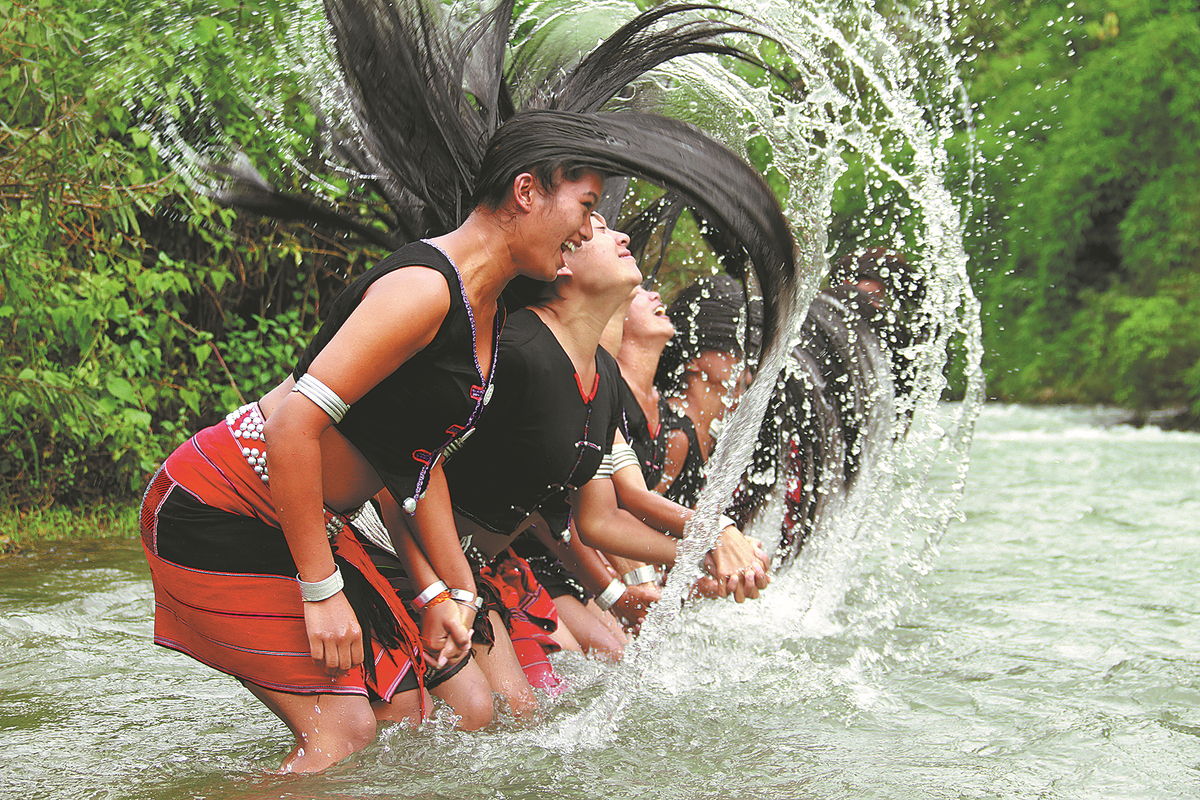
This unity is reflected in the Dong ethnic culture as the ethnic group celebrates two New Year's festivals — their own and that of the Han people.
Before the lunar calendar was introduced to the Dong, New Year's celebrations were already taking place. Traditionally, they consider the completion of agricultural activity after the autumn harvest to mark the beginning of a new year — around the end of the 10th month or the beginning of the 11th month of the lunar calendar.
"From the second day of Lunar New Year until the 15th day of the first lunar month, we have a village celebration every evening," said Meng Yongfan, Party secretary of Guangnan village in Longsheng county in the Guangxi Zhuang autonomous region.
Meng described how Dong villagers sing folk songs and play the pipa. Every evening, the village's auditorium hosts a "fantastic" show, whose participants are chosen from among the villagers by casting lots. The selected group is responsible for the evening's performance until the 15th day of the first lunar month. Every evening features a lively Dong cultural feast.
"Do not underestimate the troupes in each village. These groups, consisting of just five or six members, or maybe a dozen, encapsulate the essence of minority culture," said Huang Zhongjing, a folk customs expert in the county.
"Folk culture significantly influences our daily lives, from the food we eat to the clothes we wear, the places we inhabit and the way we move," Huang said. "Cultural troupes showcase our lives through their performances. For instance, the dragon lantern dance, which originated more than 1,700 years ago, is performed during Spring Festival to honor the dragon for saving lives, to pray for rain and to seek blessings."
Over time, the event evolved into a form of entertainment, sports and dance.
"Now, during festive occasions, the cultural troupe will perform dragon lantern dances in many situations," Huang said.
Professor Zhong said the celebration of Spring Festival across various ethnic groups affirms social unity and shows respect for ethnic differences. Also, in addition to serving as carriers of the cultural traditions of ethnic minorities, the rich and colorful festival customs have become a significant draw for tourists in recent years.
Students from major universities across the country visit Guangnan village regularly for pleasure and study, listening to Dong folk songs and admiring the traditional architecture. Many characteristic festival activities have become attractions.
In Tuanbao town in Lichuan, Hubei province, more than 200 tourists gathered at the Fenshui Resort to experience the unique customs of the Tujia ethnic group as the people greet the new year and say goodbye to the old.
For the Tujia people, ciba, a glutinous rice cake, is an essential element of Spring Festival.The process of making it is hard work, as the glutinous rice must be soaked in water for at least three days and washed three times until clear.Then, it's steamed for at least an hour before being put into a stone tank for men to pound, taking turns with wooden hammers.
"It was my first time making ciba," said Xiong Xiumei, a resident. "We all took turns pounding the rice. It was a lot of fun."
Along with making ciba, traditional New Year's customs for the Tujia and Miao ethnic groups include slaughtering pigs and enjoying a special soup called paotang. These customs have evolved into a rich set of folk activities and have become a significant attraction for tourists in the town.
After a busy morning, with pig's blood and meat cooking, the official paotang soup ceremony begins.
The feast involves serving seven large bowls and eight large plates filled with various dishes made from fresh parts of the pig. The traditional activity marks the successful conclusion of the year's harvest and serves as a prayer for favorable weather in the coming year.
Traditional sports activities — spinning tops, jumping rope and kicking shuttlecocks — were also organized at night during shousui, a custom in which people stay up all night to ward off evil and disease and welcome a new year.
A tourist commented: "Attending this event not only allowed us to experience the culture of ethnic minorities, listen to the unique mountain folk songs of Lichuan and play with spinning tops but also gave me a deeper understanding of the culture and customs of the Tujia and Miao minorities. The experience was completely different from a typical sightseeing tour."
Minzu University's Zhong believes that promoting the ethnic groups' customs will help preserve and develop cultural heritage and attract tourists from other regions.
"It is important to support and preserve traditional ethnic festivals and their unique celebrations, such as the Dai water-splashing festival in Yunnan, which was popular last year," Zhong said.
Xishuangbanna, Yunnan, received more than 2 million tourists in April, a 300 percent increase over the previous year. They brought in revenues of around 2.12 billion yuan ($295 million).
Dai people, clad in traditional costumes, danced and sang while splashing water on each other as a prayer for good fortune and to express good wishes.
"This will promote mutual understanding and exchanges among various ethnic groups," Zhong said. "For example, many tourists from non-ethnic minority areas will have a better understanding of local minority cultures. At the same time, exchanges between tourists and locals will diversify local culture. This is a two-way interaction and integration."
Palden Nyima in Lhasa, Li Yingqing in Kunming, Shi Ruipeng in Nanning and Liu Kun in Wuhan contributed to this story.
Contact the writer at zhaoruinan@chinadaily.com.cn



- Former Xinjiang herder discovers prosperity and passion on the ski run
- Young railway staff on track for Spring Festival travel rush
- China prosecutes 11,000 people repatriated from northern Myanmar over telecom fraud
- Striking iron flower ignites Pudong skyline
- Enhanced airport services ease chunyun journey
- Chinese railways handle 12.24m trips on 1st day of Spring Festival travel rush