Globalization not reversed
The resilience from developing countries' opening-up has become a critical force for resisting rather than driving the anti-globalization movement by some developed nations









The resilience from developing countries' opening-up has become a critical force for resisting rather than driving the anti-globalization movement by some developed nations
Since the turn of the century, rising globalization and inequality have fueled anti-globalization sentiments. Events such as trade wars, geopolitical conflicts and COVID-19 have caused global trade declines, sparking concerns about globalization's reversal. However, the global trading system showed resilience, swiftly recovering from shocks.
In less than two years post-COVID-19, global trade rebounded to pre-pandemic levels, with developing countries leading a robust recovery, particularly in South-South trade.
Despite the growing outcry against globalization in developed countries including the United States and European countries, such calls are relatively weaker in developing nations. Over the past three decades, developing countries' weighted average tariffs have been declining, from nearly 40 percent to around 15 percent.
Why can developing countries display great resilience in crises?
To start with, participating in global value chains has reduced developing countries' domestic income inequality.
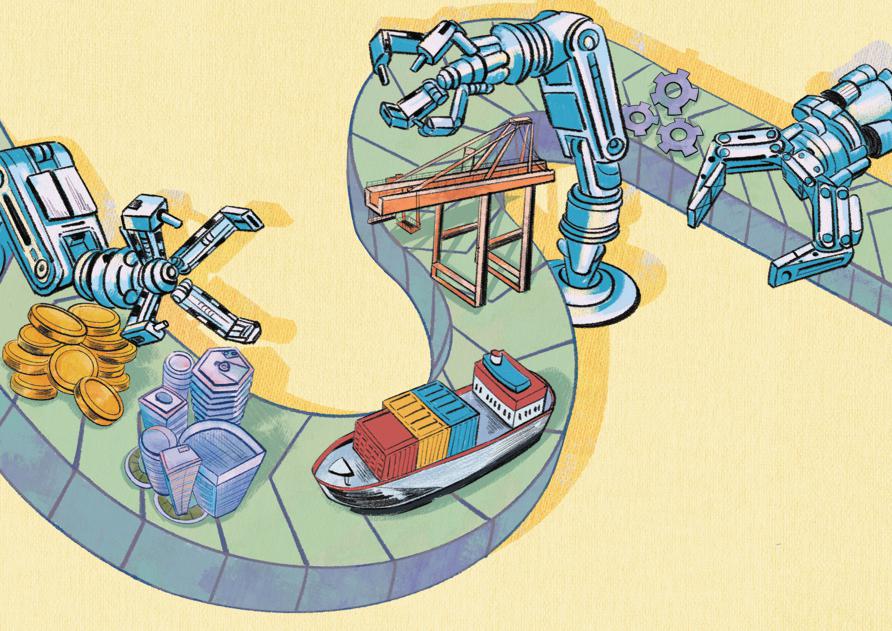
Global value chains have provided developing countries with a new means of industrialization and a new way of integrating into the global economy, which helps them elevate their level of economic development.
Developing countries can take part in the process of globalization without having comparative advantages in finished products or the entire industry — they only need to produce parts and components in certain production process.
Global value chain participation can create more job opportunities for workers and attract a large amount of foreign direct investment, thus helping developing countries "make the cake bigger".The United Nations Conference on Trade and Development has found that economies with fastest growing participation in global value chains have GDP per capita growth rates 2 percentage points above the average.
In the meantime, participating in global value chains helps increase the incomes of low-skilled workers and narrows the income gap in society. According to the World Inequality Database, over the past three decades, the average income inequality level of developing countries has increased during the first two decades and then declined in the past decade.
Second, the upgrading along the value chains will increase inequality within developing countries.
However, with their ascent along the value chains, the income gap between low-skilled workers and high-skilled ones has been widening, increasing domestic income inequality. Therefore, despite the enormous opportunities from global value chain participation, developing countries will face more difficulties in striking a balance between equality and efficiency as they seek to move up the value chain.
Third, overall, global value chain participation has reduced pressure within developing countries for protectionism.
Facing shocks from global value chain participation, developing countries are not inclined to resort to protectionist trade policies such as tariffs and import quotas. That's because developing countries face completely different situations from developed ones.
On the one hand, their economic opening-up brings more benefits to labor-intensive industries and low-income workers; therefore, they face less pressure in income distribution than developed countries, thus restraining the domestic outcry for protectionist policies. More importantly, as their global value chain participation advances, trade relations between countries are becoming increasingly complicated and protectionist trade policies can hardly protect the domestic market. It is because of the less-intense contradiction in domestic income distribution that developing countries display a stronger desire for economic opening-up than developed ones.
On the whole, global value chains have not only enhanced economic interdependence between countries, but also consolidated the social foundation within developing countries for supporting economic opening-up, thus strengthening their resilience in economic crises and making them staunch supporters of economic globalization. Developing countries have become a critical force for defending globalization, rather than a driver of the anti-globalization movement, which greatly reduces the risk of globalization going into reverse.
That said, as developing countries climb up the global value chains, income inequality within these countries will continuously worsen, resulting in greater pressure for them to roll out protectionist trade policies. When facing growing pressure from globalization, developing countries should attach greater significance to the adjustment of domestic policies.
First, for labor-intensive developing countries, gains from global value chain participation outweigh the associated risks of losses.
Global value chain participation could enhance productivity, increase exports and create job opportunities, which help mitigate domestic contradictions and effectively maintain their economic stability and sustainable development.
Second, when pursuing upgrading along the global value chains, developing countries need to pay more attention to the adverse impacts of technological progress on low-skilled workers and its social impacts.
A country's efforts to achieve industrial transformation and value-chain climbing will likely worsen income inequality. Income inequality exerts a crucial impact on social cohesion and political stability, and is thus an important premise of whether globalization can advance.
Last, the conventional protectionist measures, such as tariffs, have a limited effect in tackling inequality — adjusting domestic social policies will play a bigger role.
Countries should promote the re-employment of low-skilled workers, put in place social protection measures, and adopt long-term measures such as strengthening education and vocational training.
In the meantime, they should adopt more flexible social protection measures to reduce the cost of inequality in the short run and prevent industrial transformation from further worsening income disparities. By doing so, they could better adapt to globalization and steer its course in the right direction to achieve more sustainable and inclusive growth.
Zheng Yu is a professor at the School of International Relations and Public Affairs at Fudan University. Ye Zi is a PhD student at the School of International Relations and Public Affairs at Fudan University. The authors contributed this article to China Watch, a think tank powered by China Daily. The views do not necessarily reflect those of China Daily.
Contact the editor at editor@chinawatch.cn.