Powering seafood farming with natural gas









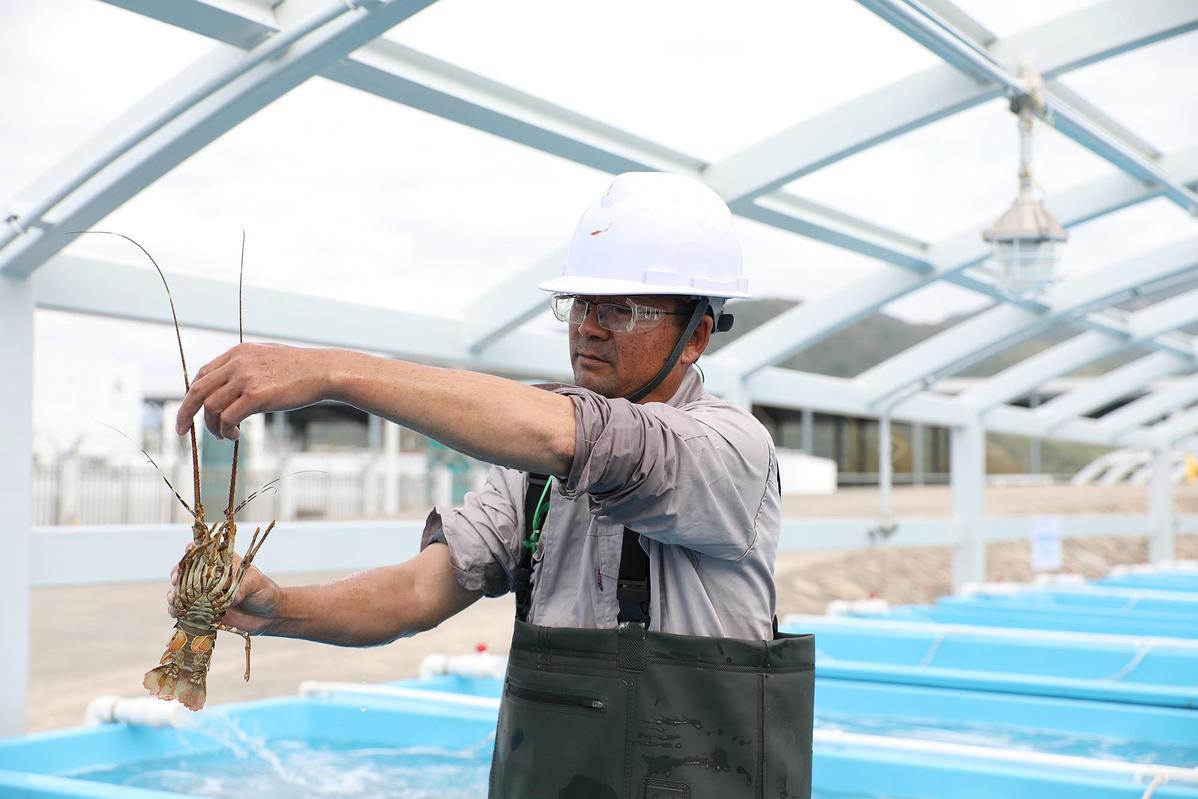
The gelid temperature of minus 161.5 degrees Celsius is cold enough to kill any sign of life on the planet. A group of engineers in Shenzhen, however, has found a way to turn extreme cold into warm cradles for breeding lobsters, groupers, abalones and other delicacies destined for the dining table.
At the scenic Dapeng Bay in eastern Shenzhen, the Guangdong Dapeng LNG (liquefied natural gas) Terminal is experimenting with aquaculture and cold energy.
The "secret sauce" that provides the engineers the confidence to farm seafoods is frigid water. "The terminal discharges about 450,000 cubic meters of cold water into the sea every day," says Niu Junfeng, senior manager of energy technology at the China National Offshore Oil Corp Guangdong Dapeng LNG Co.
This huge amount of chilly water comes from Niu's daily routine — regasifying LNG. After being collected from underground, natural gas is cooled down to minus 161.5 degrees C into liquid form for storage and transportation.
After being transported to terminals, like the one at Dapeng, the LNG is converted into gas again. These terminals are usually built near the sea and use seawater temperature for the regasification process. As a result, the temperature of the used seawater is lowered by around five degrees, Niu explains.
In Guangdong province, the poured cold water makes the seawater near the terminal stay normally between 15 and 25 degrees, depending on seasons, which is preferable for the growth of certain high-value aquatic products, he says, adding that the quality of the seawater at Dapeng Bay is first-class under national standards.
In collaboration with a local aquaculture company, the terminal started aquafarming last year by placing immature fish, lobsters and abalones into cold water tanks to improve the quality of their meat. After 40 days' observation, their growth indexes were found to be stable, showing they had fully adapted to the new environment, says Niu.
The terminal held a ceremony on Feb 3 to celebrate its successful aquaculture experiment. Hao Yunfeng, president of the CNOOC Guangdong Dapeng LNG Co, said the project is expected to have an annual output of 50,000 kilograms of seafood.
"The cold energy used is equal to 1.97 million kilowatt-hours of electricity, leading to a reduction of 1,800 metric tons of carbon dioxide emissions per year," says Hao.
With the support of the provincial and local governments, the company plans to extend the farming to open waters near the terminal.
According to Niu, the company is also exploring other ways to use cold energy, such as for making ice and cold-chain transportation.


- China's netizens surpass 1.12 billion, with 602 million generative AI users: report
- Chinese scientists identify core pathological brain network underlying Parkinson's disease
- Top political advisor meets Taiwan delegates to CPC, KMT think tank forum
- Taiwan public opinion says CPC-KMT think tank forum benefits cross-Strait peace
- Insurance fraud by psychiatric hospitals under probe
- Xi, Laos' top leader announce launch of friendship year