



US beats hollow drum of democracy









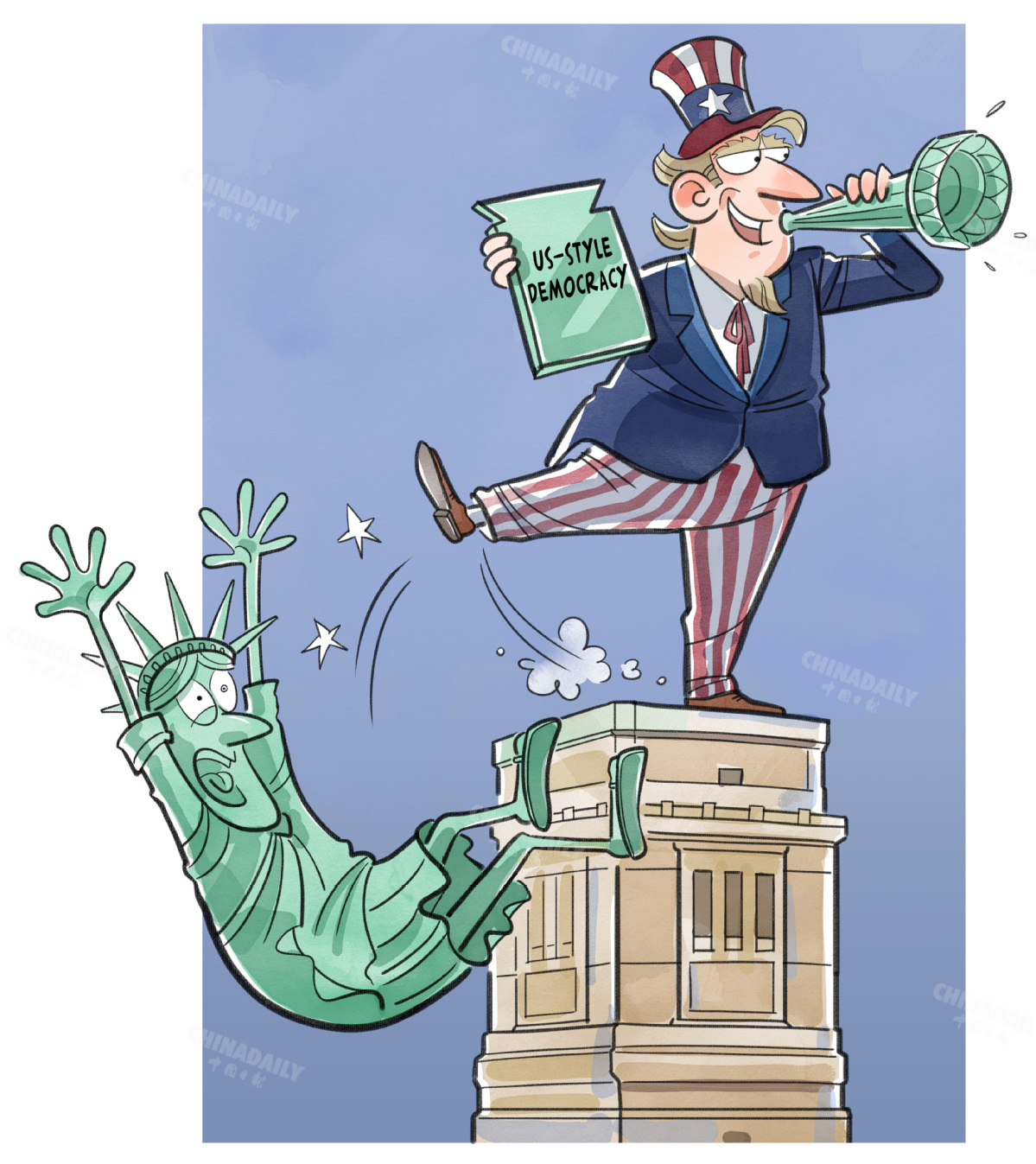
The West often tries to differentiate China from developed Western countries using the narrative of democracy versus authoritarianism, which has become particularly evident since the United States started hosting the annual Summit for Democracy as a means to counter what it perceives are authoritarian regimes. The move reflects the US' Cold War mentality and reveals its desperation to rally other Western countries' support to build a front against China. Yet the move also exposes the US' underlying fear of its waning global hegemony.
The democracy-versus-authoritarianism narrative in the West is rooted in binary thinking; it is the product of an us-versus-them mindset. US political scientist Samuel P. Huntington claimed there "can be no true friends without true enemies. Unless we hate what we are not, we cannot love what we are". The identification of friends is contingent upon the identification of enemies. This dichotomous thinking is rooted in the monotheistic exclusivity of Christianity, where non-believers are deemed heretical. In the US, this mentality extends to forming alliances against perceived adversaries, particularly countries in Eurasia.
But the binary between democracy and authoritarianism is fundamentally flawed. After the end of World War II, the West waged a Cold War against socialist countries like the Soviet Union and China, because progressive elements in Western societies were influenced by the socialist ideology, placing the US and its allies at a disadvantage.
To counter this, the CIA launched a propaganda and psychological warfare to demonize socialist countries. Interestingly, at that time, the West did not identify itself as democratic because socialism was widely regarded as being truly democratic. Instead, the West proclaimed itself to be the "Free World" to neutralize the advantages socialist countries enjoyed for being democratic.
And what did the West's touted freedom entail? Essentially, free-market capitalist ideology. According to scholars like French historian Fernand Braudel and US sociologist Immanuel Wallerstein, capitalism operates as a law of the jungle where the strong prey on the weak. Wallerstein even argues that capitalism is a dangerous anesthetic that most civilizations throughout history, especially the Chinese civilization, have sought to resist.
The West began including democracy into its narrative only after the collapse of the Soviet bloc. Scholars like Francis Fukuyama heralded the "end of history", claiming history would culminate in the Western liberal democratic system. But Fukuyama borrowed the concept of "end of history" from his mentor, French philosopher Alexandre Kojeve, who lamented that the world's history would end up in crass materialism, leading humanity back to the Middle Ages.
Can the West claim democracy as its own while labeling China as authoritarian? The premise of identifying China as authoritarian and the West as democratic is spurious to say the least. In recent years, the decline of US hegemony has exposed the chaos in US democracy — where money dictates votes, racism runs rampant, and party politics polarizes society.
Under US-style democracy, the democratic rights of ordinary people are superficially manifested in periodic voting, and politicians make empty promises during election campaigns only to backtrack on them after winning. The essence of US-style democracy is that capital reigns supreme and dictates democracy. Therefore, US-style democracy is the imposition of authoritarianism by the rich and powerful on the people at home, and maintenance of US hegemony globally.
Confucius said, "If names be not correct, language is not in accordance with the truth of things". China's whole-process people's democracy is truly representational and people-centric democracy. Democracy in China means the people are the masters of the country.
The ongoing annual sessions of the National People's Congress and the Chinese People's Political Consultative Conference National Committee are a manifestation of whole-process people's democracy. China consults various sectors of society before making major decisions, and strives to reach a consensus on common issues through consultative democracy, which complements electoral democracy in which people exercise their rights by voting.
Consultative democracy is a unique feature of socialist democracy; it coordinates the consultations of the Communist Party of China, the National People's Congress, the government, the CPPCC National Committee, people's organizations, grassroots bodies and social organizations.
Whole-process people's democracy is manifested in China's governance and the measures it takes to help people realize their aspiration for a better life. Rooted in Chinese tradition, it emphasizes that the results reflect the morality of good deeds. It is a comprehensive, process-oriented form of democracy, making it the most genuine and effective form of democracy.
Whole-process people's democracy prioritizes virtue and focuses on the long-term interests of society. On the other hand, the "democracy" which the West follows is a form of democracy that is dominated by money and power.
The fundamental distinction between China and the US, therefore, lies not in democracy versus authoritarianism, but in democracy versus hegemony, and a people-centric versus money-centric political system.
The author is a senior fellow at the Taihe Institute, a think tank based in Beijing, and a senior research fellow at the National Strategy Institute, Tsinghua University. The views don't necessarily reflect those of China Daily.
If you have a specific expertise, or would like to share your thought about our stories, then send us your writings at opinion@chinadaily.com.cn, and comment@chinadaily.com.cn.





