



Tibet's democratic development an inevitable choice









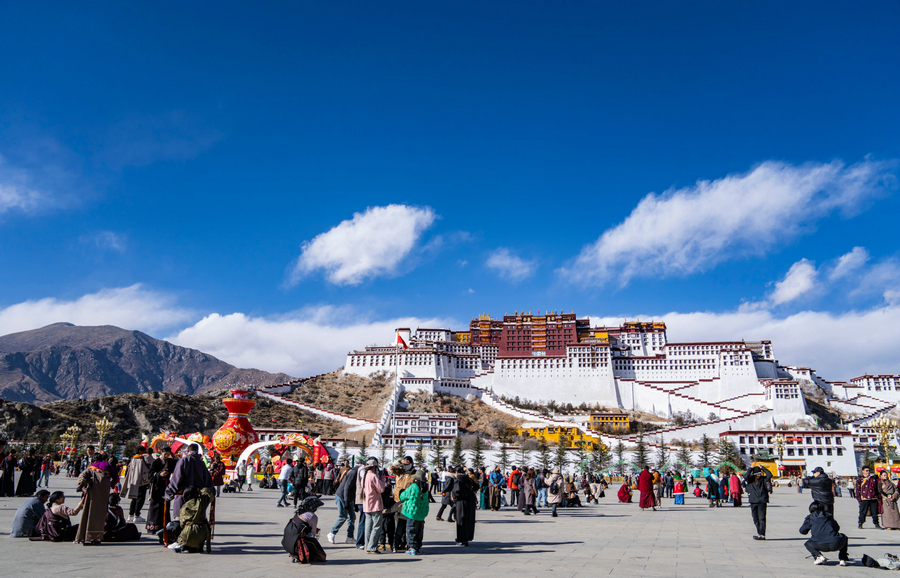
The azure sky, towering snowcapped mountains and clear rivers, these are all hallmarks of Tibet, the characteristic features of "Shangri-La". However, in the past, the feudal serfdom of Tibet was so dark, barbaric and cruel that it denied people even the basic freedoms and hindered social development. In 1904, Edmund Candler, a British journalist who visited Tibet, wrote that the Tibetan people were still in the medieval era, not only in their political and religious aspects, in their severe punishments, witchcraft, the practice of identifying reincarnated lamas, and enduring torture by fire and boiling oil, but also in all aspects of their daily lives.
The feudal serfdom in Tibet started in the late ninth century and matured after the 14th century, profoundly influencing the region's social structure and people's lives. In the first half of the 20th century, while slavery had been abolished in most parts of the world, the feudal system continued to dominate Tibetan social structure, subjecting the Tibetan people to suffering as serfs and slaves. From the local Tibetan people to Westerners, including litterateurs, and officials from the interior visiting Tibet, they all meticulously recorded the suffering of the Tibetan people.
In old Tibet, the population mainly comprised serfs, slaves and serf owners, with the serf owners accounting for about 5 percent of the total population, while the remaining 95 percent were essentially serfs and even more miserable slaves. These serfs were destined to serve their "owners" from birth, and were subjected to oppression and untold hardship.
The serf-owners had almost all the powers in society, including the making of laws, which often were enacted to favor them. Worse, the serfs were subdivided into different categories, with the lowest ranks essentially no different from slaves.
As for the Dalai Lama, he used his theocratic position to hold the power of life and death over the serfs. No wonder US scholar Melvyn C. Goldstein said that religion and the monastic establishment were heavy shackles on Tibetan social progress.
In 1951, the Tibetan people welcomed Tibet's peaceful liberation. And the entry of the People's Liberation Army and a large number of central government officials into Tibet liberated the masses, with the Tibetan people praising the PLA personnel as "living bodhisattvas".
From 1951, Tibet's theocratic feudal society began to disintegrate. But the 14th Dalai Lama's group planned to launch a rebellion so it could maintain the feudal serfdom and enjoy its privileged position. But on March 10, 1959, the upper-level reactionary group in Tibet, with support from foreign forces, disrupted the"17-Article Agreement" and launched an armed rebellion. On March 20, 1959, the central government issued instructions on democratic reform, emphasizing that democratic reform must rely on the laboring people, and the land owned by the local government of Tibet must be distributed to the farmers. All debts, corvee, and feudal levies must be abolished.
On March 28, 1959, the State Council, China's Cabinet, issued an order to dissolve the original local government of Tibet, with the Preparatory Committee for the Xizang autonomous region exercising the powers of the local government of Tibet, and marking the disintegration of the old political order in Tibet and taking charge of the situation by a million former serfs.
The abolition of the feudal serfdom led to the emancipation of the former serfs, marking the end of the suffering of the Tibetan people and ushering in spring. The democratic reform in Tibet is a landmark event in Tibetan history. The Communist Party of China led the people in implementing extensive land reform and engineering social change, abolishing the feudal system and facilitating the rebirth of all ethnic groups in Tibet. The reform, needless to say, was wholeheartedly supported by the Tibetan people.
The liberation of the Tibetan serfs is one of the landmark events in Chinese history, as well as an important milestone in achieving national unity and ethnic solidarity. In commemoration of this historic event, the Xizang autonomous region designated the "Tibetan Serfs Emancipation Day" in 2009, in order to remember history, honor the martyrs, promote the national spirit and uphold the unity and progress of all ethnic groups in Xizang.
The Serfs' Emancipation Day is not only an important turning point in Tibetan history but also a milestone in the Chinese people's struggle for national liberation and progress. The day has been designated to review and commemorate the abolition of the feudal serfdom in Tibet and the historic moment of a million serfs gaining freedom.
The day also showcases the firm determination and positive achievements of the Chinese government in safeguarding human rights, promoting social development, and helping deepen the international community's understanding and recognition of China's development path. At the same time, the day portrays a good image of China on the international stage and lays a solid foundation for friendly cooperation between China and other countries.
The author is a researcher at the Institute of Borderland Studies, the Chinese Academy of Social Sciences.
The views don't necessarily reflect those of China Daily.
If you have a specific expertise, or would like to share your thought about our stories, then send us your writings at opinion@chinadaily.com.cn, and comment@chinadaily.com.cn.





