Exploring the vibrant life of China's elderly









Before I came to China last autumn, I had spent several years studying Chinese language and culture, and I felt like I had a good overview of what might surprise me after moving here. However, certain things always managed to evade the scope of textbooks and television shows. For example, I was shocked by the vibrant life of the elderly and the differences in culture between the younger and older generations in China.
It's not just the natural variances in their daily routines and lifestyles, which are to be expected anywhere in the world. There is something much more prominent: how different age groups interact with public spaces.
During my routine strolls around the neighborhood, I would often stumble upon scenes that diverged from my expectations. I might encounter someone cooking a meal on a portable gas stove placed in the middle of the pavement. Sometimes, I might stop and join a crowd gathered around a chess or card game. Then there were the occasions where I would pass by individuals taking afternoon naps on a bench, watching TV dramas with blaring speakers, or simply listening to classical music on a radio.
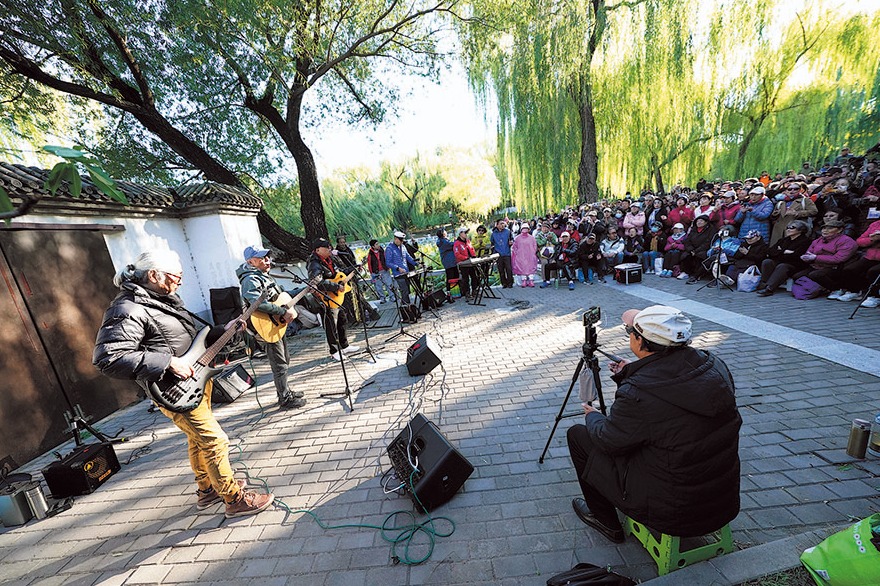
Whenever I enter a park, there are always people exercising in various ways: from brisk walkers to tai chi practitioners and sword dancers, and music can always be heard, whether it's from someone playing a flute or even coming from a choir! On the weekend, I often encounter a group dance with over a hundred participants, accompanied by another few dozen onlookers who, like me, are perhaps too shy to join. And in the evening after I returned home, I can still hear the dance music coming from the park, which is a reminder of the lively social gatherings that persist late into the night.
Remarkably, the one common aspect of all these experiences is that they are all from the older generation.
The elderly in China are lively and have vibrant lives. Even my old neighbor, who struggles to walk, still manages to climb down five floors to join his friends in the circle of chairs outside while drinking tea from their thermoses, talking about me — the weird foreigner passing by, looking at them with curiosity.
To the elderly, the park is not only a place to go for a walk on a sunny day, but it is also a locale to socialize, dance, exercise, play badminton, practice an instrument, take a nap, or play a game of chess. All of these activities, which make good use of public spaces, truly embody the term "public space".
The younger generation in China, however, is less likely to partake in this form of public life to the same extent. That is not to say there aren't young people out in public spaces, but rather that they don't utilize these spaces in the same manner.
Even after six months of living in China, I am still amazed as to how this phenomenon of elderly people and their cultural interactions in public spaces differs from my native country of Norway.
Norwegian culture is more reserved, and this becomes even more evident regarding older generations. When taking a walk in the park in Norway, for instance, you will see fewer elders engaged in social activities or exercise routines than in China.
Of course, the elderly in Norway do socialize, but not like their counterparts in China. My conclusion when comparing these two cultures is that Chinese elders are far more socially active, and they fully embrace the concept of public space.
There is a saying in Norway that states, "We are all children of our time", meaning that we are all shaped by the time and space in which we grew up. When considering the drastic changes and rapid development of China in the past century, it is no wonder that the social lives and cultural practices of its younger and older generations are so divergent. Each generation in China grew up in a vastly different socio-economic landscape, and they are shaped by these landscapes.
This disparity is much more prominent than that in Norway, which has experienced relatively small social changes within the same time span.
When I think about my retirement years, I can't help but envision a life like that of retired people in China. I imagine waking up early to get groceries, taking a walk in the park, doing some stretches, chatting a bit with my friends, joining a group dance, taking a nap on a park bench, and then making dinner on the pavement while observing the passersby — just as I observe them now.
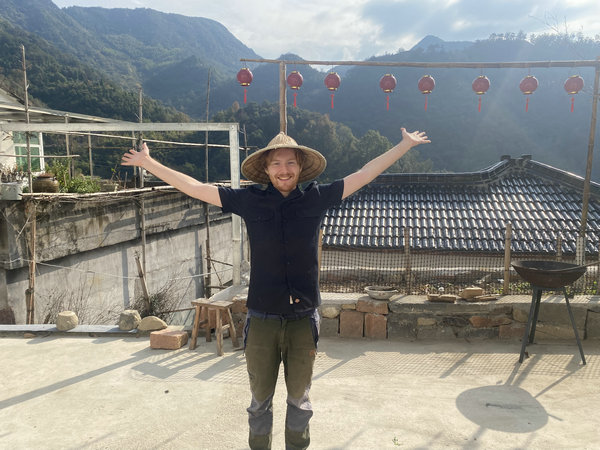
Written by August Hagen, a 22-year-old Norwegian who is passionate about learning Chinese language and culture. He is currently studying for a master's degree in Chinese language and culture at Fudan University in Shanghai.