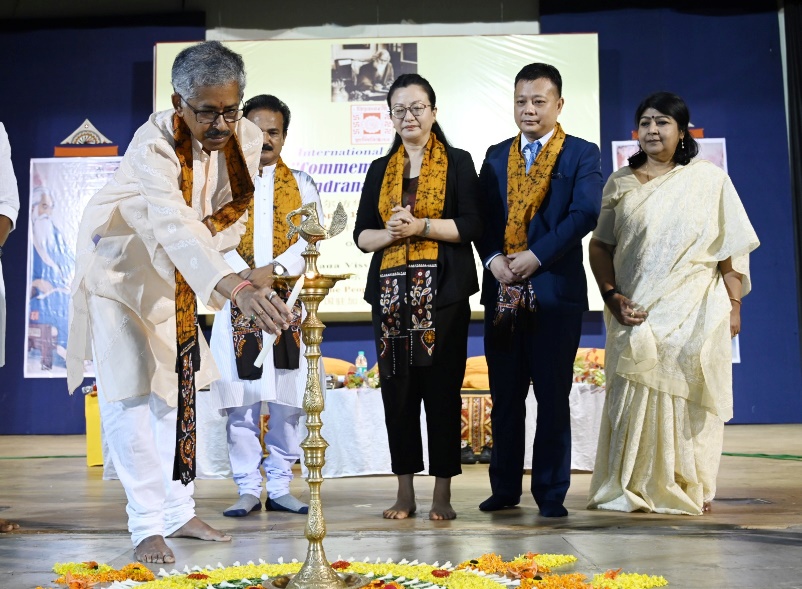
The flowers of China-Indian friendship, advocated by Gurudev Rabindranath Tagore Ji, the renowned late Indian poet, author, scholar, and philosopher who founded the Visva-Bharati University, are a great legacy for us and future generations, Ma Jia, chargé d'affaires of the Chinese Embassy in India, said earlier this week.
A two-day international conference on "Commemorating the centenary of Rabindranath Tagore's visit to China" was held at the Cheena Bhavana of Visva-Bharati University, Santiniketan, in India's eastern West Bengal state on April 1-2.
The Indian scholar's successful maiden visit to China in 1924 has been a milestone event in the history of China-India friendly exchanges, she said.
Ma noted that Tagore Ji said with joy during his visit to China that he always felt that "India has been one of China's extremely close relatives, and China and India have been enjoying time-honored and affectionate brotherhood".
Tagore Ji is an old friend of the Chinese people, and he always had special and friendly feelings towards China. He made remarkable contributions to promoting cultural exchanges between the two countries and enhancing friendship between the two peoples, Ma said.
The two countries should uphold the spirit of Sino-Indian friendship and brotherhood, Ma said. China views its relations with India from a strategic and long-term perspective and has always been committed to bringing bilateral ties back to the track of sound and stable development.
"China-India relations suffered some setbacks in recent years. This is not what we want to see, nor is it in the fundamental interests of our two countries and two peoples," she said.
Some people focus on the differences between China and India, and cast doubt on the bilateral relations, and some even deny the significance of past friendly exchanges between the two countries, Ma said, adding that such stance is unfair to our predecessors and those who have made great efforts to promote China-India friendship.
Tagore Ji awakened the national consciousness of the Eastern countries to resist Western colonialism, called for justice and peace, and supported the Chinese people in the struggle against foreign aggression, Ma said.
When accepting the Nobel Prize for Literature in 1913, Tagore Ji said, "Man is not to fight with other human races, other human individuals, but his work is to bring about reconciliation and peace and to restore the bonds of friendship and love."
The two-day international conference commemorating Tagore Ji's centenary visit to China is an earnest effort aimed at advancing healthy Sino-Indian ties, experts at the conference said.
During his visit to China, Tagore Ji said, "I shall consider myself fortunate if, through this visit, China comes nearer to India."
Tagore Ji tried to realize his dream of making the world meet at his beloved Visva-Bharati University. One important aspect of this project was the establishment of Cheena Bhavana, Department of Chinese Language and Culture, at the university in 1937. Along with Chinese scholar Tan Yun-shan, Tagore Ji attempted to lay the foundation for the study of Chinese civilization in India.
For more than 80 years, this center has nurtured a large number of envoys of friendly exchanges between China and India and has greatly promoted the development of China-India friendship.
Thanks to the unremitting efforts of Tagore Ji and Prof Tan, who later became the first director of Cheena Bhavana, the institute took a pioneering role in China studies in India.
Former Chinese premier Zhou Enlai, during a visit to Visva-Bharati, said, Tagore Ji "was not only a talented poet who had made outstanding contributions to world literature, but also an eminent representative of the great Indian people who resented darkness and strove for brightness. The Chinese people have cherished him with profound sentiments."
Tagore Ji reinvigorated the ancient path of China-India cultural exchanges and promoted mutual learning between the two great civilizations. During his visit to China, he delivered many lectures, drew a warm response, and profoundly influenced the Chinese cultural and intellectual circles.
His writings contain profound oriental philosophies and are full of humanity. Famous Chinese poets like Xu Zhimo and Bing Xin drew nourishment from Tagore Ji's works and promoted the development of modern Chinese literature, Ma noted.
Tagore Ji's collections of poems such as Gitanjali, Stray Bird, Gardener, and Crescent Moon are well-known in China. Some of his poems have been included in Chinese textbooks and have influenced generations of Chinese readers, she said.
Over the past year, China-India relations have shown a positive momentum of improvement. The two sides maintained high-level communications and interactions. Bilateral trade has grown steadily, and people-to-people exchanges between the two countries have recovered gradually, Ma said.
As long as both sides have a correct understanding of China-India relationship and deal with it in the right way ... and work towards the same direction, "I am confident that we will surely be able to dispel the dark clouds and usher in the spring," the diplomat said.
Ma shared a passage from Tagore Ji's remarks in China a hundred years ago: "Let what seems a barrier become a path, and let us unite, not in spite of our differences, but through them. For differences can never be wiped away, and life would be so much the poorer without them. Let all human races keep their personalities, and yet come together, not in a uniformity that is dead, but in a unity that is living."
China and India, as two great civilizations, have been benefiting from mutual exchanges and learning. Facing a global transformation, only through dialogue and cooperation can the two countries achieve national rejuvenation, usher in the "Asian Century" and build a community with a shared future for mankind, Ma said.
"I hope that all of us can follow Tagore Ji's footsteps, continue to support the development of China-India relations and make more contributions to China-India friendship," she concluded.
Experts from around India who attended the conference discussed ways to take forward Tagore Ji's legacy. "We want to take the relationship between the two countries further ahead and to rebuild the trust," said Avijit Banerjee, convenor and head of Cheena Bhavana.
Experts have seen that people in China are rediscovering Tagore Ji. The Chinese Embassy in Delhi and the Chinese Consulate in Kolkata, the capital of West Bengal state, were very supportive in organizing the commemoration event.
Experts attending the conference felt that Tagore Ji's philosophy and his innumerable creations will definitely help in creating a bridge between India and China in the days to come, Banerjee said.
"Tagore Ji's philosophy on India-China relationship will remain as a guiding ideology in enhancing mutual trust between the two nations," the professor said.
Visva-Bharati is planning to organize more such events, and a number of events have also taken place in China.
"Both the countries are taking big initiatives to commemorate Tagore Ji's centenary visit to China and we are sure that some ways will come out where two countries will come together as dreamt by Tagore Ji," Banerjee said.
As we commemorate Tagore Ji's visit to China, we are reminded of the timeless relevance of his vision for education and cultural exchange. The answer to many issues and problems facing humanity today can be resolved through Tagore Ji's values and ideas, according to a release issued by the university underlining the importance of the conference.
Tagore Ji, who visited China in 1924 and also in 1928, symbolizes the essence of ties between the two countries, the release said.
Renowned Chinese intellectual Liang Qichao, while delivering a lecture titled "The Fraternal Relationship between the Cultures of India and China" to welcome Tagore Ji to Beijing in April 1924, said, "The coming of Tagore Ji will, I hope, mark the beginning of an important period of history."
The writer is a freelance journalist for China Daily.