



US-Japan-Philippines summit signals trouble ahead









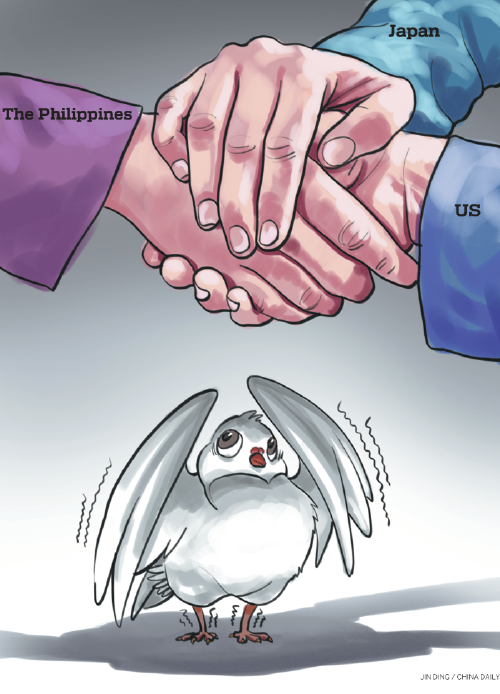
US President Joe Biden will host Japanese Prime Minister Fumio Kishida and Philippine President Ferdinand Marcos Jr. for the first US-Japan-Philippines summit in Washington on Thursday (local time). According to a White House statement, during their meeting, the three leaders will "advance a trilateral partnership", discuss cooperation in different areas and find ways to "further peace and security in the ‘Indo-Pacific' and around the world".
Besides, media reports suggest the three countries could organize joint naval patrols in the Asia-Pacific region this year.
Although there may be no direct mention of China, the background and agenda indicate the first-ever trilateral meeting is aimed at jointly containing China. This means the three countries will stir up trouble in the South China Sea and try to trigger camp confrontation, thereby threatening peace and stability in the Asia-Pacific.
In recent years, the US' strategy for the Asia-Pacific, especially for the South China Sea, has been to constrain China. The US regards the South China Sea as the front line of its strategic competition with China and an important part of the "first island chain", which covers Japan, the Taiwan island and the Philippines. In fact, the South China Sea issue is key to the US' "Indo-Pacific" strategy, which makes it important for it to win the strategic competition with China, in order to maintain its hegemony in the Western Pacific.
Against this backdrop, the US, Japan and the Philippines have, to a large extent, deepened their security cooperation on the South China Sea issue since their first defense policy dialogue in September 2022. And their first trilateral summit may signal the formation of their cooperative framework, which will help boost their bilateral and trilateral security cooperation.
In early June 2023, the United States Coast Guard, the Japan Coast Guard, and the Philippine Coast Guard jointly deployed six law enforcement vessels to conduct the first joint maritime exercise in the waters near the Philippine province of Batanes. If the three countries conduct joint naval patrols in the South China Sea this year, it will mark the first time that they have transitioned from using "quasi-military forces" to deploying naval forces together. This move represents a more perilous military venture for the United States in the South China Sea.
What's more, the trilateral framework covers not only the South China Sea but also the East China Sea and the Taiwan Strait. Together with the quadrilateral security dialogue (the Quad) among the US, Japan, India and Australia and the AUKUS (Australia-United Kingdom-United States) security alliance, the framework is aimed at forming a comprehensive US-led "Indo-Pacific" security network whose aim will be to contain China.
The US, as expected, will be the dominant player in the network, with Japan following the US' lead and the Philippines acting more like a pawn. The US is trying to use the other two countries and stir up trouble in the South China Sea by hyping up the "China threat" theory to maintain its global hegemony. As for Japan, it wants to prove its loyalty to the US in exchange for the US' tacit support for its re-militarization and efforts to become a "normal" country. The Philippines, on its part, is simply trying to get political and economic benefits from the US by frequently provoking China on the South China Sea issue.
The US has been hyping up the "China threat" theory and inciting bloc confrontation in the Asia-Pacific, inviting criticism and objections from many quarters. That shows the US is against the integration of Asia-Pacific economies.
For China, the South China Sea issue is related to not only its sovereignty, territorial integrity and maritime rights but also its national security, all of which China will resolutely safeguard. Since the safety of navigation in the South China Sea is critical to China's strategic security and sustainable economic development, China wants the South China Sea to remain an area of cooperation rather than confrontations.
To be sure, it is not in the interest of any party to create a situation of fierce confrontation, let alone a conflict, in the South China Sea. So China will steadfastly resist all forms of intimidation and take every necessary measure to uphold regional peace and stability.
The author is an associate researcher of Southeast Asian studies at the Chinese Academy of Social Sciences' National Institute of International Strategy.
The views do not necessarily reflect those of China Daily.
If you have a specific expertise, or would like to share your thought about our stories, then send us your writings at opinion@chinadaily.com.cn, and comment@chinadaily.com.cn.





