



Is there overcapacity in China's EV sector?









The allegation by the United States and Europe that China faces "overcapacity" in its electric vehicle (EV) industry is groundless.
Overcapacity is a term describing the relationship between supply and demand. Overcapacity exists when demand is lower than supply. So we must look at overcapacity from the perspectives of production and sales.
Purely electric vehicles account for over 70 percent of China's new energy vehicle (NEV) sales. In 2023, the production and sales of NEVs nationwide were 9.587 million and 9.495 million units, respectively, both accounting for over 60 percent of the global total. The output was only a little higher than the sales figure, by a small margin of less than 100,000 units. Given the huge scale of supply and demand, such a small margin is quite normal. Clearly, there is no overcapacity.
Importantly, the Chinese market consumed the lion's share of the NEVs it produced, with domestic NEV sales reaching 8.29 million units last year, while the nation's NEV exports accounted for only about 12 percent of its total sales. China's domestic demand for NEVs is robust, in pace with the country's green development drive.
There has been a sustained balance between supply and demand over the past few years in China's NEV industry. Yet it is believed that demand is on the rise worldwide. An estimate by the International Energy Agency shows the global demand for NEVs in 2030 will be 4.5 times that of 2022.
"The production and sales growth is basically synchronized, indicating the strong demand and vitality of China's electric vehicle market," said Kong Dongmin, a professor in economics at Huazhong University of Science and Technology.
Is the "overcapacity" narrative an attempt to accuse China of "dumping" new energy vehicles in overseas markets?
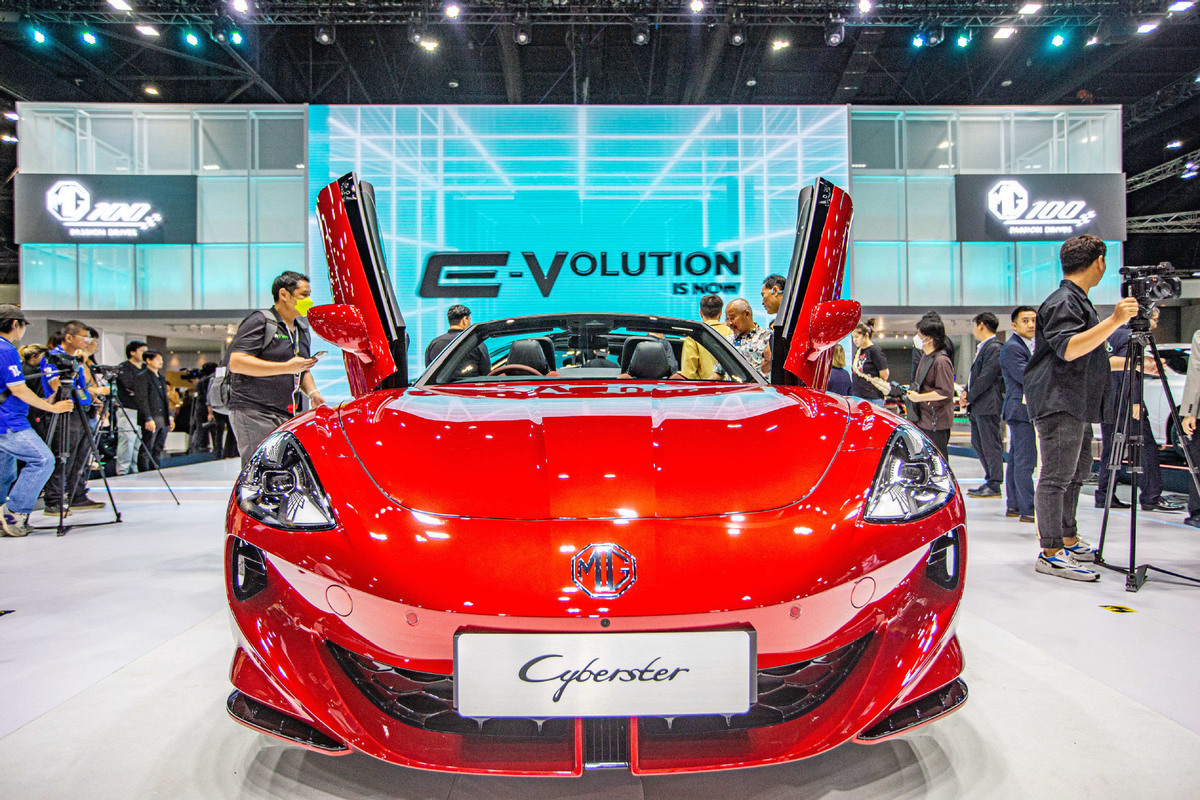
The rapid growth of China's new energy vehicle sales in overseas markets is attributed to the competitiveness not only in price, but also in design.
The comprehensive advantages of price and quality make China's new energy vehicles stand out in the arena of international competition. Greater consumer demand for Chinese products has caused unexpected panic among individual American and European manufacturers, experts say.
"The protection of local backward production capacity may be the real reason behind the accusation of 'overcapacity' against China's new energy vehicle sector," said Sun Yifei, a professor at the University of International Business and Economics in Beijing.
China's advantages in production cost and product design of new energy vehicles come from the long-term layout and in-depth research and development of its enterprises, he added.
Chinese EV enterprises rely on continuous technological innovation, a sound production and supply chain system, and adequate market competition to develop rapidly, rather than relying on subsidies to achieve competitive advantages, China's Minister of Commerce Wang Wentao told a roundtable meeting in Paris attended by representatives of EV enterprises on Sunday.
China's NEV advantage does not come from subsidies, but from improvements in enterprise efficiency brought about by technological innovation.
In the NEV industry, the speed of technology iteration is relatively fast. The product upgrading and efficiency improvement brought by scientific and technological innovation are things that benefit people all over the world by contributing to the green transformation of the global automobile industry.
Meanwhile, profits growth also indicates that China's NEV makers are not beset by "overcapacity." According to the data released by the National Bureau of Statistics, the total profits of China's automobile manufacturing industry grew by 0.6 percent in 2022 year on year, and 5.9 percent in 2023 year on year, respectively, against a fall of 4 percent and of 2.3 percent for industrial firms with annual revenue of at least 20 million yuan (about 2.82 million US dollars) nationwide. This shows that automobile manufacturing enterprises, including electric vehicle makers, have achieved good economic benefits in steady operation, and the overall development trend of the industry is healthy.
It is true that the comparatively low prices of China-made NEVs are one of the factors behind the growth of sales among overseas customers. In fact, the prices in overseas markets for some models of China's leading NEV brands are almost double that in China.
China's NEV industry is steadily moving forward along a healthy, orderly and sustainable track. Accusations of "overcapacity" are absolutely the wrong focus for the United States and Europe if they want to sharpen the competitiveness of their EV enterprises.





