


Exhibition celebrates heritage skills
Tibetan embroidery and artwork on display show how talent has been nurtured, Yang Feiyue reports.









Tapping potential
Samdrub Kyab is among thousands of young people in the region who have benefited from the local drive to carry forward intangible cultural heritage over the past 14 years.
Most have been children of farmers and herdsmen, and didn't go far in education, according to Gangseng Truk, who is in charge of operations of the center that was established in 2010.
The center has evolved to offer more than 20 intangible cultural heritage training and commerce programs.
Outside Rangtang, training sites and experience centers have also been established in Shanghai, Beijing, Jiangxi province's Jingdezhen, Jiangsu province's Suzhou and Sichuan province's Chengdu.
"These sites are mainly for our students to broaden their view through cultural exchange and pick up new skills," Gangseng Truk says.
Tashi Lhamo, 28, was one of the first who went to the center and studied Tibetan medicine, which was among the first to be named a national intangible cultural heritage in 2006.
"If it weren't for the free training program, I would probably have got married, as many other girls my age did," Tashi Lhamo says.
She had been doing nothing but grazing her family's cattle, and then got to systematically pick up fundamental science and culture classes at the center, before she made inroads in Tibetan medicine theories and practiced for seven years.
Now, Tashi Lhamo has become a leader in her division, in charge of about 200 Tibetan medicine students, and offers training to them.
She has also engaged in combining Tibetan medicine with skin care products, and helped with the center's medicinal bath services in other cities.
"There's so much potential in Tibetan medicine and I'd like to keep tapping into it while having more people appreciate and benefit from it," Tashi Lhamo says.
She takes pride in the fact that the transformation of her life has, in turn, convinced more families in the plateau to support their children's decision to pursue a career at the center.
To date, the center has enabled more than 3,000 farmers and herdsmen to make a living through practicing intangible cultural heritage.
At the moment, the Rangtang center is under renovation and expansion and will offer more modern facilities for local young people to better grasp the essence of intangible cultural heritage and build on it to deliver creative works, Samdrub Kyab says.
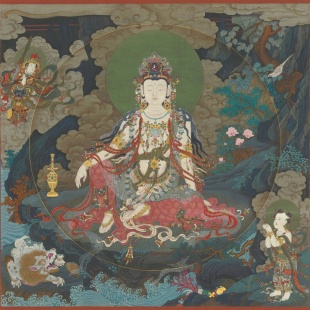
Song Nianshen, professor from Tsinghua Institute for Advanced Study in Humanities and Social Sciences, says he is impressed that students in the training center's thangka class would also study Song Dynasty (960-1279) landscape, flower-and-bird, and figure paintings, as well as classic artworks such as murals in Dunhuang, Gansu province.
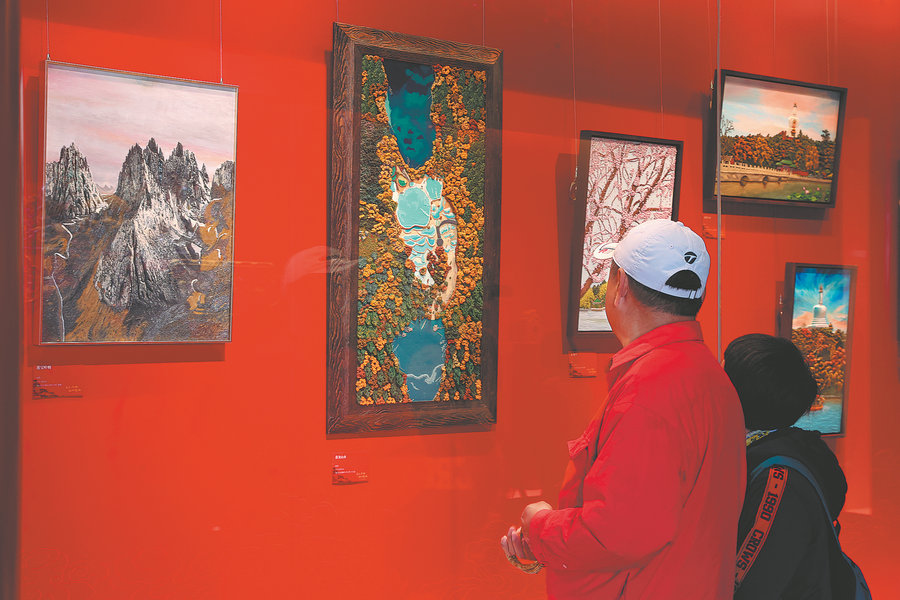
He also notes how students in the embroidery workshop not only learn traditional Tibetan crafts such as pile embroidery but also inherit the techniques from Su embroidery, an ancient craft that originates from the garden city of Suzhou in Jiangsu.
"Teaching excellent Han heritage crafts to young Tibetan people is of great significance for craft exchanges, cultural inheritance, and the country's integration," Song says.
He attributes the creation of innovative, high-quality craft products from the center to its current teaching philosophy.
"The training center is open to local underprivileged youth free of charge, helping them to cultivate virtues, aspirations, and careers, and (thus) transforms 'herdsboys' into inheritors of intangible cultural heritage and outstanding artists. This not only achieves innovative transformation of Chinese culture but also becomes a key means for poverty alleviation and prosperity in Rangtang county," Song says.
In the cultivation plan for Rangtang intangible cultural heritage, Song says he "sees the absorption and integration of multiple traditions of both Han and Tibetan people within the craft".