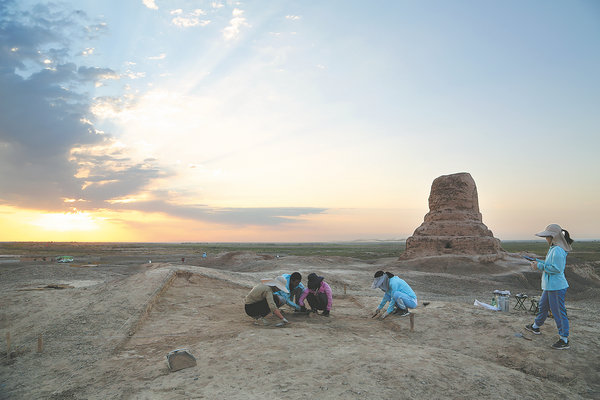
The finds have helped reveal the site's identity. Archaeologists now believe it was a Buddhist temple, first built in the 3rd century and falling into ruin around the 10th century, contemporaneous with the period of the Three Kingdoms (220-280) to the late Tang Dynasty (618-907).They have been able to determine its scope, layout, the types of its main buildings, the format of the site, and the evolution of the complex.
The site lies on an ancient platform of about eight meters in height, to the east of a steep precipice. To date, excavations cover 3,900 square meters.
The two existent structures are a stupa in the center of the site, and a pagoda with a square-shaped base in the northernmost section. Other buildings were once located around them, and were not built at the same time, but gradually formed a large site, Xiao says, adding that the stupa has a typical format that can be traced to Central Asia in the 2nd and 3rd centuries, and what remains of it stands about 12 meters in height.
As one of the site's earliest buildings, the stupa is inferred to be center of the temple, with many other buildings facing toward it.
The pagoda has suffered the ravages of time, making it difficult to judge its original function, but it must have been an important building among the others in the site, since it's larger than the central stupa and had at least five stories, Xiao says.
Between the two there were various structures inferred to have been used by monks. They include buildings featuring a layout of homocentric squares, which was common in the Tarim Basin and Central Asia at the time, and others with a format unique to Kashgar. Altogether, more than 40 rooms have been found, Xiao says.
A highlight is a rectangular Tang Dynasty building believed to be a Buddhist temple. It has a central hall, side halls on two sides and a courtyard in front of the central hall.
Xiao says that this format was seldom seen in Central Asia then, but is similar to temples in the Central Plains of China. He believes that it shows the influence of the Buddhism school, which got localized in Central China, in Kashgar at the time.
Historical records show that Empress Wu Zetian, who reigned from 690 to 705, ordered the building of Dayun Buddhist temples across the country, including in Xiyu, or the western regions, a term used to describe today's Xinjiang and Central Asia in ancient times. One such temple was built in ancient Shule (today's Kashgar) and had a Chinese abbot. Archaeologists infer that the rectangular building was possibly a Dayun Temple.
Archaeologists believe the stupa was built first, and then different kinds of buildings were gradually built to its south, east and north. Finally, the rectangular hall was built during the Tang Dynasty and became the new center of the complex, Xiao says.