Unified market will tap economic potential









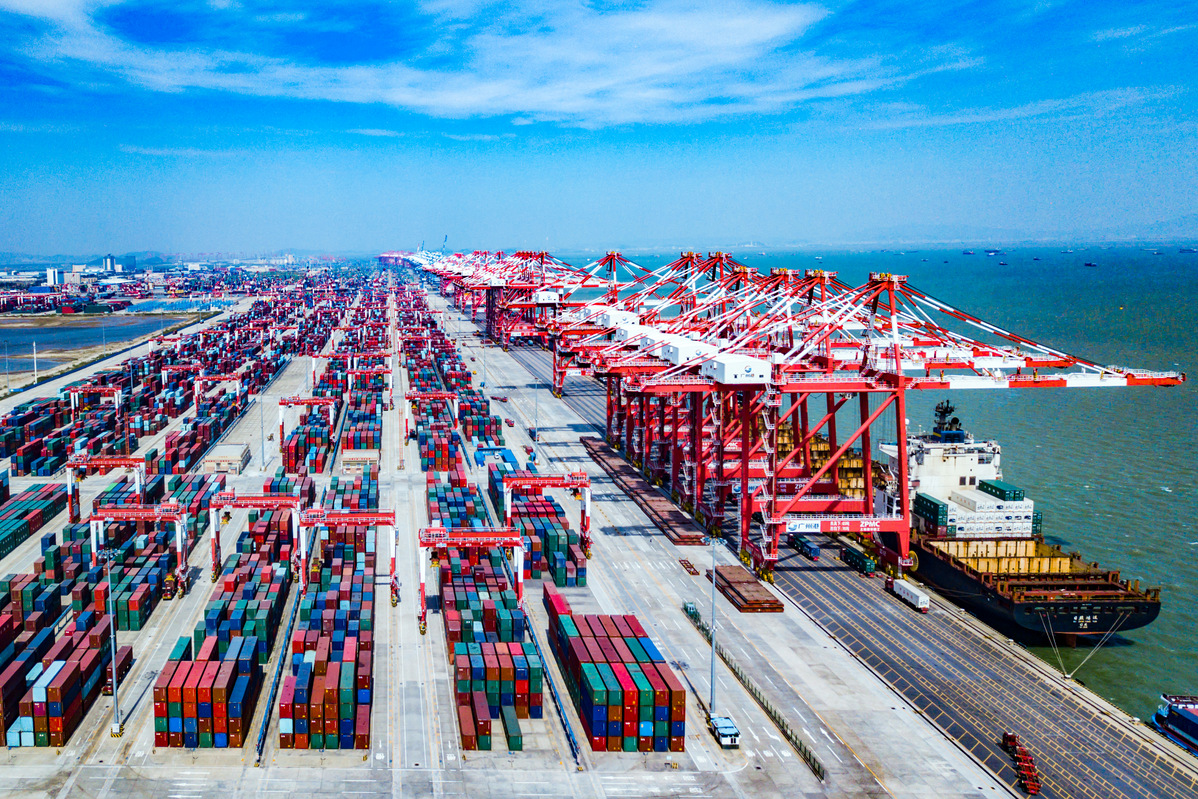
The Chinese government has reiterated the necessity to accelerate the construction of a unified national market by dismantling local protectionist and market barriers, and creating an environment characterized by high efficiency, fairness and openness. These efforts are necessary for transitioning from a large to a strong market, optimizing resource allocation, enhancing supply quality and boosting domestic demand.
Markets play a crucial role in resource distribution, primarily dictated by their scale and the balance between supply and demand. A sufficiently large market can generate economies of scale and scope, satisfying consumer needs at affordable prices. However, a market's effectiveness depends on a robust system that ensures fair and voluntary transactions. Without these, market mechanisms falter, leading to inefficient zero-sum outcomes.
Economic globalization, represented by free trade, has facilitated global trade activities, allowing even smaller economies to reap the benefits of larger market scales.
But recent de-globalization attempts by some countries are slowing global economic growth and exacerbating scarcity in the markets. By setting up trade barriers, some developed economies have fragmented the global market, increasing transaction costs and reducing economies of scale. And geopolitical conflicts and protectionism resorted to by some economies have prompted countries to secure their supply chains, further straining global resources such as oil and gas, and fostering monopolistic market structures.
To counter these global shifts and promote high-quality growth at home, China needs to address the problem of market scarcity and strike a more dynamic balance between supply and demand. A unified national market can address this problem, but a holistic approach to production and market systems is required to build it. A unified market can also ensure the free flow of goods and resources throughout the production, distribution, circulation and consumption cycles by eliminating closed and segmented small markets and isolated economic loops.
By connecting the domestic and global markets, and leveraging global resources, Chinese authorities can strengthen internal and external linkages and optimize resource allocation. And by capitalizing on the scale and agglomeration effects of a large market, the authorities can vigorously promote innovation, reduce the cost of innovations, and ensure innovations yield better fruits. This in turn will promote competition, deepen specialization and support the growth of businesses, raise household incomes, increase labor productivity, improve supply quality and upgrade consumer demand.
The construction of a unified national market is also necessary to establish a new development pattern, facilitate the efficient and free flow of goods and resources, leverage the vast economic landscape to unlock domestic market potential, and inject new vitality into high-quality economic development.
First, the focus should be on pushing forward the "dual circulation development paradigm" which allows the domestic and overseas markets to reinforce each other, with the domestic market as the mainstay. Economic activities rely on the seamless integration and circulation of various production factors across manufacturing, distribution, circulation and consumption. A unified national market can significantly reduce the costs of research and development, as well as manufacturing, logistics, marketing and labor. It can better promote technological innovation and industrial upgrading, and steer the economy toward higher-quality circulation and efficiency.
On the other hand, continuously optimizing the business environment, expanding high-level opening-up and building a strong gravitational field for global resources will establish efficient linkages between domestic and overseas markets, and enable the Chinese economy to gain new advantages in global competition.
Second, a unified national market will boost domestic demand and deepen supply-side structural reforms. It will also nurture high-quality supply, and meet high-quality demand. The immediate priority is to integrate the strategy for expanding domestic demand with deepening supply-side structural reforms.
And third, the aim should be to meet the people's growing aspiration for a better life. In 2023, China's total retail sales of consumer goods reached 47.1 trillion yuan ($6.51 trillion), making it the world's second-largest goods consumption market, with the continuous increase in urban and rural disposable incomes and upgrading of the national consumption structure indicating a shift toward higher-quality, diverse and personalized consumer demands.
While significant progress has been made in building China's market system, there remains a gap between the mechanisms for the efficient aggregation and rational flow of various elements, with persisting regional market barriers still hindering domestic market circulation.
Therefore, it is necessary to build an efficient and standardized unified national market to strengthen unified market institutional rules, better protect property rights, increase market access, promote fair competition and develop an efficient social credit system.
It is also necessary to ensure the market is based on fair competition. While adhering to market principles and the rule of law, it is necessary to make certain the market plays the decisive role in resource allocation with the government playing a guiding role and intervening wherever necessary. Further, better protecting intellectual property rights and improving the regulatory system by assigning clear responsibilities to various government departments will further standardize market competition and interventions, creating a stable, predictable business environment for all.
By deepening reform and widening opening-up, China can help build an open global market system that increases transparency and openness. In addition, by expanding institutionally open systems with efficient rules, regulations and management, China can build a high-standard global free trade zone network, which in turn will generate new foreign trade dynamics, boost foreign trade and investment, strengthen mutually beneficial industry and supply chains, and create broader development opportunities for domestic and international businesses.
The author is a researcher at the China Center for International Economic Exchanges.
The views don't necessarily represent those of China Daily.