



AUKUS ties threat to peace in Asia-Pacific
New Zealand's shift in anti-nuclear policy may undermine regional stability: Experts









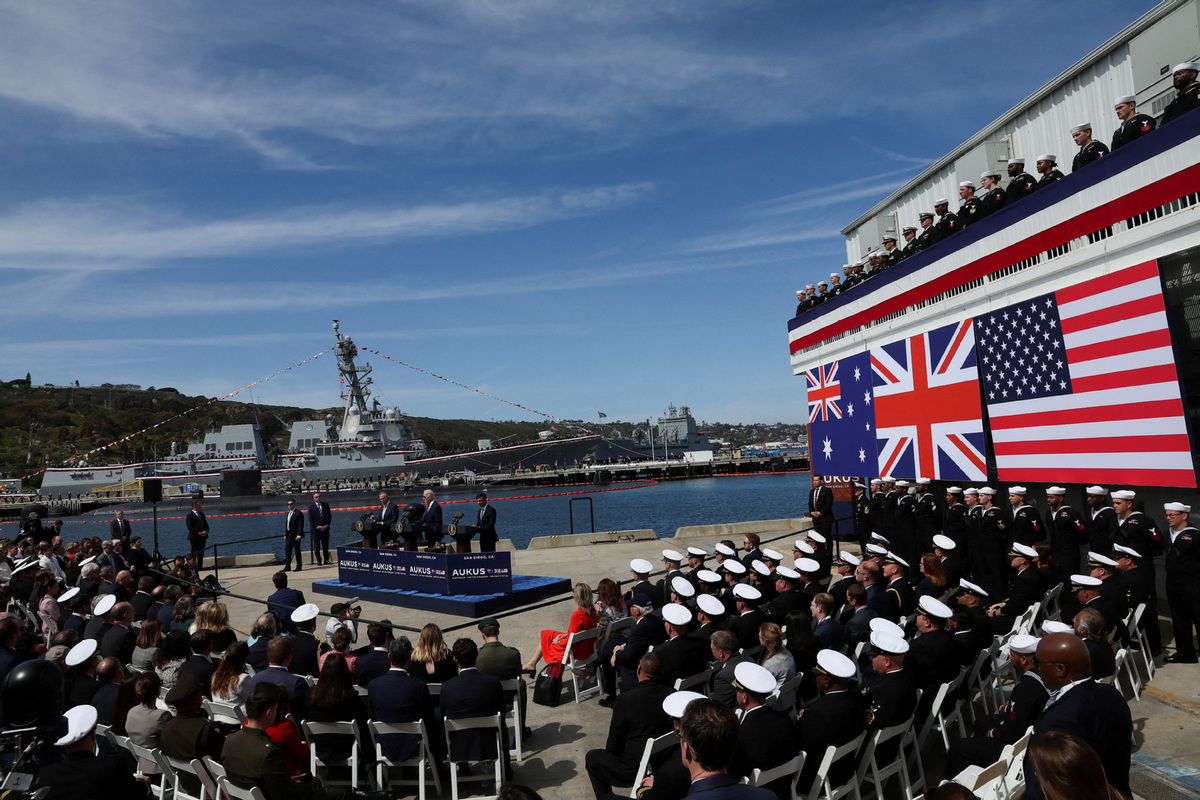
For 40 years, an anti-nuclear stance has been the cornerstone of New Zealand's foreign and security policy. But that may change, analysts say, as the country's conservative coalition government considers whether to drop such a stand and throw its weight behind the AUKUS trilateral pact.
In recent weeks, there has been a great deal of diplomatic activity among Australia, New Zealand and the United States with a focus on AUKUS, a security pact comprising Australia, the United Kingdom and the US, and on breathing new life into the ANZUS security treaty comprising Australia, New Zealand and the US.
New Zealand's involvement in ANZUS ceased in the mid-1980s after it instituted an anti-nuclear policy.
Earlier this month, New Zealand's Deputy Prime Minister and Foreign Minister Winston Peters met US Secretary of State Antony Blinken and discussed regional security.
They said in a joint statement that New Zealand and the US were "working more closely than ever" on "shared challenges".
The statement highlighted New Zealand's long-standing membership in the US-led Five Eyes global intelligence network that also includes Australia, Canada and the UK, and its status as one of NATO's four "Indo-Pacific partners", along with Australia, Japan and South Korea.
Peters and Blinken endorsed the increased US military presence in the Pacific region, saying there were "powerful reasons" for New Zealand to engage with AUKUS and the Quadrilateral Security Dialogue, or the Quad, an alliance comprising Australia, India, Japan and the US.
New Zealand is seeking to join Pillar II of AUKUS where it will share military technology with Australia, the UK and the US.
In a recent interview with Australian Associated Press, former New Zealand prime minister Helen Clark warned of a "profoundly undemocratic" shift in New Zealand's foreign policy.
The government was taking the country on a "geopolitical shift which Kiwis didn't vote for", she said.
"New Zealand has worked carefully on a bipartisan basis for decades to balance its economic interests, democratic values and nuclear-free and independent foreign policy.
"This continues to be possible if politicians keep their nerve and are not drawn into geopolitical games driven from elsewhere."
Chen Hong, executive director of the Asia Pacific Studies Centre at East China Normal University in Shanghai, said New Zealand's decision to collaborate with AUKUS highlights potential disruptions to regional peace and stability.
AUKUS, primarily focusing on nuclear submarine collaboration, introduces the risk of nuclear proliferation in the South Pacific region, Chen said.
"Despite New Zealand's intention to join Pillar II of AUKUS, future potential risks associated with such engagements should not be ignored."
Global implications
The ramifications of New Zealand aligning with AUKUS would extend beyond regional dynamics, with significant global implications, he said.
He underscored the underlying motivations of AUKUS, which originated in 2021 with the aim of countering China's influence in the Asia-Pacific region.
"The concerted efforts by the US and its Western allies to enlist New Zealand in this small bloc represent a strategic maneuver to bolster their military capabilities," he said.
"This will not only escalate regional arms race and geopolitical confrontations but also undermine peace and stability in the Asia-Pacific region and even globally."
Wellington should consider its ties with Beijing — its largest trading partner — and think twice before making the final decision, he said.
"New Zealand should approach its involvement in AUKUS with prudence and strategic foresight and jointly advance stable and far-reaching growth of its comprehensive strategic partnership with China."
Grant Duncan, a political scientist in Auckland, New Zealand, said the current US administration "sees China as a major rival, so they need all the allies they can get in the Pacific".
The New Zealand military has been run-down in recent years to a point where "the country is practically defenseless", Duncan said.
On the other hand, the risk is that involvement in AUKUS would make New Zealand a potential target, he said.
Contact the writers at karlwilson@chinadailyapac.com.










