



'Nuclear-free world' a Japanese ploy to dispose toxic water









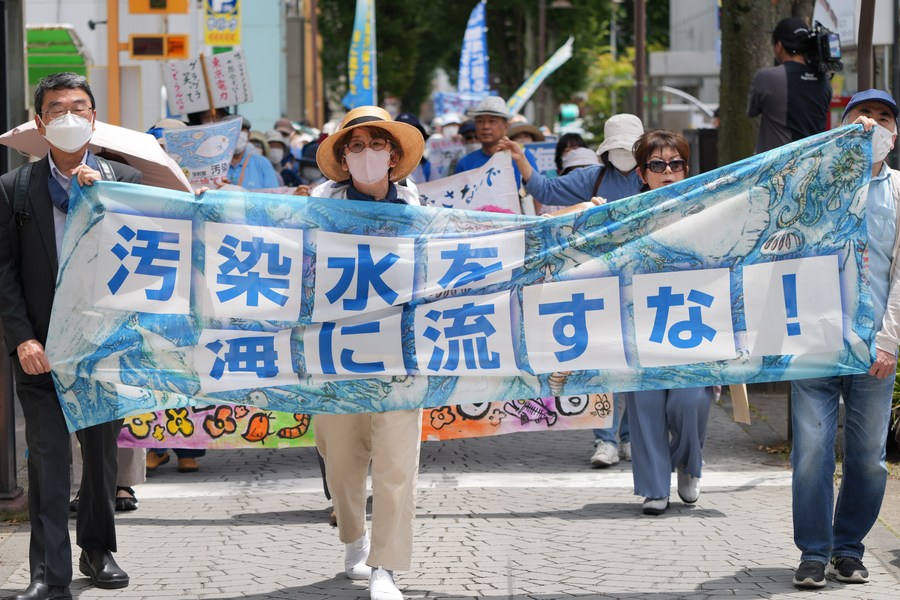
Tokyo Electric Power Company began discharging the nuclear-contaminated water from the damaged Fukushima Daiichi nuclear power plant into the sea for the fifth time on April 19. The company had previously announced that it would discharge about 54,600 metric tons of radioactive water in seven rounds in the 2024-25 fiscal year (April 2024 to March 2025).The problem is that the water contains about 14 trillion becquerels of radioactive tritium that could damage the marine ecology and harm human health.
The Japanese company's action is in total contrast to Japanese Prime Minister Fumio Kishida's recent speech to the United States Congress. Addressing the Congress, Kishida said that as a native of Hiroshima, he is committed to promoting the Nuclear Non-Proliferation Treaty. Since assuming power, Kishida has never let an occasion go by without using the so-called anti-nuclear narrative and projecting Japan as the only victim of nuclear bombs.
In 2020, Kishida published a book to promote his political thoughts, but surprisingly the book didn't propose any specific plan to build a "nuclear-free world". In June 2022, at the Shangri-La Dialogue, Kishida proposed "peace visions", mentioning practical cooperation to achieve a world without nuclear weapons. And in May 2023, the Hiroshima summit issued a joint document on the Hiroshima Vision on Nuclear Disarmament.
Kishida pretended to hold high the banner of "denuclearization" to attract the attention of the world. But the call to build a nuclear-free world was Kishida's ploy to construct a narrative in line with Japan's security and environmental interests, and thus to occupy the moral high ground. On the surface, Kishida advocates the peaceful use of nuclear energy, but ignoring global opposition and the threat it poses to the marine environment and ecology and human health, he backed TEPCO's decision to dump the radioactive water into the sea.
TEPCO had been tampering with safety records for years — since much before the Fukushima nuclear accident — and there is evidence to prove that. In 2002, the company's senior officials resigned after being charged with tampering and falsifying nuclear power plant safety records. In January 2007, the company admitted in an investigation report that since 1977, it had been doctoring data to cover up safety hazards detected in 199 regular inspections at its three nuclear power plants, including the Fukushima Daiichi Nuclear Power Plant.
The company has also been concealing facts. After the Fukushima accident in March 2011, experts said a core meltdown had occurred in units 1 to 3 of the Fukushima plant. But TEPCO refused to admit it, only saying it had suffered "core damage". It was only after two months that it admitted that the "core had melted". Even after that, it blamed the massive earthquake and the devastating tsunami it triggered for the Fukushima plant accident, while ignoring its failure to fulfill its responsibilities.
The "safety myth" construed by TEPCO to cover up the "man-made disaster" gave it enough bargaining chips to stage the painful drama which allowed it to go ahead with its decision to discharge the radioactive water into the sea as "a last resort".
Moreover, TEPCO has always had stooges and sympathizers in political circles, and it has never stopped luring politicians with special offers. For instance, many senior government energy officials joined TEPCO as members of the board of directors after they retired.
As for the Nuclear and Industrial Safety Agency, it was set up under the Ministry of Economy, Trade and Industry, and remained affiliated to the ministry from 2001 to 2012. This sparked widespread public protests, with people asking how a ministry promoting nuclear energy could regulate the use of nuclear energy.
In August 2023, TEPCO started discharging the radioactive water from the Fukushima plant. Even after facing widespread opposition from the international community, Japan did not direct the company to change its radioactive water discharge plan. Instead, it tried to build a so-called nuclear safety narrative by subtly changing the term "nuclear-contaminated water" to "nuclear-treated water" to make the radioactive water in the Fukushima plant sound less harmful.
To restore Japan's image that has been damaged by the nuclear wastewater discharge decision, the country's Ministry of Foreign Affairs has formulated a dissemination policy under which it may invest about 70 billion yen ($450 million) to deal with so-called false information. Specific response measures include the Japanese government more strictly monitoring negative information and publicizing positive information in an attempt to influence the people's understanding of the radioactive water discharge plan.
But since it is calling for building a "nuclear-free world", the Japanese government should take practical actions on the radioactive water discharge issue, because the peaceful use of nuclear energy cannot be at the cost of the environment and human health. The Japanese government should also attach due importance to the legitimate rights of other countries, especially its neighbors, to be protected against nuclear contamination and consult all stakeholders and international organizations on how to safely dispose of the nuclear-contaminated water after proper treatment. And it should stop building the meaningless narrative of a so-called nuclear free world.
The author is an assistant researcher at the Center for the Institute of East China Sea Issues, Chinese Academy of Social Sciences.
The views don't necessarily reflect those of China Daily.





