



Experts' take on China's space exploration









Editor's note: The space industry is a critical element of China's national strategy. In order to better serve the economy and society, China integrates space science, technology and applications and upholds the principle of exploration and utilization of outer space for peaceful purposes. Three experts share their views on the issue with China Daily.
Lunar missions exciting time for space
By Quentin Parker
The success after success of China's space program, with all its diverse elements for scientific exploration and technological development in what remains a risky business, is as impressive as it is exciting.
China launched three astronauts into low-Earth orbit on Thursday night for a six-month mission at the Tiangong space station, as part of its preparations to send astronauts to the moon by the end of the decade. During a press conference on April 24, China Manned Space Agency stated that the development and construction of systems for a Chinese manned lunar landing are progressing as planned, with the aim of achieving a moon landing by Chinese astronauts before 2030.
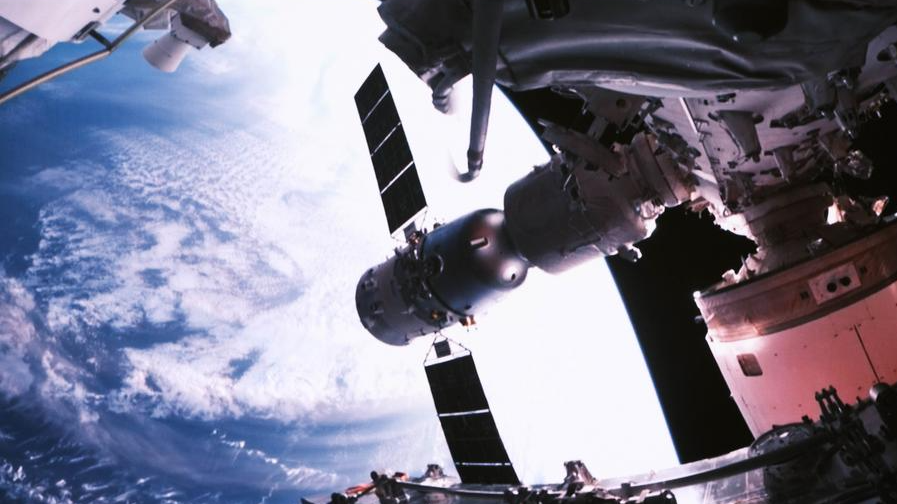
China's accomplishments in space exploration and technology over the past five years, in particular, are without precedent. This includes the completion of China's space station Tiangong (Heavenly Palace), whose first major component, the core module Tianhe, was launched in April 2021 and the two major science modules, Wentian and Mengtian, were launched in 2022.
China's space station continues its program of development and progress from its current T-configuration but with plans for further expansion. Indeed, the docking time for "taikonauts" from launch to entry into the space station has recently been reduced from an already impressive six-seven hours to just two and a half hours due to the development of space rendezvous and docking technologies.
Tianzhou 7, the latest automatic cargo resupply vessel, took off from the Wenchang Satellite launch center in the Hainan island in January and docked in three hours compared with the 16-19 hours taken by the Elon Musk Space-X "Dragon" capsule to dock with the International Space Station (and the about six hours taken by the old Soyuz capsules).
Also, there was the Tianwen 1 Mars mission with Zhurong Rover in May 2021 — perhaps the most complex and hazardous of China's space missions. This should be seen in the context of about 60 percent of Mars missions failing to land on the surface of the Red Planet.
Also, the Chinese Space Station Telescope, Xuntian, is scheduled for launch and operation in 2025. Xuntian is an optical and ultraviolet space observatory that will boast a 2-meter-diameter lens, making it comparable to the venerable Hubble Space Telescope. Although the resolution of China's telescope will be similar to Hubble's, its field of view will be 350 times larger.
More important, China's Chang'e (Beautiful Moon Goddess) series of lunar missions have proved amazingly successful, with the Chang'e 3 lander making the first landing on the moon way back in December 2013. The mission included a lunar lander and a small yutu (jade rabbit) rover that was set down in the Mare Imbrium region of the moon, a prominent lava filled basin from one of the largest impact craters known in the entire solar system and easily visible to the naked eye. It made China only the third country to achieve a lunar soft landing.
Chang'e 4, a similar mission of lander and rover, followed in 2019. It was designed as a backup in case Chang'e 3 failed. What set the mission apart was that its landing zone was on the far side of the moon, which is not visible from Earth, the first such landing in space exploration history.
This feat was made possible by the success of Chang'e 3 that gave the mission planners and scientists the opportunity and confidence to reconfigure Chang'e 4 for the more challenging but interesting far side alternative. Since this made the mission far more complicated, to maintain essential communication with the Earth a separate queqiao (magpie bridge) relay satellite was deployed into a halo orbit around the so-called L2 Earth-moon Lagrangian point of gravitational equipotential for stability. This mission, too, was a big success.
The Chang'e 5, which followed, was China's first lunar mission that involved bringing back rock sample from the moon. It was launched in November 2020 and landed on the moon on Dec 1, 2020. The return module came back with its precious cargo of 1.7 kilogram of moon rock two weeks later. The scooping device attached to the lander was developed by the Polytechnic University of Hong Kong while my own university, the University of Hong Kong, was fortunate enough to get a small sample of the moon rock for scientific study.
As a result, China became only the third country, after the United States and the former Soviet Union (now Russia), to bring back rock samples from the moon.
Just like Chang'e 4 was a backup for Chang'e 3 so was Chang'e 6 for Chang'e 5. Given the success of Chang'e 5, the Chang'e 6 mission has been redesigned to collect rock samples from the far side of the moon for the first time. This mission is due to be launched in the near future. If successful, this will be another science bonanza, as game-changing amounts of water ice are suspected to exist in the shadowed lunar craters which can be used as fuel for future space missions or to breathe by future space explorers.
However, international cooperation is vital in space exploration. And I believe China is keen on deepening cooperation as it has made clear in its white paper on space program published in January 2022. Indeed, many of the scientific payloads on the Chang'e landers have had international scientific packages. For example, Chang'e 4 had scientific packages by Germany, Sweden, the Netherlands and Saudi Arabia.
And while the European Space Agency supported the Chang'e 5 mission by providing essential tracking from both its Kourou station in French Guiana and Maspolomas station in the Canary Islands at various crucial parts of the mission, different scientific payloads have been provided by France, Italy and Sweden again, and a Pakistani ICUBE-Q CubeSat for Chang'e 6 for detecting ice traces on the lunar surface from orbit.
The Chang'e series of missions is not over, for Chang'e 7 is planned for around 2026 and Chang'e 8 for around 2028, with both focused on the south pole of the moon in order to build a China-led lunar base in the 2030s.
Anticipating further international cooperation, this follows the recent unveiling of the most comprehensive lunar atlas ever created, crucial for guiding future lunar endeavors. This remarkable achievement is the result of over a decade of meticulous work by Chinese lunar scientists and geologists. With this in mind, "watch this space" as humanity sets its sights on new aspirations of lunar exploration and envisions moon bases as a gateway to further frontiers.
The author is director of the University of Hong Kong's Laboratory for Space Research. The views do not necessarily reflect those of China Daily.





