Lesson of the giraffe: US-China exchanges









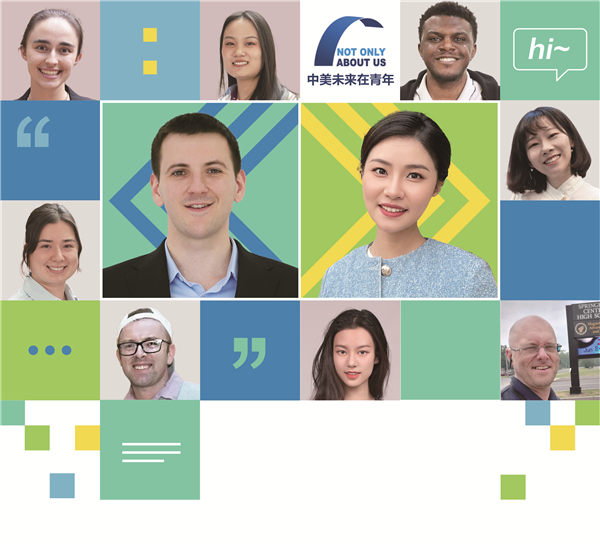
Personal stories showcase the transformative power of US-China educational exchanges, fostering mutual understanding and bridging cultural gaps.
Brand Munson once heard someone mention that his favorite animal was a giraffe, and the reason he gave was quite surprising to Munson at the time: giraffes' long necks enable them to view the world from a unique perspective unlike anyone else.
This insight was eye-opening for Munson and made him think: growing up on a farm in South Dakota in the middle of the United States, with a population of only 1,700 in his hometown, where should he go to broaden his horizons?
So, in 2014, he decided to come to China and spent a year here as an English teacher.
"There were so many things so uniquely different in China that created a lot of curiosity in my mind," said Munson in the latest episode of China Daily's Not Only About Us, recalling his choice to come to China.
This episode focuses on how educational exchanges between China and the US contribute to a deeper mutual understanding between the two peoples.
Having returned to the US, Munson is currently a graduate student at Harvard University. He reflected that the year he spent in China has transformed him, shaping the person he is today, because the cultural immersion he experienced in China opened his eyes to the diversity of the world and helped him develop an appreciation for different perspectives.
"Not everything is like where I came from, and there are a lot of other beautiful things out there in the world than just my little home that I was raised in," he said. "That's such a powerful thing to do, especially when you're young."
Sun Panpan from China and Kylie Aronson from the US are roommates at The Johns Hopkins University-Nanjing University Center for Chinese and American Studies (HNC). Established in 1986, the center features professors from both China and the US. Chinese students are taught by US professors, while international students receive instruction from Chinese professors.
Sun and Aronson often assist each other with assignments and take the time to explain the things they don't understand about each other's culture.
"We're best friends, and we travel and work out together," said Aronson, who explained that their biggest clash is their different perceptions of temperature: while Sun loves the warmth of indoors, she prefers to open the window and embrace the chilly air outside.
Chloe Bohn, also a student at the HNC, hails from Wisconsin in the US.She recalled that when she was in high school, her family hosted a Chinese student for a year.
"I was a year older than him, so I liked to tease him that I was his older American sister," Bohn said. "That was my first experience having a person-to-person cultural exchange so consistently."
This hosting experience quickly evolved into a lasting bond between two families: when Bohn first arrived in Nanjing, the father of her "Chinese brother" picked her up from the airport, helped her settle down, and even traveled all the way from Tianjin in North China to Nanjing, which is in East China, to ensure she didn't spend her first Christmas in China alone. Her "Chinese brother" is still studying in the US and joined Bohn's family for Thanksgiving dinner last year.
Although this relationship may seem limited to just two families, Bohn believes that person-to-person exchanges play a vital role in the US-China dynamic because such interactions can help dispel cultural stereotypes that both peoples might hold toward each other.
"Now when I go back to the US, if I hear something about China that I don't agree with, I can disagree not just based on opinion, but because I've really been here," she said.
Li Xinran, a reporter for China Daily, shared her teenage experience of staying with a family in South Carolina, US, when she was 16. She affectionately called her host parents "Patricia Ma" and "Bill Ba", adding the Chinese terms for "mother" and "father" to their first names.
"That helped us get really close," said Li. "And I didn't feel like I was living in someone else's home. It was like they took me in as one of their family members."
While attending high school in the US, Li was surprised by how little the local people knew about China. Being the first Chinese person many of her peers had ever met, Li was bombarded by questions such as whether there are really a lot of people in China and what Chinese people typically eat.
"It made me realize that even with technology and the internet, people still have a lot to learn about my home country," said Li. "I suddenly felt this burden, like I was a civil ambassador for China."
Li brought her erhu, a traditional Chinese two-stringed bowed instrument, with her to the US. She would play for her classmates, using the opportunity to introduce them to this aspect of Chinese culture. By doing this, she felt she was fulfilling her role in bridging the cultural gap and sharing her country's heritage with peers on the other side of the world.
Clifford Larsen is a teacher at Springfield Central High School in Massachusetts. Having previously taught English in China, he now teaches Chinese in the US.
To make his students more engaged, Larsen goes beyond language instruction. One example was introducing them to Chinese cultural activities like Chinese chess and planning to launch classes on mahjong and ping-pong. He also arranges field trips, including visits to Chinese restaurants, where he teaches students how to place orders in Chinese.
"If I can be a small part of educating people in a different language and expanding their horizons in that way, that's my mission in life," he said, envisioning a future where his students will travel to China, return with excitement, and share their experiences with him. "That would be a dream come true."
As one of the hosts, Dylan Walker noted in the program that with so many foreigners learning Chinese now, it's no longer considered an "encrypted language".
"The only way to really understand a country or a place you're living in is by learning the language," he said. "And through that, you'll be able to understand the traditions, the customs, the history, the food, everything."