



US faces an uphill task persuading allies to join its attack on Chinese green products









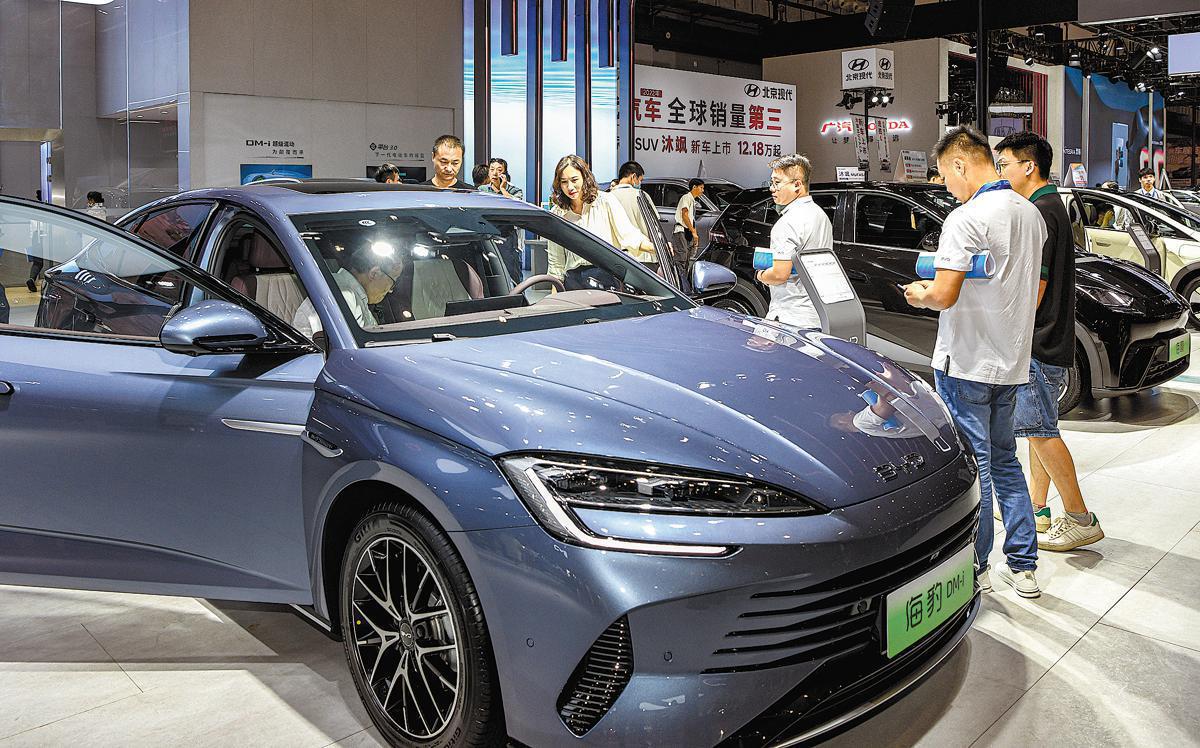
According to US media reports citing sources familiar with the matter, the Joe Biden administration is expected to raise tariffs on Chinese electric vehicles from 25 percent to 100 percent this week, and increase the tariffs on other clean energy goods from China, citing data security, state subsidies and China's "overcapacity".
Such a move, if taken, will not help spur the competitiveness of these industries in the United States, nor will it prove conducive to advancing the cooperation on addressing climate issues between the two countries, arguably one of the few fields where the two sides are still working together.
As no Chinese EVs have been exported to the US market, the to-be-raised tariffs on them will only serve as a preemptive protection for US domestic EV makers. Yet while ring-fencing them from the market-leading competition that would stimulate innovations and technological progress, as long as the US government does not close the US market to other foreign EV makers apart from those of China, the US' EV industry will still lose out in the competition with EV makers in Europe, Japan and the Republic of Korea. These EV makers are being tested in their competition with each other and their Chinese counterparts.
That's exactly why Tesla values its factories and business in China. Tesla is not content with napping in the cradle of its home market. Its CEO, Elon Musk, is well aware how US companies at home become lame ducks the moment such protectionist measures are lifted. He wisely chose to build one of the company's largest factories in arguably the most competitive EV market in the world, long before the US government realized the US was lagging behind in the EV race. Competition is good for business as long as it is fair. Chinese EV makers have taken the lead by winning out in the fierce competition at home, which has fostered a complete range of supporting industries and constant innovation to meet the demands of the mega-size market. These are China's comparative advantages in the global competition.
As it did with its sanctions against Chinese telecom giants Huawei and ZTE, the Joe Biden administration is again trying to cajole the European Union, as well as other allies, to form a united front against Chinese EVs and other green products. That will be a key part of the agenda US Treasury Secretary Janet Yellen is bringing to the meeting of G7 finance ministers and central bank governors next week in Italy.
But Yellen might find her Italian job a mission impossible, despite the great lengths she is going to in trying to hype up the topic before the meeting. Not only because the members of the group have different views on economic and trade ties with China, but also EU consumers and many local EV makers welcome Chinese EVs and other green products that they recognize help promote the EU's green transition and local companies' innovation. They, along with most EU policymakers and leaders, think it is the US' actions that are a problem.
The call of the US financial chief for the other G7 countries to ban Chinese EVs and green products is part of the US' public opinion offensive against China's green products under the pretext of "overcapacity" and "government subsidies". It is a call that is likely to fall on deaf ears as these countries are unwilling to sacrifice their own green development prospects and industrial competitiveness to support a move that is primarily intended to win the administration votes in the upcoming US presidential election.
As a veteran economist who has just wrapped up her second trip to China in two years last month, which must have provided her with a first-hand experience of China's commitment to realizing the green transition, Yellen should be in a better position than those armchair strategists in Washington to know that although charging infrastructure, range anxiety and EV affordability seem to be the main barriers to the development of the US' EV industry, the real gap exists in US policymakers' long-term ignoring of the imminence of the EV era, and thereafter US EV makers' lack of input into the research and development of core technologies.





