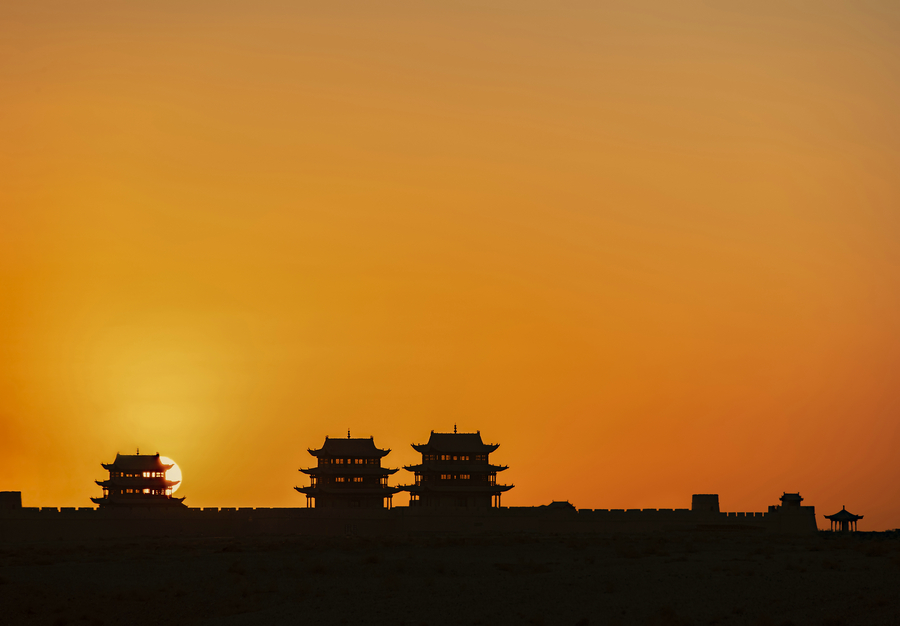
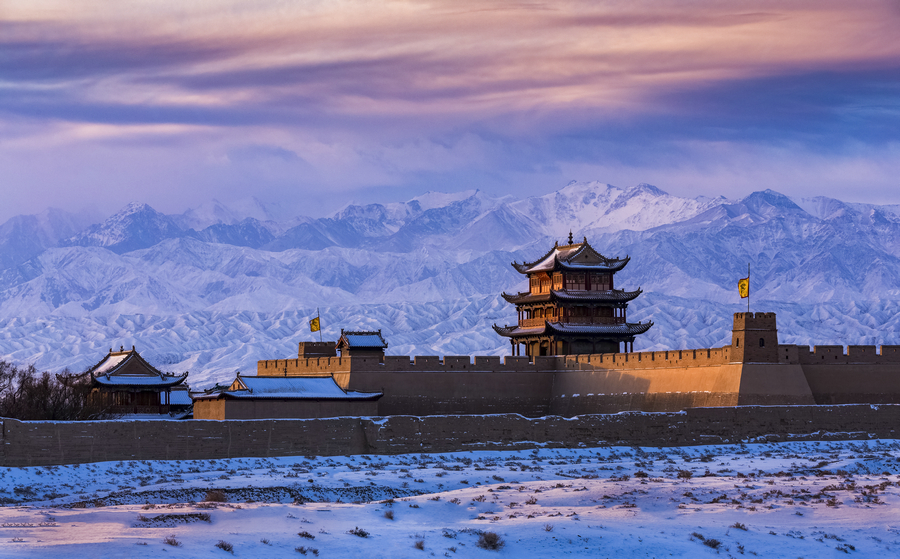
Jiayu Pass, known as “the first great pass under Heaven”, is located in the middle of a narrow valley five kilometers west of Jiayuguan city of Gansu province. It marks the westernmost end of the Ming Great Wall, with its wall extending through the Gobi desert. Historically referred to as the "throat of the Hexi Corridor" due to its strategic location and impressive architecture, Jiayu Pass was known as the fortress locking down the frontier. It was a crucial transportation hub on the ancient Silk Road.
Jiayu Pass was built in 1372, the fifth year under the reign of Hongwu of the Ming Dynasty. It comprises the inner city, outer city, “luocheng” (an additional layer of fortifications), “wengcheng” (a defensive enclosure outside a city gate), moat and the northern and southern wings of the Great Wall, spanning a total length of approximately 60 kilometers.
Jiayu Pass is a world cultural heritage, a national 5A-level tourist scenic spot, a national key cultural relics protection unit and a national patriotic education demonstration base. Major attractions include Jiayu Pass Fortress, the Overhanging Great Wall, the First Pier of the Great Wall, tombs of Wei and Jin Dynasties (220-420), Heishan Stone Carvings, Mulan City and the gliding base.
Xuanbi Great Wall (Overhanging Great Wall)
Xuanbi Great Wall and Duanbi Great Wall (Broken Great Wall) are important parts of the western Great Wall of Jiayu Pass. They were built in 1540 during the reign of Ming Emperor Jiajing, under the supervision of Li Han, an officer in charge of military affairs of Suzhou. Duanbi Great Wall is located to the south of Heishan Valley Pass, running east to west, while Xuanbi Great Wall is located to the north of the valley, running south to north. The steep and straight wall of Xuanbi Great Wall is impressive and majestic, earning it the nickname “Western Badaling Great Wall”. Both the Duanbi and Xuanbi Great Wall form a defensive structure that jointly guards the Heishan Valley Pass.
Rouyuan Gate
Rouyuan Gate is the west gate of the inner city, with word “rouyuan” carved on the stone plaque of the gate. “Rouyuan” reflects the Ming Dynasty’s policy of conciliation towards the nomadic people beyond the frontier. This policy aimed to soothe distant regions and ensure long-term peace and stability in the country.
Wenchang Pavilion
Wenchang Pavilion was originally built during the Ming Dynasty and rebuilt in 1822, during the reign of Emperor Daoguang of Qing Dynasty (1644-1911). The pavilion is a two-story structure with a gable-on-hip roof style. On either side of the lower level are single rooms and 18 red lacquered pillars surround the structure, forming a cloister. During Ming and Qing Dynasties, Wenchang Pavilion was a place where intellectuals and poets met, compose poems and read. By late Qing Dynasty, it had become a workplace for governmental officials.
Corner Tower and Watchtower
The inner city has corner towers, also called "defense towers", at each of its four corners. These towers, resembling fortresses, served as guard posts for soldiers. The north and south walls feature watchtowers, which were used to store weapons. From these towers, one can see that Guanghua Tower, Rouyuan Tower and Jiayuguan Tower are aligned on the same central axis. This unique style of "tunnel-like city gates" and elevated pavilions represent the continuous development of architectural history and forms over thousands of years of history in China.
East and West “wengcheng” (defensive enclosures)
The east and west “wengcheng” (defensive enclosures) of Jiayu Pass are heavily guarded. The gate of the east “wengcheng” bears the inscription “chaozong”, reminding officials passing through to remember the central government and the emperor when traveling to the farthest borders. Meanwhile, the gate of the west “wengcheng” is inscribed with “huiji”, signifying that envoys, officials, merchants and travelers from the western region would meet here before paying tribute to the central government. The south-facing gate of the west “wengcheng” is not directly connected to the gate of the inner city, adding an extra layer of security, making it a solid defensive line for the inner city.