The reality behind tariffs on Chinese EVs









While in the midst of writing Inspiring Greater Bay Area, a book dedicated to introducing the transformative vision reshaping southern China and beyond, I stumbled upon news on the European Union's imposition of tariffs on Chinese electric vehicles (EV). It would apply additional duties of up to 38.1 percent on imported Chinese electric vehicles from next month, and potentially instigating a trade war with China.
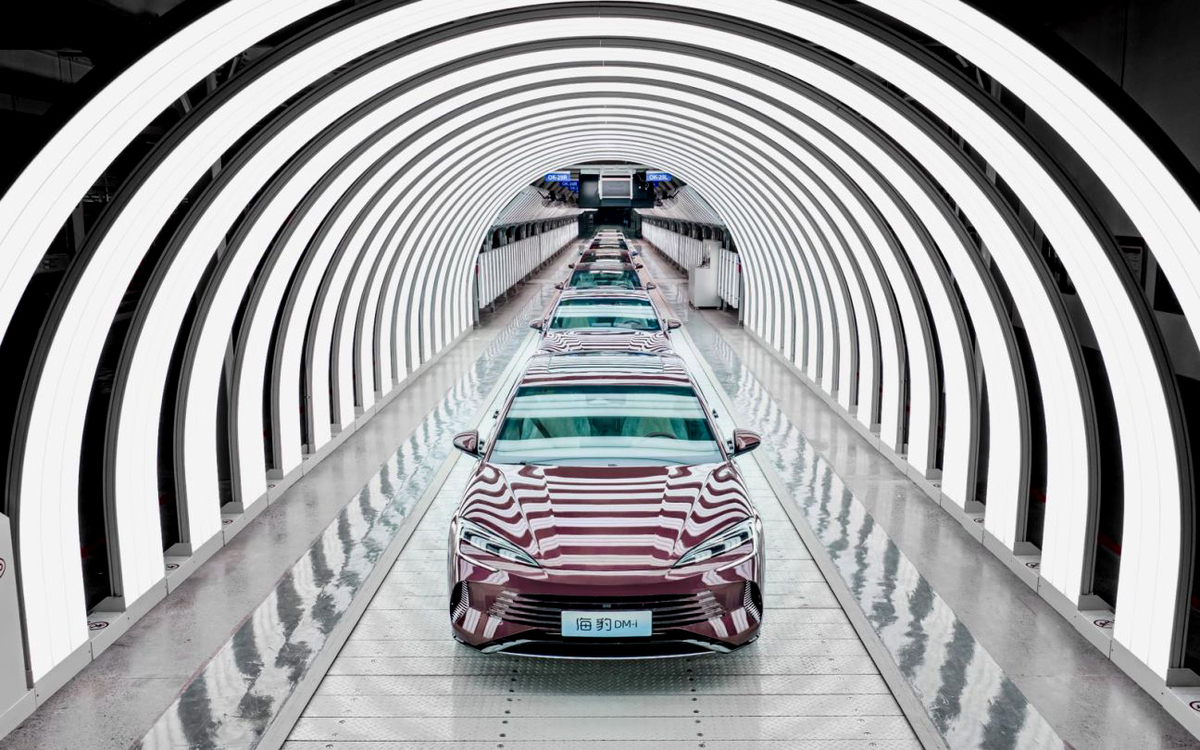
The news prompted me to explore BYD, a company that is under close scrutiny by the European Commission. When examining BYD, it's hoped people recognize that tariffs serve to obscure genuine issues on the EU front and prompt the raising of more fundamental questions about the future trajectory of Chinese enterprises and their role in the global market.
BYD Auto was established in January 2003 by Wang Chuanfu, who was born in 1966. Much has been written about the journey of Wang Chuanfu, a destitute child from Anhui province, who has ascended to become one of the world's most prominent business leaders.
Regarding Wang, one quote from Charlie Munger (1924-2023) stands out as particularly intriguing. Munger said: "This guy is a combination of Thomas Edison and Jack Welch." In 2008, acting on Munger's recommendation, Warren Buffett made a $232 million investment in what was then a relatively obscure Chinese company.
Both in the United States and the European Union, BYD has been frequently finding itself portrayed as a threat. This recurring spotlight underscores the company's significant stature. One cannot consistently attract attention if one's influence is negligible. Western politicians often attribute BYD's success to unfair practices, citing government subsidies that supposedly give it an edge over US and EU automobile manufacturers. Yet such arguments overlook crucial factors.
The success of companies such as BYD primarily stems from a conducive ecosystem — such as that found in the Shenzhen region — stable leadership, diligent work ethic and, perhaps most significantly, a genuine capacity for innovation. BYD has more than 90,000 research and development engineers, and applied for more than 48,000 patents globally and has been granted more than 30,000.
Tariffs imposed by Western politicians on Chinese cars offer no solution in the long run. While they may appear as protective measures — naturally, countries aim to defend their interests — they merely mask weaknesses and fail to bolster players capable of winning global competitions. In other words, imposing tariffs is the easy route and doesn't demand much innovation or strategic thinking.
It's worth noting that both the EU and the US had ample time and resources to anticipate the shift toward EVs. The lack of European counterparts to BYD raises significant questions about the EU's strategic planning. In the realm of EVs, as well as in cyberspace and artificial intelligence, the world operates as a G2, with China and the US represented by BYD and Tesla, respectively. The EU faces a challenge in this regard, and rather than attributing its shortcomings to external factors, it should focus on internal reform, strategic thinking and assertive action.
China's adept maneuvering on the global stage deserves acknowledgment. The most fundamental question is whether companies such as BYD can surpass internationalization and truly establish themselves as global entities. While many obstacles lie ahead, both internal and external, seeing how Chinese companies globalize themselves would be beneficial, not just for China but for the world as a whole. Especially in a field as crucial as sustainable transportation, such progress holds immense promise for the future well-being of humanity.
The moment has arrived for Chinese companies to step into the spotlight as global leaders. While they will forge their own distinct path, they can draw valuable lessons from historical examples such as the success of US enterprises and the complex experiences of Japan. Nevertheless, a global corporation earns its distinction through its executives possessing a global mindset and its products and brands eliciting universal appeal across continents.
It is crucial for the world, particularly the Western world, to embrace this shift in principle. Taking all aspects into consideration, this shift promises to trigger heightened competition, thus driving progress for all stakeholders involved.
The author is founder of the China-Europe-America Global Initiative, editor of China and the World in three volumes, and creator of the Inspiring Series, a collection of books that aims to introduce China to the world. The forthcoming installment in the series is China: Inspiring Greater Bay Area. The views don't necessarily reflect those of China Daily.