The myth of 'China's overcapacity'
Imposition of anti-dumping tariffs on Chinese green goods will not boost corresponding US industries









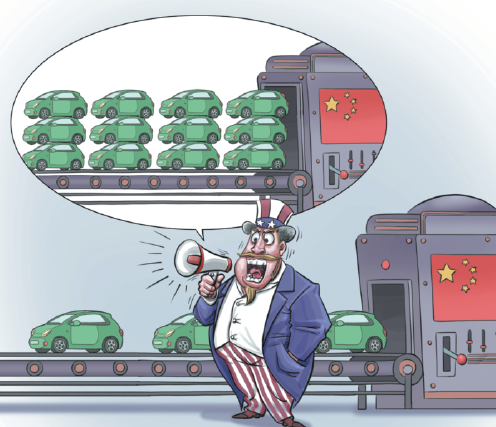
Some US economists and politicians have claimed that China has an overcapacity problem, and that the United States must adopt anti-dumping policies because China is dumping its excess capacity into the US. As a result, the Joe Biden administration has recently announced new tariff rates on $18 billion worth of Chinese imports — a 100 percent tariff on Chinese electric vehicle imports, a 50 percent tariff on Chinese solar cells, and a 25 percent tariff on certain Chinese steel and aluminum imports.
This overcapacity allegation is unfounded. It is critical that the erroneous thinking of "industrial subsidies lead to overcapacity and overcapacity leads to dumping" should be corrected.
Whether or not there is overcapacity in China depends on how overcapacity is measured. If overcapacity is defined as the difference between potential and actual production, there is overcapacity in China to some extent. However, there is a fundamental difference between the overcapacity referred to by China and the dumping due to overcapacity claimed by the US.
Overcapacity is a common problem in global economic development. According to our calculations, China's capacity utilization rate is within the so-called reasonable range, on par with that of the European Union, the US, Brazil and other economies.
The root cause of the current overcapacity in China is the lack of effective demand in the global market. To address this problem, the government is working to build a unified national market to effectively alleviate the pressure caused by a lack of effective demand in the world.
Take China's "new three" exports — electric vehicles, lithium batteries and solar cells as an example. Even if China does not export the "new three" products, the US will not be able to export them to seize the market. The reason is not that the US does not have subsidies, but that the US does not have a whole industry chain to support their production. In other words, China's "new three" products are not winning in the market because of subsidies.
When judging whether subsidies have an impact on exports, the criterion should be whether China's industrial subsidies comply with World Trade Organization rules. Currently, China's industrial subsidies are mainly subsidies for R&D, which are aimed at incentivizing technological innovation and do not belong to the WTO's prohibited (red light) subsidy category. Furthermore, the beneficiaries of the subsidies cover enterprises with different ownership structures including State-owned enterprises, private enterprises, and foreign-funded enterprises.
China has strong export power, with a total foreign trade volume of around 41 trillion yuan ($5.6 trillion) and the largest export volume in the world. China's strong capabilities in exports are first and foremost because of the comparative advantage of Chinese goods, which are cheaper than others and highly competitive. Second, China has made good use of a large and ever-expanding international market. Comparative advantage can explain the difference between the Global South and the Global North. Exporting labor-intensive products is because of China's lower labor costs. But comparative advantage is not the whole story.
The strength of Chinese exports stems from stepped-up economies of scale. That is to say, when exporters make the market bigger and lower the fixed costs of companies, they can sell more and earn more. So it's not because of Chinese subsidies. In other words, even industries that are not subsidized at all in China can export a lot to other countries, which is a strong rebuttal to the "overcapacity" allegation.
The US' so-called overcapacity allegations and the anti-dumping measures taken by the US have insufficient evidence and unjustified intensity.
First, there is insufficient evidence. Chinese automobiles have not caused substantial harm to the US' domestic automobile industry. Chinese exports of new energy vehicles to the US accounted for a meager 1 percent of total US auto sales, a proportion that is certainly not sufficient to cause substantial harm to the US domestic auto industry. In fact, the challenges facing the US auto industry stem mainly from the hollowing out of US industry and the incomplete value chain, which constrain the development of its auto industry, rather than simply because of competition with cars imported from China.
Second, the intensity of anti-dumping measures is unreasonable. The average tax rate of the US is around 37 percent. Defining China as a non-market economy and charging anti-dumping duties of up to 100 percent on new energy automobiles imported from China is obviously highly unreasonable.
China should deal with anti-dumping measures taken by the US by vigorously developing a unified domestic market.
Cultivating new quality productive forces and eliminating backward ones is obviously one direction. Another direction is to actively cultivate a large domestic market. Among the three main drivers of economic growth, investment is certainly the most objective and practical way to boost the economy in the short run. Given the current global environment, exports are not the main driver of economic growth. Using domestic consumption to drive economic growth is certainly desirable, but consumption is insufficient at present. Fostering consumption takes time. Without income growth, it's impossible to boost consumption. Therefore, the most effective way to boost growth in the short run is to stimulate investment.

The author is president of Shenyang-based Liaoning University. The author contributed this article to China Watch, a think tank powered by China Daily.
Contact the editor at editor@chinawatch.cn.