Researchers work to reduce emissions in dairy industry
Genetic selection being used to lower sector's output of methane










Editor's note: China Daily is publishing a series illustrating the country's efforts to achieve its carbon peaking and carbon neutrality goals.
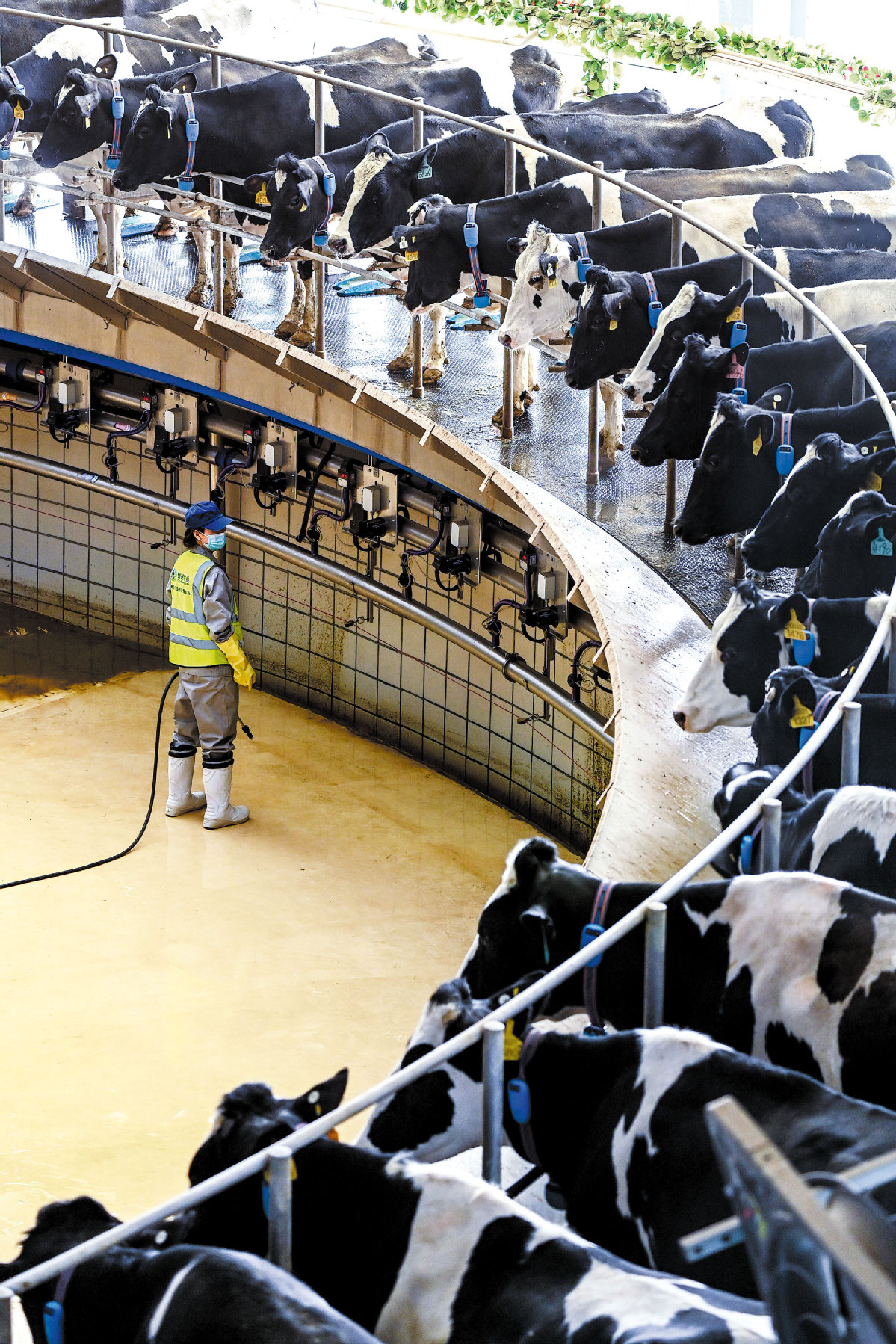
With China's appetite for milk showing no signs of turning sour, a team of scientists has embarked on a groundbreaking mission in the Inner Mongolian autonomous region to create low-methane-emitting dairy cows.
Launched last year by Sk.xing, the largest cow breeding enterprise in China, the ambitious project aims to identify genes that contribute to high milk production, longevity and low emissions of methane, according to the company, headquartered in Inner Mongolia's capital Hohhot.
As the second most abundant global man-made greenhouse gas behind carbon dioxide, methane has more than 80 times the warming power of CO2 over the first 20 years after it reaches the atmosphere.
According to the International Energy Agency, the flammable gas is responsible for about 30 percent of the rise in global temperatures since the industrial revolution.
An estimated 60 percent of the world's methane emissions are from human activities, with agriculture, fossil fuel extraction and consumption, and decomposition of landfill waste as the largest sources. Agriculture, including animal husbandry, is responsible for 40 percent of man-made methane emissions.
Li Xihe, a leading scientist at the company, shed light on the intricate, multi-phased research involved in achieving the mission's goal of decarbonizing the dairy cow sector.
The journey begins with measuring the methane emissions of individual cows using a special device resembling a feeding trough, he said.
This cleverly designed contraption not only attracts the cows but also monitors the gases they inhale and exhale, providing valuable data for analysis.
As a ruminant animal, cows, as well as sheep and goats, host millions of tiny microbes in their stomachs. While they aid in digestion and are helpful to the livestock's health, an unfortunate by-product of their functioning is the creation of methane gas, which is expelled into the atmosphere through the animal's mouth and rear end.
The team is using mid-infrared spectra to collect methane emission data and then utilizes machine and deep learning algorithms to build a predictive model for each cow's methane output, he continued.
"With the established model, the researchers can predict the methane emission level of each cow, serving as a crucial parameter for identifying low-emission candidates," he said.
To complete the selection process, they analyze the complete genome of each cow, ultimately selecting those with both low methane emissions and desirable genetic traits, the scientist added.
Li describes the research as a meticulous process that requires time and dedication.
Developing a reliable methane emission prediction model takes at least two years, he said.
Assessing the chosen cows' milk components and mid-infrared data requires another year. Selecting cows with both high milk production and longevity while maintaining low methane emissions takes an additional one to two years.
However, more research is still needed after the low-carbon core herd is established, he stressed.
Scientists will meticulously monitor the herds' methane emissions, milk production and other vital parameters, to build a comprehensive database that confirms the low-methane status of these chosen cows.
"These exceptional cows will then form the foundation of a breeding program, producing low-methane embryos and facilitating large-scale herd expansion," he said.
Li and his team are also exploring the ideal fodder and management practices for these cows, optimizing their living environment to ensure that they fully express their low-methane genetic potential.