



Integration, expansion, collaboration









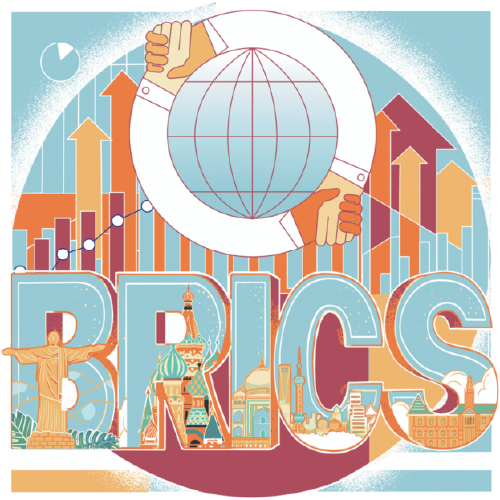
Double-size group of developing countries set to further swell as precursor of a community with a shared future
As the 16th BRICS summit approaches, the world's attention is firmly fixed on this influential forum of developing countries. This historic summit will mark a pivotal moment, being the first to include the newly admitted members following BRICS' inaugural expansion with the inclusion of Egypt, Iran, the United Arab Emirates, Ethiopia and Saudi Arabia. The global community is keen to see how this expanded platform will shape the future of international cooperation and governance.
Russia, the 2024 BRICS chair, has placed a strong emphasis on smoothly integrating the new members. In the economic and financial domain, the agenda is dominated by the urgent need to address rising protectionism and the weaponization of unilateral sanctions. Other strategic priorities include fostering high-tech collaboration, transforming the international payment system, and expanding the use of national currencies in mutual trade, all while building resilience against global economic volatility. Additionally, at the 2023 BRICS summit, Chinese President Xi Jinping proposed the creation of an "artificial intelligence study group" to foster innovation in artificial intelligence among the BRICS nations. Continuing this important endeavor, the 2024 summit prioritizes closer collaboration in science and technology, including AI, to potentially break the Western monopoly on global AI governance.
The 2024 BRICS summit will certainly be shaped by these strategic priorities, with a particular focus on integration and expansion, tackling protectionism and sanctions, advancing high-tech collaboration and reforming the international payment system. However, while BRICS is expanding its reach and influence, it is not positioning itself as a strategic rival to the West. The 2024 chairship's focus on strengthening interaction with multilateral platforms such as the World Trade Organization, the International Monetary Fund, the World Bank and the G20 highlights the role of the grouping as a constructive dialogue platform. The members of the expanded BRICS are not aiming to replace existing global governance structures but to devise innovative and complementary mechanisms that work within a more balanced, inclusive and democratic framework. This cooperative vision, especially amid growing global tensions, will undoubtedly be a defining feature of this historic summit.
While the integration of the newly admitted members is likely to dominate discussions at the upcoming summit, the agenda will continue to include items related to expansion and the various forms it may take, with over 30 countries expressing an interest in joining. However, it is concerning that some debates around expansion, namely from those outside the grouping, emphasize division over unity, confrontation over cooperation, and a zero-sum approach to international relations. This "Cold War mentality", prevalent in Western policy circles, stands in stark contrast to the vision of a community with a shared future proposed by China, which stresses peaceful development, mutually beneficial cooperation and shared prosperity.
The Cold War mentality is reflected in misguided fears that the expanded BRICS, now holding 42 percent of global oil and gas reserves, 72 percent of the world's rare-earth metals, and 42 percent of annual grain production, could wield increased influence over global supplies and prices to the detriment of Western nations. A similar situation goes for the expanded BRICS efforts toward alternative AI governance and de-dollarization, which is often misunderstood as an anti-US policy, when in fact it only consists of asset diversification in response to the excessive weaponization of the US dollar and sanctions. Such misguided beliefs aside, the BRICS expansion will significantly contribute to overcoming this Cold War mentality, advancing the vision of a community with a shared future through greater inclusivity and collaboration on the global stage.
This Cold War mentality was particularly evident during Turkiye's application to join the BRICS.Turkish officials hesitated to publicly announce their bid, likely out of fear of a negative reaction from the West, leaving Russia to confirm Turkiye's official application in September 2024. Public debates in both Turkiye and the West have focused on how Turkiye's BRICS application conflicts with its NATO membership, overlooking the reality that the BRICS is not a military alliance, or bloc imposing binding decisions. Instead, the BRICS operates chiefly as a forum, or platform for constructive dialogue, exchange and cooperation, intentionally avoiding bloc-style thinking. The cooperative nature of Sino-Indian relations within the BRICS, despite their regional differences and India's participation in the Quadrilateral Security Dialogue, highlights the inclusive approach of the group. Besides NATO, a similar line of debate has been to superficially juxtapose Turkiye's aspired integration into the European Union with its bid for the BRICS, despite the fundamental differences between the two. Dominated by wealthy Western European countries, the EU aims to create a supranational framework on a regional level, while the BRICS focuses on global governance, where the principles of sovereignty, equality, and inclusivity remain central.
As the world grapples with the most severe humanitarian crisis since World War II and the deepest economic downturn since the Great Depression, it is clear that the Western-dominated global governance system is failing. It has been unable to prevent major conflicts or address global economic instability, raising the risk of further escalation, possibly even World War III. In this context, it is only natural for developing nations to challenge the Cold War mentality and seek a greater role in shaping global governance — one that does not necessarily come at the expense of Western countries. The BRICS expansion itself holds strong potential to foster greater democratization, stability and inclusivity in the global system, offering a pathway to a community with a shared future away from an oppressive system dominated, or monopolized, by a handful of countries.
The author is an associate professor and a visiting senior fellow at the London School of Economics and Political Science. The author contributed this article to China Watch, a think tank powered by China Daily.
Contact the editor at editor@chinawatch.cn.





